• Hey Guest!
    British Car Forum has been supporting enthusiasts for over 25 years by providing a great place to share our love for British cars. You can support our efforts by upgrading your membership for less than the dues of most car clubs. There are some perks with a member upgrade!

    **Upgrade Now**
    (PS: Upgraded members don't see this banner, nor will you see the Google ads that appear on the site.)
Tips
Tips

New Brake MC & Warranty with DOT-5 Fluid?

dklawson

Yoda
Offline
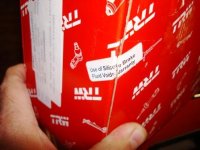
I just received a new brake master cylinder for our project '72 Spitfire. It arrived in a TRW box with a statement/decal on the outside warning that the use of Silicone brake fluid would void the warranty.

I discussed this with the supplier and they told me that there have been issues with the compatibility of the fluid with the seals due to surface finishes and the DOT-5 fluid not providing enough lubrication. They suggested several problems that might arise from this.

I'm still considering using DOT-5 as I've used it with success (and no problems at all) in both my Mini and our GT6. Has anyone out there experienced seal problem with master cylinders when using DOT-5?
 
Doug- A friend just had that issue with his clutch system after 5 years it is full of black goo.
I think his conclusion to flush every year with the dot 5 is a little over the top , so I think he is gonna try the Valvoline Syn.
 
I get about 3 years before it turns to black goo in my clutch slave cylinder. 6 years and no problems with brakes and clutch master.
 
Weird. My DOT 5 is guaranteed for 10 years or 100,000 miles, and I have never seen it turn to black goo. Sounds more like you didn't get all the glycol out of the system. Or maybe there really are seals that are incompatible?
 
Had the same notice on my rebuilt m/c from Apple. Two years now with DOT-5 and no problems.
 
I've used silicone brake fluid in my 1958 TR3A since 1990. During that time, I've driven it over 101,000 miles and never had any goo in the fluid. It turns black quite soon after filling the system but that's not a problem. But never goo ! On occasion, I have collected what I drain out and let it sit in a glass jam jar for a month. The black goes to the bottom and the fluid above this returns to its original purple colour. But even then, whatever that black sediment is in the bottom of the glass jar is - it is never goo !
 
I had heard about Apple's warnings on their rebuilds. I was very surprised to see this "warranty" warning on a new TRW/Girling MC.

I've got too many (16) years on the DOT-5 fluid in the GT6. When that car went back on the road it had new rubber everywhere in the hydraulics so there was absolutely no DOT-4 or other fluid in the system and no parts had ever seen DOT-4. The same is true on the Mini but only for about 8 years. I have not noticed any black in the fluid and no degradation in the operation of the brakes OR clutch in either car.

I'm still planning on using DOT-5. I wanted a little feedback from those of you who have undertaken brake work more recently than I have... just in case something had changed over the years.

Thanks for all your comments.
 
yes, I got the same warning. see photo

IMHO, this is a CYA by the manufacturers, to avoid litigation. To be fair there is considerable misinformation in circulation. Also, there is no way to verify if 'any' hydraulic fluid is being applied per mfg's recommendations.

FWIW, I've been using silicone in the 250 hydraulics since 1986 (WHEN IT WAS FIRST AVAILABLE)and have had no problems. However, I do replace fluid every 3 years, approx.
 

Attachments

  • 17771.jpg
    17771.jpg
    32 KB · Views: 285
What bothered me MORE about the "no silicone" warning was the cap of the new MC has a molded in text saying to ONLY use DOT-3.

So, let's create a "what if" situation. What if you have NOT rebuilt/replaced the wheel cylinders, calipers, and flex lines. What if you mount your new MC and fill it with DOT-3. Your new MC is happy with its DOT-3 fluid and within a short time all your other (old type rubber) hydraulics fail. The MC is still under warranty but now you have to rebuild everything else and switch to DOT-3? That doesn't sound right to me.

I agree that the warranty label on the box sounds like a CYA statement. But I REALLY don't like the molded in DOT-3 statement on the filler cap. That sounds like an accident waiting to happen with even more liability issues than using DOT-5. I don't believe they've thought this through very well.
 
As a shop that does repairs, I have had numerous discussions with British cylinder reliners and parts suppliers.
They all tell me the reason is that a lot of the only-available-parts for British cylinders are NOT compatible with DOT5.

Legally, you have a brake failure, and the State Fuzz do an analysis of your car (which I have seen happen), find out the cap says "DOT3", and you've got DOT5, well, I wouldn't chance it.

As far as the scenario of putting DOT3 in and all the other bits failing:

"So, let's create a "what if" situation. What if you have NOT rebuilt/replaced the wheel cylinders, calipers, and flex lines. What if you mount your new MC and fill it with DOT-3. Your new MC is happy with its DOT-3 fluid and within a short time all your other (old type rubber) hydraulics fail. The MC is still under warranty but now you have to rebuild everything else and switch to DOT-3? That doesn't sound right to me."

If it had DOT3 before, and you were just counting on putting DOT5 in and "solving" your problems, best think twice.

If those parts were on the brink of failure anyway, and they failed with DOT3, well, they needed replacement, right?

The ONLY thing I use DOT5 in is a hydraulic clutch on a 1949 Willy street rod, due to proximity of clutch slave to exhaust.

On further consideration, my Brit Mobile has a booster.
I will NOT use DOT5, as if that booster fails and DOT5 goes into my engine and turns to silica (sand) during combustion, the cost of rebuild will exceed my available funds.
 
TOC said:
I will NOT use DOT5, as if that booster fails and DOT5 goes into my engine and turns to silica (sand) during combustion, the cost of rebuild will exceed my available funds.
Congratulations! That's the craziest reason I've heard yet for not using DOT 5!
:crazyeyes:
 
Warning came in a message in the club magazine from another Marque.
I have no idea, yet, looks right.

Seems Silicone turns to Silica under the heat of combustion.

It was a warning, and I ain't gonna take a chance.

Since power boosters aren't common in the smaller British cars, you probably don't need to worry.

I don't worry, either.
I just won't use the stuff.

I have seen pressure brake switches go out every couple of months, as the DOT5 went past the seals.
They now have "DOT5 Friendly" stoplight switches, finally.

I recall in our shop having an FMC Motor Home, dual master, dual hydravacs.

Every year, Master, one HydraVac, and wheel cylinders on that end, as the DOT5 went past them.

Why?

No idea.

New parts, new fresh system, was a royal pain.
 
Funny they didn't mention what happens after glycol gets into that same vacuum booster (which normally has no fluid in it at all). The glycol quickly rusts the inside, and the flakes of rust get sucked into the engine.

In my Winnebago/Dodge motorhome, with some sort of hydraulic-assist power brakes (I forget the name offhand), DOT 5 did actually solve all my brake problems, including the caliper seal that had been leaking (couldn't source a new seal at the time; later I found a new one which is still on the bench somewhere as there was no longer any apparent need). Never touched the brake hydraulics again. (Can't recall just how long that was, maybe only 10 years or so before the wife got sick and I donated the motorhome to charity, with the brakes being almost the only thing still working well.)

In my Chevy, bought new in 1980 (with vacuum booster), I converted to DOT 5 at the first sign of hydraulic problems in 1988, replacing only the caliper that was leaking. The entire rest of the system was never touched again, and was still working perfectly when the car was scrapped in 2005, with some 250,000 miles on it.

In the TR3A, I used to have to replace seals every few months; until I realized that American DOT 3 and DOT 4 was NOT compatible with the original seals (or the replacements sold then). Once I converted to DOT 5; I went for some 10 years without ever touching the hydraulics (and then it was only because a hose failed). In fact, I just moved those calipers to the project TR3, as they are still working perfectly today. The bleed valves still opened easily, even though they hadn't been touched in nearly 10 years. Quite a contrast to the project TR3, where both bleed valves were rusted into place (in spite of dry storage) and twisted off rather than come loose, even after soaking in PBB and applying heat.

So, make your own decision, that's fine. I'll keep on using the stuff as long as it's available.

BTW, TRs had vacuum boosters starting with the TR5/250 (optional on the 4A as I recall), so did Stags. My Stags have DOT 5 in them as well, but I've only owned them a few years so it's too soon to tell.
 
True:
DOT 3 and 4 are NOT compatible with older British systems!
We used toi search high and low for "Girling" brake fluid in the shops or you would have problems.

A couple of more interesting items:

It seems ABS systems and DOT5 do not get along.
Serious valve damage to the ABS controller can happen.
How?
Don't know.

I have read that "early" DOT5 was silicone based (as opposed to?) and that water, which was absorbed by DOT3 and 4 and periodically flushed out now puddles at the bottom of cylinders.

THAT I have seen.
DOT5 equipped with cylinders rusted at the bottom.

On the "rust flakes".....generally, it's smoke.
Run brake fluid through your engine and you get white smoke.

Granted, if you simply ignore the white smoke, and the booster eventually rusts, and rust gets into the engine, well, whose fault is that, again?

In dual-exhaust British vehicles, with split exhaust manifolds, when someone asks why their brake reservoir is dropping in level, the FIRST question is (or should be), do you have white smoke out of ONE exhaust pipe?

On the "goop" question, I found this:

https://www.rollsroyceclub.co.za/TeeOneTopics/Tee_One_Topics_Issue_39_Sep04.pdf

pages 2 and 3 on "goop".

Apparently, the system is not as clean as it should be?
 
TOC said:
If it had DOT3 before, and you were just counting on putting DOT5 in and "solving" your problems, best think twice.

If those parts were on the brink of failure anyway, and they failed with DOT3, well, they needed replacement, right?

I will NOT use DOT5, as if that booster fails and DOT5 goes into my engine and turns to silica (sand) during combustion

Perhaps I should have been a bit more specific in my scenario. I'm NOT addressing shortcomings of a failing system, all the rubber bits in the hydraulic systems will be new. My concern is that MOST of our cars were designed and built when British cars could NOT run DOT-3. Period. Throughout my youth I was warned that DOT-3 fluid used in systems designed originally for DOT-4 resulted in complete failure of the seals in short order.

My point was that I have a replacement part (MC) that is telling me to use a fluid that may be totally incompatible with my other brake components. (i.e. How can I safely put DOT-3 in the master cylinder when the hoses and caliper seals are only compatible with DOT-4? The brake MC supplier doesn't know what the other seals in my system are.)

I understand your concern about "burning" DOT-5 based on feedback you've had from a club. If you find a technical blurb or find someone with first-hand experience/information on the subject please be sure to post that. The problem seems unlikely but I welcome any additional information you find on the subject.

The comments on material compatibility concern me
TOC said:
the only-available-parts for British cylinders are NOT compatible with DOT5
To be compatible with brake fluid (DOT-3 and DOT-4 specifically) the rubber parts are typically made from EPDM. EPDM is one of the FEW rubbers compatible with common brake fluids. It is completely compatible with silicone oils. Silicone oils are compatible with all common elastomers... except silicone rubber itself. Of course, the brake manufacturer may use a sophisticated blend of other material in the base rubber for their seals but anything that would be compatible with DOT-3 or -4 would be compatible with DOT-5 by default.

The explanation offered to me by the parts supplier was that the surface finish of the parts has to be different for moving seals operating with DOT-5. They made the comment that DOT-3 offers the best lubricating properties while DOT-5 is the worst. A lack of lubricity for a given surface finish would explain why one fluid may be preferred over another for a given situation. However, based on my own 16+ year experience with DOT-5 I find it hard to believe that it is so significantly different in lubricating properties that it would allow the seals to wear out.

Regardless, I appreciate your observations and suggestions. Thanks again for all the comments.
 
Funny, the different "reasons" you get from various manufacturers and suppliers, isn't it?

By 1972, hadn't Triumph gotten clear of the Girling requirement in brake fluids?

Jag was done a lot earlier than that.
I THINK Rover kept on a while (if I recall, Rover 200TC still required Girling).

I have rebuilt more cylinders in my time of all sorts of makes, still have three-stone honers and even a "hillbilly honer" somewhere, and having a non-smooth finish as part of a production run on a safety item like a brake cylinder causes my jaw to slack.
 
I guess one of my "buttons" is safety.....for many reasons.

Watching state and local municipalities, I wonder, if we start having a rash of brake issues, if we as an old/collector car hobby might fall under a closer safety scrutiny.

I cringe whenever I hear of a crash involving an old car...
We had on fairly local a couple of years ago.
Restored Model "A" Ford.
Some jackass crossed 3 lanes of traffic in his pickup and hit them head-on.
Both dead in the "A".
No seatbelts (and not required), but, seeing pictures, not much good it would have done, as the pickup went OVER the front bumper.

I take care to make sure all my cars are safe, and those of my friends.

I dropped out of one local car club when the club president told us all of a brake failure, and how they went down a hill, across a road, through a fence, and stopped.

Husband rebuilt ONE wheel cylinder.
Then 6 months later, different place, same scenario, except DOWN a hill after the fence.
Everyone is given a maximum of one of those in their lives, two is pushing it, and what would have happened if there were a busload of Nuns in the way?

Another thing that is worrisome is the "I've had DOT5 in my car for "X" years and never had a problem".
What I DON'T hear is "I bleed them every year".
Water does not get absorbed by DOT5, rather, it drops out to the bottom and rusts the snot out of the bottom of the cylinders.

Recommendation is to flush and bleed MORE often than with DOT3 or 4 (at least from what I have read), and the racer crowd tells folks to bleed the water out BEFORE every race.

I am very puzzled, too, that DOT5 stopped leaks, when generally, due to it's smaller molecular structure (I think that's what it says) it will find all sorts of places to leak DOT 3 or 4 never did.
Been my experience, too.

I have yet to see an adequate flush with alcohol of a DOT3 or 4 system to put DOT5 in.....
Seals, hoses, all sorts of stuff won't clean, and SHOULD be rebuilt fresh.

I am glad it works for some folks so well.

Dave
 
Again, I appreciate your input.

I share your concerns for safety with brakes. That is why the project car is getting its calipers rebuilt, new wheel cylinders, and a new MC.

I have also heard that alcohol is bad for flushing the rubber in brake systems. However, I do not understand "why". As I mentioned earlier, the primary seal material for brakes is EPDM. The common solvent alcohols are Isopropyl and Ethyl and EPDM is compatible with both. Regardless, as I mentioned all the brake system rubber will be new on my project, only the metal lines will be retained. They will be flushed (with alcohol) and blown dry prior to use.

Thanks again.
 
Back
Top