• Hey Guest!
    British Car Forum has been supporting enthusiasts for over 25 years by providing a great place to share our love for British cars. You can support our efforts by upgrading your membership for less than the dues of most car clubs. There are some perks with a member upgrade!

    **Upgrade Now**
    (PS: Upgraded members don't see this banner, nor will you see the Google ads that appear on the site.)
Tips
Tips

TR2/3/3A Modern blade fuse box ?

GTP1960

Jedi Knight
Offline
While I'm waiting around for Moss to send me replacement parts for narrow belt & alternator conversion, it gives me time catch up on my reading.

In Roger Williams "how to improve Triumph TR2-4A":
he is a strong advocate for adding a modern blade fuse box ( to any TR driver, anyway).

I was wondering if anyone has an opinion or experience with this modification?

i'm interested in best box to use, (Williams mentions 8, 12 or 16), but no specific one.
where to put it,
wiring issues
Amp limits
etc.

My 3A is neg. earth, with an 80w pusher fan & new headlights( though I can't remember the specs).

Thanks much.
 
I am installing one inside near the hood release (TR 4) to protect the additional circuits for the alternator, fan control and power (lighter) socket. I found a 8 bladed fuse block on amazon for the low amperage (1-5A) circuits with the power socket being the only high current circuit 15A. The new wiring is loomed in Painless loom sheaths and tucked under the original blue taped harness.

I thought about installing a large main fusebox near the original location but water intrusion could be a problem along with rewiring the vehicle. My solution is to fuse the new circuits and change the original high current circuits (headlights and horn) to relays to reduce loads on the original wiring. I have already replaced the OD wiring with new and installed a Bosch 40A relay with diode to protect the contacts.

I am trying to make these changes without making it obvious although most purists will notice right away that and fan and alternator are not proper for this vehicle.
 
Thx Dave,
while I'm not making any major aesthetic changes;

i have given up on keeping things "correct", and have just resolved to keep all the original parts in case someone, else down the line, wants to put things right again.

I am thinking I'll use a waterproof box & put it near ( or replace) the two fuse bus on the right side of the TR3A 's engine compartment.

Geo mentioned using inline fuses as an alternative, which makes a lot of sense aesthetically, but the thought of tracking them down when one blows makes a bus more appealing to me. Especially sense I'm not what you would call a gifted mechanic or technician!
 
FWIW, I use a mixture, with a Lucas fuse box located near the original fuse box; plus hidden circuit breakers for the headlights and an in-line fuse for the OD solenoid. Not done on this car yet is the in-line fuse for the tail lights.

The main advantage of blade fuses, as far as I can tell, is that they are cheap. I'm sticking with glass for the TR, even though my other cars use blades.
 
. Not done on this car yet is the in-line fuse for the tail lights.s.
Randall,
for the tail lights. Do you intend to use only one for the tail lights or add one for brake lights another for turn signals and so on?
Charley
 
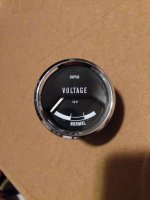
One rather large piece I left out was that I have removed the ammeter and installed a voltmeter in its place. This means I have removed the original current path from the generator thought the regulator, ammeter out to the battery. I have used a #8 wire from the alternator output to the starter solenoid and powered the voltmeter from the ignition switch to show system voltage. I contacted "the gauge shop" in the UK and he made me a voltmeter from a Rover that looks just like it would have come from the factory in the Tr4.

IMG_3521.jpg

I'm still working on the final low current wiring layout but with the increased current of the alternator I was not comfortable with it running through the original wiring and bladed terminals. The potential for voltage drops at poor high current connections hidden behind the dash is scary.

One day when I can afford the correct color wiring I will build my own harness without mixing British and US wiring color codes.

Advance Auto Wire has ready made harness and fuse block kits to upgrade and protect most British classics, but that is well outside my budget.
 
Randall,
for the tail lights. Do you intend to use only one for the tail lights or add one for brake lights another for turn signals and so on?
Charley

Sorry, I didn't put that clearly. I plan to duplicate the setup used on later TR3/A, where a single in-line fuse protects all the lamps that come on with the first position of the headlight switch (tail lights, dash lights, front marker lights).

The brakes and turn signals are a mixture, since I added relays under the dash to make the corner lamps do triple duty as brake lights, turn signals and tail lights. The flasher is fed from the original fuse and switch, and still feeds the front turn signals directly (through the control head of course). But the (mechanical) brake light switch and two relays get their power from a fuse in the new fuse block, which is hot all the time. (I like the brake lights to work even with the key off.)
[video=youtube;q4GMcD9DktQ]https://www.youtube.com/watch?feature=player_detailpage&v=q4GMcD9DktQ[/video]

BTW, Dave, on my previous TR3A (the one in my avatar), I added a 60 amp Ford alternator complete with remote sensing so it went to the full 60 amps every time I started the car. Not so much an issue here in CA, but back when I lived in the Midwest I worked 2nd shift and got thoroughly sick of having a dead battery because it didn't have time to recharge during my 2 mile (each way) commute to work. So I wanted a system that recharged the battery NOW. I ran the full alternator output through the original wiring, and added a shunt to the back of the factory ammeter so it only indicated half of the charging current. (In effect making it a 60 amp ammeter.) In 20 years of driving that setup almost every day, the only problem I had was the original control box going open inside.

Here's a shot of the shunt, taken as I was parting out the car after it got totaled


If/when I upgrade the current TR3 to an alternator, I will take the same approach (but beef up the connections inside the control box).
 
One rather large piece I left out was that I have removed the ammeter and installed a voltmeter in its place. This means I have removed the original current path from the generator thought the regulator, ammeter out to the battery. I have used a #8 wire from the alternator output to the starter solenoid and powered the voltmeter from the ignition switch to show system voltage. I contacted "the gauge shop" in the UK and he made me a voltmeter from a Rover that looks just like it would have come from the factory in the Tr4.

View attachment 36429

I'm still working on the final low current wiring layout but with the increased current of the alternator I was not comfortable with it running through the original wiring and bladed terminals. The potential for voltage drops at poor high current connections hidden behind the dash is scary.

One day when I can afford the correct color wiring I will build my own harness without mixing British and US wiring color codes.

Advance Auto Wire has ready made harness and fuse block kits to upgrade and protect most British classics, but that is well outside my budget.

I have been trying to find brown /yellow wire, locally,( and other close color schemes) without luck.
i ran new 10g & 14g wire from the new alternator. My old generator wiring was probably not original but still the worst for wear.
i mulled over the best way to bypass the voltage regulator & splice the main alternator feed wires together
(previously connected to "A &A1" on the VR). Finally just soldered a "Y" with large shielded spades. Not crazy about the results, so if anyone can share a better way.....


i hadn't thought about the original ammeter gauge. Will a 45a alternator burn it out? I think it only registers 30a +/-.

Funny thing, I'm beginning to see the attraction of concours TR'ing & keeping everything correct.
At the very least you have a definite schematic plan to follow about all issues, though perhaps detrimental to daily driving.

BTW: thanks for the advance auto wire harness tip, I'm going to check that out.
 
Hey Randall,

Can you describe that ammeter shunt you used? (Class 101)

I am bypassing the VR (is that the control box you referred to?), as the new alternator has an internal one.
I would like to keep the original ammeter if I can.
Thanks for sharing all the pics, BTW:

Guy
 
The generator control box (as the British call it) actually performs three functions: in addition to regulating voltage it also regulates current and disconnects the generator from the battery when it isn't turning fast enough to charge. (Otherwise, the generator tries to run like a motor and runs the battery down.) I wasn't using it's functionality at all with the alternator, just kept it as a way of joining the wires together. Next time, I'll probably use something like this
cn-1_s14.jpg


https://www.madelectrical.com/catalog/cn-1.shtml
 
I don't know that 45 amps would burn up the original ammeter; but the first time I did this conversion, it did appear that the 60 amps at every startup was damaging the movement. The needle would whack the peg pretty hard and after a few cycles of that, started to stick. At any rate, I don't like seeing instruments hit the peg like that and it was an easy thing to fix. Probably take longer to explain than to do it :smile:

To understand the shunt, you need two things: All electrical conductors (except superconductors) have some resistance; and two resistances in parallel will divide the current in inverse proportion to their resistance. If they are equal, then each gets half the current.

Internally, the ammeter is just a loop of wire (the magnetic field from the wire is what moves the needle). So, if you add another wire in parallel with the same resistance as the ammeter, it will take half of the current. With only half of the current going through the meter, it indicates half of the actual current.

For my first go-round, I just added strands of steel "handy wire" (aka baling wire) across the ammeter until I liked the result. Steel has a higher resistance than copper, so I was effectively paralleling multiple strands to get a low enough resistance.

To get the right effect, I first noted the ammeter deflection with the headlights on (engine off), and then kept adding strands until I got half as much deflection. Probably not "best practice", but I just left the ammeter hanging on the wires while I went through the process of adding strands and checking the reading, so it went really quick. Not very precise of course, but precision really isn't much of an issue here. Really, all you want to know is whether the battery is being charged or discharged, and whether it is a little or a lot. It just doesn't matter if full scale is 60 amps or 70 amps (as long as it will take the full current).

If memory serves, I wound up with 4 strands of what was probably 18 AWG steel wire, but of course YMMV. Sorry I don't have a photo, but I didn't own a camera then (and wouldn't have thought to take one even if I did have a camera).

Years later, when I got the powder coated center panel seen above, I spent some time measuring the actual resistance of the ammeter. The two original TR3 ammeters that I checked were both very close to 1.2 milliohms (.0012 ohms), although a friend checked his early TR6 ammeter and found over twice that (2.7 milliohms). Consulting a copper wire chart like this one https://www.powerstream.com/Wire_Size.htm, I found that 3-1/2" of 16 AWG wire would be about the same resistance. So, that's what you see in the photo above.

 
BTW: thanks for the advance auto wire harness tip, I'm going to check that out.

Just so you'll know what to expect, the AAW harness is more of a harness kit. You get their "power block", which is a mounting plate with lots of relays and fuses; plus enough wire to hook everything up. But the wire is not cabled into a harness as such, you have to do that for yourself, as well as trim each wire to length, add the appropriate termination and so on. The wire itself is very high quality and has reasonable approximations to the old British color codes, but looks quite unlike original wire.

Likely everyone knows this, but just in case someone new wanders by, you can also get good reproductions of the original wire, in the original colors, from British Wiring https://www.britishwiring.com/PVC-Wires-s/67.htm
They also sell complete reproduction harnesses (be sure to research and ask for the one that matches your car, not all TR3 nor all TR3A are the same).
 
Thanks Randall I forgot about British Wiring as a source of correct color code wiring. I see now after looking at the diagram that the AAW "harness" is more of a kit, should have known with the number of options and features available.

Guy if you plan on keeping the ammeter I would follow what Randall has done with placing a shunt on the ammeter.
 
Just so you'll know what to expect, the AAW harness is more of a harness kit. You get their "power block", which is a mounting plate with lots of relays and fuses; plus enough wire to hook everything up. But the wire is not cabled into a harness as such, you have to do that for yourself, as well as trim each wire to length, add the appropriate termination and so on. The wire itself is very high quality and has reasonable approximations to the old British color codes, but looks quite unlike original wire.

.

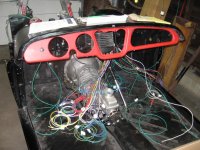
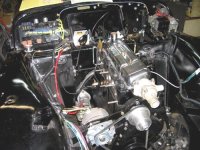
I installed the Advance Wiring harness. It is quite a bit of work, but I I must say, it was one of the most enjoyable jobs I did on the TR resto. I'm very satisfied with the results. Below is a couple of pics taken during installation.

IMG_0464.JPGIMG_0462C.JPG :encouragement:
 
The generator control box (as the British call it) actually performs three functions: in addition to regulating voltage it also regulates current and disconnects the generator from the battery when it isn't turning fast enough to charge. (Otherwise, the generator tries to run like a motor and runs the battery down.) I wasn't using it's functionality at all with the alternator, just kept it as a way of joining the wires together. Next time, I'll probably use something like this
cn-1_s14.jpg


https://www.madelectrical.com/catalog/cn-1.shtml

I like that connector a whole lot better than my duct tape & baling wire:

(I also like his relays)
 

Attachments

  • image.jpg
    image.jpg
    36.8 KB · Views: 138
I installed the Advance Wiring harness. It is quite a bit of work, but I I must say, it was one of the most enjoyable jobs I did on the TR resto. I'm very satisfied with the results. Below is a couple of pics taken during installation.

View attachment 36440View attachment 36441 :encouragement:

Wow, That's scarey. I have a tough time figuring out what to do with one wire, much less.......

but your project looks great(looks like you went the whole nine yds.). Is that a Toyota tranny? How's that working out?
 
(I also like his relays)
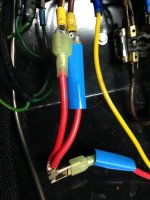
I bought a bunch of relay sockets with pigtails on eBay (they're only like $1 each if you buy in quantity) but ultimately decided I don't like them. Personal opinion of course, but I would rather just put quick connects on the wires and plug them directly into the relay. This is one example of why: I needed to make a joint close to the relay but when I used the heat gun to shrink the tubing, it also partially melted the socket! Still works, but was ugly.


I also later decided that reusing the original headlight socket was probably a mistake, so the second attempt included new sockets.
 
Wow, That's scarey. I have a tough time figuring out what to do with one wire, much less.......

but your project looks great(looks like you went the whole nine yds.). Is that a Toyota tranny? How's that working out?

Yeah, it looks scarey, but if you take your time it goes well. You'll notice that all the wires and/or group of wires are labeled. That makes it easy to route and arrange them. Most of the time is spent putting connector and heat shrink tubing on. All of my connectors are crimped and soldered. After the wires were all in and bundled together, I used corrugated/split plastic wiring loom. Very easy to install and it leaves the wiring accessible if you need to go in there later on. It comes in all kinds of sizes and colors and even has fittings available like tees and 90 degree elbows. And yes, that is a Toyota tranny. It's a great gearbox.

1-hosa-wire-loom.jpg
 
Hey Randell,

just an FYI: I ordered those relays & a few other electrical stuff from Madelectrical.com, but he no longer has those CN-1 insulated post.
however he gave me a jegs cat# 555-10521 for a alternative, 2 post unit.
pricey, but has two isolated terminals, so it fits the alternator wiring need very well.
https://www.jegs.com/i/JEGS-Perform...1/10002/-1?parentProductId=758462#moreDetails

so you plan on going back to the bullet connectors?
I do plan on putting inline fuses on the headlights & low & high beam relays.
i may end up running all new wire : (ever time I've opened the can, I've found worms), but I'm not ready to do a full harness.

did you use 4 relays (2 per single headlight) or just 2 total?

BTW: another thing Mark at mad electrical recommended was installing relays on the starter motor.
said these newer replacement starters can spike 50amp. So I'm going to do that also.

Thx
 
Back
Top