• Hey Guest!
    British Car Forum has been supporting enthusiasts for over 25 years by providing a great place to share our love for British cars. You can support our efforts by upgrading your membership for less than the dues of most car clubs. There are some perks with a member upgrade!

    **Upgrade Now**
    (PS: Upgraded members don't see this banner, nor will you see the Google ads that appear on the site.)
Tips
Tips

Ignition warning light

M

Member 10617

Guest
Guest
Offline
Can anyone explain the function of the TR3 ignition warning light? Until yesterday, the light went out and stayed out whenever I started the car. Yesterday I had to have my regulator and generator replaced (one fried the other???). Now, the ignition warning light comes on when I am about to start the engine and goes off once I have started, but it comes back on whenever I am idling or am at 1000 rpm. There is a cryptic statement in the Triumph handbook about this, but not much and not very clear.
 
Lex -

Sounds like the light is doing its thing: letting you know when the generator isn't charging properly. When the idle is up, generator is putting out enough to run the car and charge the battery.

1000 rpm sounds a bit high for it to be just going out. When you replaced the regulator and generator, was the battery checked out? May need a proper charge.

Hope this helps, and I'm sure someone else will chime in here shortly.

Mickey
 
Also check your belt tension. I could be the belt is a bit loose and slipping at slower speed. I also agree with Mickey.
 
Mickey, Tom, and Andy,

Thanks for the input. I was unsure why the light was coming on when the car was idling (and had not before yesterday's incident) but now I see that THIS is normal and whatever the heck was going on before was not normal. I learn something every day.

The mechanics (at a shop that specializes in Triumphs) checked the battery, cleaned the posts, etc., etc., so I think it is OK. They also set the belt and I have to assume it is tight enough. On my way home -- about 50 miles from the shop -- the ammeter rose to about 30 when I started, but at cruising speed it remained at between 0 and 30 most of the way home.

Here's what one of the mechanics subsequently e-mailed me. "When we tested it using a digital volt meter it was normal. On a generator system it takes some time for it to get to a higher charging voltage. It starts at battery voltage around 12.5V and goes up slowly to about 14V depending on load. When at idle it is not turning fast enough to charge (light on). Different voltage regulators will start charging at different RPM, usually just above idle. Yours kicks in a bit high but still normal. What wasn't normal [yesterday] was that when it went off it came back on at a higher RPM. Hopefully you won't see that again. Next time you are down this way we can check your idle speed with a digital tachometer. By ear I don't think your idle is as high as your tach reads."

Lex
 
LexTR3 said:
By ear I don't think your idle is as high as your tach reads."
That is certainly a possibility. Those old mechanical tachs tend to read high as they wear. I haven't checked it, but mine reads around 800 at what feels more like 500.

And the speedo reads over 100 mph at around 70 actual, but that's a different story :laugh:
 
Strange, I know I wrote this up, but I don't see it in this thread.

When the key is on, the red light on the dash basically indicates the state of the "cutout" contacts inside the control box, which connect the generator output to the battery. When the generator output drops low enough (due to low rpm), the cutout is supposed to open as otherwise current would flow backwards from the battery into the generator (trying to turn the engine).

Normally, the light should stay out (contacts closed) down to idle rpm. But if your idle is a bit low (etc), it may come on without necessarily indicating a serious problem. As long as it goes back out (and stays that way) at higher rpm, it probably is not indicating a problem.

If you are interested in double-checking your garage's work (or just learning more about how the charging system works), there is a fairly simple test procedure in the "Lucas Generator and Control Box tests" that you can download from:
https://docs.google.com/leaf?id=0B2H2NJt3...hYmRl&hl=en
 
I am gradually having all the guages rebuilt. I have just had the temperature guage rebuilt; the tachometer will be next on my list.
 
Randall,

Many thanks for the information and advice. When I was having trouble yesterday, the light came on an stayed far too long. Then it started coming on at totally unexpected times, like when I was doing 55 mph. That's when I went to the shop and they replaced the regulator and the generator (which, though brand new, was dead!). Now the light comes on at a normal 9for me) idle, but immediately goes out when I accelerate and stays out until I idle again. I will check out the Box test. Many thanks.
 
One of the duties of the control box is actually to limit the output of the generator to what is safe for the generator. I learned the hard way (many years ago) that trying to cheat by turning the regulator up a bit is likely to lead to thrown solder and a useless "new" generator.

I only wish I'd figured that out sooner, BEFORE I'd burned up 3 or 4 of them!
:laugh:

Still makes me nervous any time I see over 20 amps charge on the ammeter; but it's OK for a short time after the engine is started (and the generator is cold).
 
Oh... yes... one more twist to this tale. Someone in years past switched the covers to the ignition warning light and the turn signal light bulbs. So, I get yellow when the ignition warning light comes on and red when the turn signals come on. Fixing this would be simple enough if the heater were not in the way! With the heater installed, there seems to be no way to get at the lights to change them. But... I can live with that.
 
Can you get your hand up there just enough to either swap the bulb sockets or undo the wingnuts and pull the center panel forward (to swap the wingnuts)? It's been many, many years since I've done this on a TR3, so I don't remember how easy (difficult) it might be!?
 
Actually, getting the center panel to pull out to get to the back of it is not that difficult. There are four wing nuts. The two on the bottom have to be removed (easy to get to), but the two at the top need only to be loosened enough to pull the bottom of the panel forward to clear the studs, and then lowering the panel enough to clear the upper slots in the dash where those wing nuts are. In other words, the studs in the top do not go into holes, they're in slots. You may have to remove the glove box to get to the upper one on the passenger's side...I don't remember. But that's not much of a job.
 
martx-5 said:
Actually, getting the center panel to pull out to get to the back of it is not that difficult. There are four wing nuts. The two on the bottom have to be removed (easy to get to), but the two at the top need only to be loosened enough to pull the bottom of the panel forward to clear the studs, and then lowering the panel enough to clear the upper slots in the dash where those wing nuts are. In other words, the studs in the top do not go into holes, they're in slots. You may have to remove the glove box to get to the upper one on the passenger's side...I don't remember. But that's not much of a job.

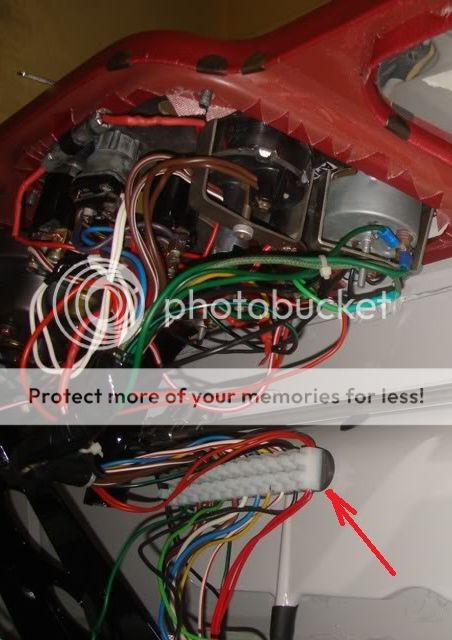
Somewhat off-topic, but related, I installed an intermediate terminal strip which allows me to pull the center panel out and easily access all of the main circuits. if you look closely, you can see the rare-earth magnets epoxied to the terminal strip, which is simply held by magnetic attraction to the bottom of the scuttle vent sump.
DSC04880.jpg
 
martx-5 said:
Actually, getting the center panel to pull out to get to the back of it is not that difficult...

Though you may also have to undo the line to the oil pressure gauge -- I know mine doesn't have enough slack/flex to allow the center panel to move very much until it is undone.

Just don't start the engine until the line is reconnected!
 
LexTR3 said:
Can anyone explain the function of the TR3 ignition warning light? Until yesterday, the light went out and stayed out whenever I started the car. Yesterday I had to have my regulator and generator replaced (one fried the other???). Now, the ignition warning light comes on when I am about to start the engine and goes off once I have started, but it comes back on whenever I am idling or am at 1000 rpm. There is a cryptic statement in the Triumph handbook about this, but not much and not very clear.

The simplest way to describe the function is that the ignition lamp "looks at" the voltage difference between the battery and the generator.
 
Geo Hahn said:
Just don't start the engine until the line is reconnected!
Also don't lose that sneaky little leather washer.

However, my recollection is that there is enough room behind those lamps to pull the sockets out and down, even with the heater installed and the panel still screwed to the dash. You have to work mostly by feel, but I'm sure I've changed the turn signal bulb on a car with a heater, without doing any disassembly.

But since the heater was optional, and never did do much good anyway (IMO), I just took mine out and left it. No sense hauling the extra weight around all the time.
 
LexTR3,

Where in Virginia are you located (is Lex your name or are you near Lexington :smile:)? Also, curious what shop you are using?

Scott
 
Thanks a million for all the good advice and guidance. I think I'll let the experts work on changing the bulbs when the car goes in for its winter tune-up and other work. At the same time, I am thinking of having some of the old wiring upgraded and the tachometer rebuilt.

I am located in Lexington, VA, and the shop I use is located in Waynesboro, VA.

By the way, I have always heard that the TR3 heaters were about as warm as a puppy's breath, but not mine. In the middle of winter, with snow all around and temperatures way down there, I had to keep reducing my heater because it put out so much warm air. In one case, I even had to turn it off. My car, on the other hand, was a normal 185 degrees. This was one of my pleasant surprises with the car.
 
Ah, Mike Gassman's shop (I live "next door" in Staunton).

Mike and I used to hang out in our "youth" when he had just finished his 1969 TR6 and I was starting my TR4A.

Scott
 
Back
Top