• Hey Guest!
    British Car Forum has been supporting enthusiasts for over 25 years by providing a great place to share our love for British cars. You can support our efforts by upgrading your membership for less than the dues of most car clubs. There are some perks with a member upgrade!

    **Upgrade Now**
    (PS: Upgraded members don't see this banner, nor will you see the Google ads that appear on the site.)
Tips
Tips

Idle Too Fast

My two cents: why not disconnect the linkage piece by piece, until you find the part that's binding. Note also that heat builds as you drive, so what is loose on a cold engine may be binding after driving a bit.

And you did check the pedal linkage where it enters the firewall, right?

Tom
 
Oh darn! For some strange reason, I was thinking of H6 carbs, but of course your 4A has HS6. So of course pushing on the idle stop screw did nothing, yours are attached to the body instead of the throttle shaft like mine are. Sorry, I'm not going to be much help. But, now that you can see the problem under the hood, it should be easier to trace it down. I believe there should be just a little bit of play between the lever on the left in your photo with the pinch bolt and the actual throttle lever to the right.
 
That's a great idea! I deliberately snugged the linkages before tightening the balancing screws so that there is "zero" play between the foot pedal and the carb linkage. I'm going to try leaving some play as you suggest. That just may be the problem after all. In fact, it's only 9:00 o'clock, and I may try that before midnight.
 
I, too, have an engine that doesn't like to come back to idle. With my car, I am 99% certain it is binding at the lever (Moss part no. 373-385 for reference) on my rear carburettor. The lever, and other associated parts, are fitted to the throttle shaft and slide over a flat on the shaft. There is a nut that tightens the lever to the throttle shaft. If the proper bush, through which the throttle shaft is inserted, is not used (too short, for example) of a washer is omitted (my problem) the lever can easily bind against the carb body. I figured out my problem because the screw, for the choke, that runs through the lever, doesn't line up properly with the fast idle cam.

A stronger spring had been put in my car by the PO. When I reverted to new, original style, springs I started to experience the problem. I have mitigated the problem through fiddling and lubrication, but I will need to disassemble the carburetor linkage, and reassemble it properly to cure the problem. Too much trouble, to solve a minor annoyance. A stab of the throttle returns me to idle, and I could always use stronger springs, i suppose.

As others have mentioned, I would check each linkage and look for what is binding, as surely something is...

BTW, your linkages and associated hardware look beautiful. Where did you get the parts?
 
That's a great idea! I deliberately snugged the linkages before tightening the balancing screws so that there is "zero" play between the foot pedal and the carb linkage. I'm going to try leaving some play as you suggest. That just may be the problem after all. In fact, it's only 9:00 o'clock, and I may try that before midnight.

And the result is ... ?

Inquiring minds want to know!
Tom
PS - just to clarify, are you saying the engine speed *increases* to a high rpm? Or just that it *sticks* at a high speed. Your original post said "Suddenly 1800 RPMs at every stop light;"
 
OOPS, that's just a stock file photo--not mine. Also, just to clarify--my throttle sticks, and doesn't speed up, though it sure seems like it at times. I "corrected" my post above. No matter how many times I proof read, I still . . . .
 
Just to cap this: Got it fixed finally; I added a stronger spring to the accelerator shaft, greased everything again and left some deliberate clearance in the levers per my pic above. Finally!
 
Congrats on the improvement. To help others with a similar problem, could you point out where that "deliberate clearance in the levers" is?

Thanks.
Tom
 
Too quick to celebrate. Here it is just a few days later and I've got a fast idle problem again, maybe worse than ever.

I've looked at virtually everything I can think could be the problem. Idle comes down each time I flick the gas pedal.

I centered the jets, and I doubt either jet needle is bent. The pistons rise and fall neatly. All linkages clean and greased.

Doesn't it have to be something loose in the butterfly at this point?

Could it be that I just don't have the pinch bolts tight enough on the connecting shafts between the two throttles or is that irrelevant to the issue? Could something be slipping, allowing a butterfly to stay open?

Anthing else come to mind that I may be overlooking?
 
Did you disconnect the gas pedal linkage, to see if the "sticking" is in the bushing at the firewall?

I'd sure try to isolate the sticking before I took the carb apart.

Tom
 
Sorry for all the dramatics. Now I've got it fixed! Guaranteed. I'll post a pic and explanation.
 
This issue wasn't nearly as complicated as I made it. Over the past two weeks, I bought new springs, oiled and greased everything, centered the jets, added a new foot pedal return spring, adjusted the mixture, balanced the carbs, and on and on . . .

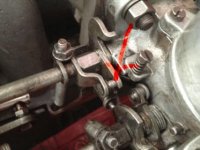
Here is the primary cause of all of my problems with a racing idle on my HS6 SUs:
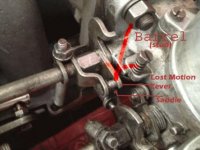
Carb-Linkage-2.jpg

Somehow the linkage must have slipped after getting hot (this started after a long idle where the temperature approached 190 degrees or higher). In the picture you can see the lever fastened with a pinch bolt fitting, and that lever, one on each carb, has a small barrel stud marked in RED that fits in the "saddle" of the throttle "lost motion lever" which is Moss part 372-840.

In all my maneuverings and adjustments, I balanced my carbs by loosening the pinch bolt, and when I re-tightened the pinch bolt I deliberately set the barrel at the bottom of the saddle so that there would be no delay or "play" when pushing the gas pedal. The problem was that the barrel was not allowing the throttle levers to return fully closed.

Last week I thought I'd fixed this by floating the barrel smack in the middle of that saddle (the lost motion lever). I thought that fixed it, but it didn't.

Today, I noticed the problem with my idle racing at 1900 rpms. So, I loosened the pinch bolt, rebalanced the carbs, and then made absolutely certain that upon re-tightening the pinch bolt on the levers (Moss part 371-860), that barrel on the pinch bolt was pushed to the very top of the saddle in the lost motion lever. That way, the barrels push the butterflies shut. In other words, the springs pull the levers up against the saddle, forcing the throttle levers to close fully. The idle is where it should be.

You can see that in the picture (which I edited for clarity after my initial post).

You'll note at least three levers in the Moss drawings: Throttle levers, levers next to the throttle levers, and lost motion. I have a hunch that "lost motion" may tell the story of what I went through.

Sorry for the long opera. I hope someone else will benefit from the above.

 

Attachments

  • Carb-Linkage.jpg
    Carb-Linkage.jpg
    17.9 KB · Views: 102
Last edited:
Hey - congratulations! Good job of troubleshooting.

"This issue wasn't nearly as complicated as I made it"

I know those words very well ... like when I spent almost an entire month trying to get my 1960 M-B engine to run - and the problem was just a loose terminal on the wire between coil and distributor. Oy.

Tom
 
An extra return spring is a common way of improving return to idle. It's usually fitted horizontally between the bellcrank (under the carbies) and the sliding bracket on the dynamo.

Often the bellcrank pivot pin often misses being lubed, causing elongation of the ferrule on the pin. Throttle response becomes slightly delayed until the slack is taken up.

Viv.
 
Back
Top