• Hey Guest!
    British Car Forum has been supporting enthusiasts for over 25 years by providing a great place to share our love for British cars. You can support our efforts by upgrading your membership for less than the dues of most car clubs. There are some perks with a member upgrade!

    **Upgrade Now**
    (PS: Upgraded members don't see this banner, nor will you see the Google ads that appear on the site.)
Tips
Tips

hs6 "414" needles - 2000 rpm idle

eschneider

Jedi Warrior
Offline
hs6 "414" needles - 2000 rpm idle

Just rebuilt a pair of hs6's and can't get the idle to come down below 2000 rpm with the throttle controls disconnected the idle screws not touching the stops, choke disconnected, and the carb-to-carb shafts loose

Yes, I'm checking the throttle plates, vacuum leaks, jet centering.... I may have *slight* leakage at the throttle shafts, but.... 2000 RPM????? I would think a vacuum leak would just make it run crappy....

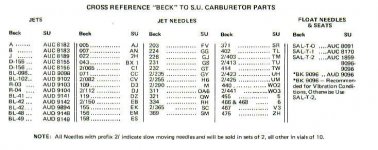
Question: the kit had needles marked "414".... needles that came out of the carbs were "TW". What the holy heck is a 414? Checked it with the vernier calipers and they seemed to be comparable, but it's bugging me. I couldn't find any info on them.
 
Re: hs6 "414" needles - 2000 rpm idle

I don't know what a 414 is (doesn't seem to be in my old database). But, I'm reasonably certain that's not the problem with your high idle. Something has to be letting too much air in, and the needle can't do that. Nor can jet centering.

One check is to look through the bore at a light with the piston removed and the throttle fully closed. If you can see light anywhere around the throttle plate except right at the shafts, there's your problem. Most likely the plate is either turned front to back, or not properly centered. But if you've changed the shaft, the new shaft might not be made right.
 
Re: hs6 "414" needles - 2000 rpm idle

Can the throttle plates be installed backwards on those carbs?
 
Re: hs6 "414" needles - 2000 rpm idle

The thottle plates (butterfly) are slightly oval with a bevel all around. The bevel is not like a chamfer. The sloped bevel goes one way for one half of the oval and the other way for the other half. If you install it and screw it in backwards, the sharp edges will try to "seat" instead of the correct way where the "flat" of the sloped bevel will seat flat against the ID of the throttle bore.
 
Re: hs6 "414" needles - 2000 rpm idle

The 414 needle IS identical to a TW needle. Made by a different company. I have the whole cross reference file.

Peter
 
Re: hs6 "414" needles - 2000 rpm idle

Don,

That's what I meant. Could they be partially open and causing a vacuum leak?
 
Re: hs6 "414" needles - 2000 rpm idle

Peter,

Can you share the cross reference file with us or are the copy right issues?
 
Re: hs6 "414" needles - 2000 rpm idle

well first i would check that the return springs are definitly closing the butterflys. i have a set of hs6's on my car and if i dont have some return springs the throttles open. im not talking about stock return springs on the tr6, but extra ones for the su's. i bought a couple for an mgb and got a little bracket from pep boys which is made for american v8's as a throttle spring return bracket. i put this on the center manifold bolt for the intake. maybe this is the problem?
Randy
 
Re: hs6 "414" needles - 2000 rpm idle

Hello Eschneider,

if you can't reduce the idle by closing the throttles by hand, i.e. making sure they are as closed as possible, then I think Randall has hit the problem.
These throttle plates are made with the fixing holes larger than the fixing screws so as to allow the best fit in the throttle body. The way to fit them is loosely assemble in the carburettor and then hold the throttle spindle closed while checking the fit of the throttle and once minimum daylight is visible, then tighten the screws. New screws are essential by the way as they are split at the end so as to be able to lock them in place.

Alec
 
Re: hs6 "414" needles - 2000 rpm idle

I had the same problem with my TR3 15 years ago. It drove me nuts as I hunted areound the carb for leaks (at least I ended up rebuilding them and bushing the shaft) with no luck. It turned out to be a vacum leak at the manifold to head junction. Try looking there. I have heard that if you spray some sort of combustible (WD40, quickstart etc.) in the area the leak will suck it in and increas the RPM. I have never tried this myself (too chicken) but it makes sense. All I did was repleced the gasket and this time used a sealler on it, then the RPM was down to 500 (if I wanted it).
 
Re: hs6 "414" needles - 2000 rpm idle

Brosky said:
Peter,

Can you share the cross reference file with us or are the copy right issues?
I'll try to attach a jpeg of the scannned page.

These parts were made by Jerry SAlny of Salcorp who sold to the likes of beck/Arnley, Vera, Nisonger, etc. Moss still has his kits. The old kit numbers (SAL1414, etc) were derived from the needle number (414). I used to work for Jerry back in the early 70s. We shipped a lot of these parts.

I hope the attaching process works. (it didn't last time I tried) PM me if you want a copy.

Peter C.
 

Attachments

  • 7827.jpg
    7827.jpg
    54.4 KB · Views: 128
Re: hs6 "414" needles - 2000 rpm idle

Thanks, Peter !
 
Re: hs6 "414" needles - 2000 rpm idle

TR3driver said:
...reasonably certain that's not the problem with your high idle. Something has to be letting too much air in, and the needle can't do that. Nor can jet centering.

One check is to look through the bore at a light with the piston removed and the throttle fully closed. If you can see light anywhere around the throttle plate except right at the shafts, there's your problem.

That is apparently it. I stuck a flex flashlight down the pcv port in the intake, and looked through the carb barrels with the pistons lifted.

One might say, "I have seen the light". Bwa-ha...ha..... er... ha.

Sorry.

So I'm still learning, and I've been trying to wrap my brain around this. I get that air leaking past the throttle plates will cause high RPM - its analogous to having the throttle partly open.

Suggestions about vacuum leaks made me scratch my head, though. Why would a vaccuum leak on the intake cause the idle to be raised? On an injected car, the computer responds by trying to increase the fuel. On a carbureted car, I would have thought that an intake leak would just weaken the mixture and cause the engine to run crappy.

I am empty glass; I seek only to achieve stoichometric nirvana, masters.
 
Re: hs6 "414" needles - 2000 rpm idle

eschneider said:
Why would a vaccuum leak on the intake cause the idle to be raised?
Because on these primitive engines, the idle mixture is slightly rich of stoichiometric; while best fuel economy (most power for a given amount of fuel) is somewhere lean of stoich. So, a small air leak can increase power resulting in a higher idle.

ISTR the emissions book even mentions this effect, saying that the idle rpm should rise slightly when you remove the oil cap (which increases air flow through the PCV into the intake, effectively a small vacuum leak).
 
Back
Top