• Hey Guest!
    British Car Forum has been supporting enthusiasts for over 25 years by providing a great place to share our love for British cars. You can support our efforts by upgrading your membership for less than the dues of most car clubs. There are some perks with a member upgrade!

    **Upgrade Now**
    (PS: Upgraded members don't see this banner, nor will you see the Google ads that appear on the site.)
Tips
Tips

How do you set the timing on a Pertronix distribu

tntriumph59

Member
Offline
Hey guys and gals,

I have switched out the original distributor with a Pertronix distributor on my TR3a. My question is how do I set the timing? I understand you cannot use the typical strobe timing light, so what is the preferred method for these distributors?

Thanks,
Andrew
 
The Pertronix works just like points, so you can static time it the same way.

My preference is to just get close enough for the engine to run, then do the final adjustment with the road test method. Find the timing where you can just force the engine to ping (by lugging it when thoroughly warmed up), then back off about 2 degrees from that point. If you ever hear pinging (perhaps after getting a tank of bad gas), you can back off another 2 degrees (1/2 mark on the advance unit).

But you can also use a timing light, by marking a point on the pulley about 3/8" advanced from the hole at TDC.
 
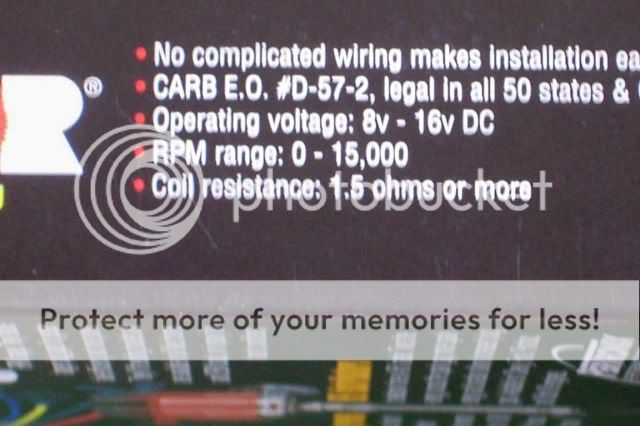
From the Pertronix box:
PERTRONIXvolts.jpg
 
Yes I did. I have a Lucas Performance coil. TR3driver I like the idea of putting a mark 3/8" in front of the TDC hole. Thanks for the suggestion.
 
poolboy said:
From the Pertronix box:
PERTRONIXvolts.jpg

That is kind of misleading, though. It can be used with a 1.5 ohm coil of course; but to use a 1.5 ohm coil on a 4 or 6 cylinder engine, you also need a ballast resistance in the circuit.
 
How do you static time a Pertronix?, from admittedly fallible memory I thought most static timing instructions talked about "turning the distributor until the points just start to open" or put a 12 volt test light somewhere on the points or something like that.

I have always just put the distributor about where it was before, if it doesn't start try a couple more positions until it catches, once it catches advance to get highest idle speed, then back off a little bit then do a little trial and error on "pinking" by running uphill at 2-3000 RPM in third and trying to accelerate.

Also have heard you can burn out your Petronix by sitting with the ignition on and fiddling with it not running. Lastly, my timing lights have always worked fine with a pertronix.
 
glemon said:
Also have heard you can burn out your Petronix by sitting with the ignition on and fiddling with it not running.
Good point, I forgot to mention that. With or without the Pertronix, it's best not to leave it sitting with current through the coil for long periods of time.

But you should have no trouble in completing the timing in just a couple of minutes, which won't harm the Pertronix or points (or coil).
 
The time quoted by the Pertronix tech people varies. However, you should have a minimum of 3 minutes with the engine off and ignition on to set the timing. If you need more time than that.... make sure the power wires for the ignition module have spade lugs (not ring terminals) and unplug one of the wires when you are not actively involved in setting the timing.

As Randall said, treat the Ignitor module just like points during static timing. You do have to use a test lamp since there are no points to watch opening. Regardless, it is quite easy to static time Pertronix Ignitor modules. The new Ignitor-II modules are different... they cannot be static timed.
 
tntriumph59 said:
Yes I did. I have a Lucas Performance coil. TR3driver I like the idea of putting a mark 3/8" in front of the TDC hole. Thanks for the suggestion.

There are two versions of the Lucas coil if memory serves. The 3 ohm one will fry your Pertronix. This is a common thing to mismatch, and the primary reason people who have a bad experience with their Pertronix do so (in my experience).

Not trying to give you a hard time, just want to make sure.
 
tdskip said:
There are two versions of the Lucas coil if memory serves.
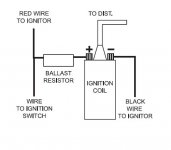
That is true, but the 3 ohm version is the "good" one. If you use the 1.5 ohm, then you need a ballast resistor in series with the coil (but not in the power lead to the Pertronix).
 

Attachments

  • 28728.jpg
    28728.jpg
    17.7 KB · Views: 306
The TR6 ballast resistor wire supplies over 8 volts to the coil. It's enough voltage to satisfy the 8 volt minimun for the Pertronix Ignitor switch to work properly.
If you have a ballasted ignition that supplies less than 8 volts to the coil, you will need to pick up a 12 volt feed from the ignition switch.
Other than that the Pertronix doesn't care. If the coil was compatible with the points and condensor and the rest of the ignition system before the conversion,it'll be happy with the Pertronix and vice versa.
 
You can buy a strobe timing light that can be preset for the the amount of advance you require.

Get the engine running and use the advance curve for the distributor published in the manual to check timing at tickover and when fully advanced.

Ash
 
Back
Top