

-
 Hey Guest!
British Car Forum has been supporting enthusiasts for over 25 years by providing a great place to share our love for British cars. You can support our efforts by upgrading your membership for less than the dues of most car clubs. There are some perks with a member upgrade!**Upgrade Now**
(PS: Upgraded members don't see this banner, nor will you see the Google ads that appear on the site.)
You are using an out of date browser. It may not display this or other websites correctly.
You should upgrade or use an alternative browser.
You should upgrade or use an alternative browser.
Horsepower fetish.
- Thread starter Tabcon
- Start date

Darrell_Walker
Jedi Knight
Offline
Hi Tab,
Thanks for sharing what you found out from Moss, sounds like my engine is in good shape.
Another option for a thicker head gasket is a solid copper gasket from Gasket Works. They are available in many thicknesses, all the way up to 0.125.
BTW, I checked out your site, very nice work so far. I hope you dyno it once you get it running!
Thanks for sharing what you found out from Moss, sounds like my engine is in good shape.
Another option for a thicker head gasket is a solid copper gasket from Gasket Works. They are available in many thicknesses, all the way up to 0.125.
BTW, I checked out your site, very nice work so far. I hope you dyno it once you get it running!

rikiwho123
Senior Member
Offline
Looking at your motor and seeing what you have done you don't need any blower your engine looks great and have you ever seen a blower backfire not pretty looking when all your fine work is on the ground;good luck and happy holidays.rick.

MadMarx
Jedi Warrior
Offline
funny to read all this.
Tab - you should make up your mind which way you would like to go at first:
Naturally aspired
or
Turbo
Naturally aspired means:
Wild camshafts, high compression, special headers, and so stuff....
Turbo means:
very low compression 8:1 - 8,3:1, mild camshaft with almost no overlap or you would make wonderful turbo flames all the time.
Header is not important.
If you put a charger on a high compression engine you almost cannot run any high boost pressure so your advantage of the charger is almost nothing.
But you want to run high boost get the most out of the charger.
Thats why the Moss charger has almost no boost not to blow up the engines they are selling it for.
Cheers
Chris
Tab - you should make up your mind which way you would like to go at first:
Naturally aspired
or
Turbo
Naturally aspired means:
Wild camshafts, high compression, special headers, and so stuff....
Turbo means:
very low compression 8:1 - 8,3:1, mild camshaft with almost no overlap or you would make wonderful turbo flames all the time.
Header is not important.
If you put a charger on a high compression engine you almost cannot run any high boost pressure so your advantage of the charger is almost nothing.
But you want to run high boost get the most out of the charger.
Thats why the Moss charger has almost no boost not to blow up the engines they are selling it for.
Cheers
Chris
Monkeywrench
Jedi Trainee
Offline
I think Tab only needs to lower compression. A ported head, good header, etc all still matter on a supercharged engine.
However, good luck keeping your transmission together for any amount of time. You should probably swap to a Toyota or a T5.
However, good luck keeping your transmission together for any amount of time. You should probably swap to a Toyota or a T5.
Vintage Performance Developements has a lot of experience with
blowers on Volvo P1800's. The problem with the TR head is it's not a flow through design. You can pump all the fuel & air in you want but it needs to get out. One of the best things you can do is get a real good header like the Stahl header. OTher things to consider when approaching the 200hp mark, your ( stock )crank is one, your axles are another.
just my .02,
Jim G
blowers on Volvo P1800's. The problem with the TR head is it's not a flow through design. You can pump all the fuel & air in you want but it needs to get out. One of the best things you can do is get a real good header like the Stahl header. OTher things to consider when approaching the 200hp mark, your ( stock )crank is one, your axles are another.
just my .02,
Jim G
Monkeywrench
Jedi Trainee
Offline
jimg said:Vintage Performance Developements has a lot of experience with
blowers on Volvo P1800's. The problem with the TR head is it's not a flow through design. You can pump all the fuel & air in you want but it needs to get out. One of the best things you can do is get a real good header like the Stahl header. OTher things to consider when approaching the 200hp mark, your ( stock )crank is one, your axles are another.
just my .02,
Jim G
The B20 (2.0L) Volvo racers are getting 200bhp naturally aspirated out of their race motors (with stock port locations). Port configuration is about exactly the same as the TR4, but with a slightly better combustion chamber and bigger bore (shorter stroke than the TR).
Check this thread out.. https://forum.savarturbo.se/viewtopic.php?t=48429&postdays=0&postorder=asc&start=240
I don't see the stock crank lasting at all, and rear axles will need to be replaced to aftermarket units.
Tab, no offense, but to do this right, I think you're looking at another $10k on top of what you already have.
MadMarx
Jedi Warrior
Offline
Horsepower is one thing but the most impresive thing at Tabcons cars is this....and I love the music too:
https://www.youtube.com/watch?v=-J4xkHuP7QY
Cheers
Chris
https://www.youtube.com/watch?v=-J4xkHuP7QY
Cheers
Chris

OP

Tabcon
Jedi Warrior
Offline
My goodness, can't we all just get along! 
LOL!
I should have realized that anytime you talk about adding hp to the venerable TR4 motor that there would be some disagreement.
I did!
Actually, I'm only kidding as this thread has been a good source of information for everyone.
To answer some of your concerns, yes my crank has be balanced and hardened and yes I am running upgraded axles. After watching Chris' video on Youtube about shifting without a clutch, the transmission seems pretty stout to me. I never intend to torture mine like that. darn Chris, you are tough on that thing!
Excellent driving though.
With this in mind, I don't think that anyone punishes a relatively stock TR motor as much as Chris has. I'm not saying that he has abused it for the sake of abusing it, but that he drives it like a race car and that it seems to be holding up quite well. I fully understand the concept of a dedicated racer, but this car is not one. Sure I will use it as a track day and fast road car, but I don't intend to campaign this car in any competition events that would require me to wring it for all it's worth. I also understand that if the motor or transmission gets damaged that I will have to repair it. Not a problem as I think I can handle this as well.
What I am not attempting to do with this car is to pamper and baby it like a Sunday driver, and I was never concerned with originality. I was extremely careful and meticulous in the build and did many things to avoid any possible problems, but s*$t happens and even the most careful of drivers tooling about in a car this old will someday have to make repairs. It's all part of the equation and I don't mind taking a risk with the motor or the transmission if it means making it faster. For me, fast = fun and I don't see the point of making something fast that is not supposed to be if you don't recognize and accept the inherent risks involved. Just ask the guys that campaign 5 million dollar Testa Rosa's like it was 1956 all over again. Now these guys are nuts...but I respect them because they drive these cars in the manner they were intended to be driven.
LOL!
I should have realized that anytime you talk about adding hp to the venerable TR4 motor that there would be some disagreement.
I did!
Actually, I'm only kidding as this thread has been a good source of information for everyone.
To answer some of your concerns, yes my crank has be balanced and hardened and yes I am running upgraded axles. After watching Chris' video on Youtube about shifting without a clutch, the transmission seems pretty stout to me. I never intend to torture mine like that. darn Chris, you are tough on that thing!
Excellent driving though.
With this in mind, I don't think that anyone punishes a relatively stock TR motor as much as Chris has. I'm not saying that he has abused it for the sake of abusing it, but that he drives it like a race car and that it seems to be holding up quite well. I fully understand the concept of a dedicated racer, but this car is not one. Sure I will use it as a track day and fast road car, but I don't intend to campaign this car in any competition events that would require me to wring it for all it's worth. I also understand that if the motor or transmission gets damaged that I will have to repair it. Not a problem as I think I can handle this as well.
What I am not attempting to do with this car is to pamper and baby it like a Sunday driver, and I was never concerned with originality. I was extremely careful and meticulous in the build and did many things to avoid any possible problems, but s*$t happens and even the most careful of drivers tooling about in a car this old will someday have to make repairs. It's all part of the equation and I don't mind taking a risk with the motor or the transmission if it means making it faster. For me, fast = fun and I don't see the point of making something fast that is not supposed to be if you don't recognize and accept the inherent risks involved. Just ask the guys that campaign 5 million dollar Testa Rosa's like it was 1956 all over again. Now these guys are nuts...but I respect them because they drive these cars in the manner they were intended to be driven.
Darrell_Walker
Jedi Knight
Offline
g1enterprises said:Then again you could always go this routehttps://www.youtube.com/user/Vancouverbyte#p/a/u/0/EtcQp0ivbQE
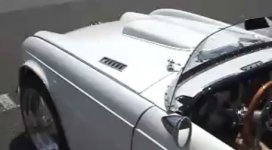
I like the bonnet vents:
Attachments
OP
Tabcon
Jedi Warrior
Offline
I saw this thing on youtube!
I love it when the guy says, ..."yea it's got a bit of a cam in it." A CAM...A CAM!!!, darn this thing has a little more than a bit of a cam in it. Then the guy drives off in it and shifts into second at about 1,200 RPM's...LOL! What a poseur!
Oh yea, nice touch with the "Moonie" wheels!
I love it when the guy says, ..."yea it's got a bit of a cam in it." A CAM...A CAM!!!, darn this thing has a little more than a bit of a cam in it. Then the guy drives off in it and shifts into second at about 1,200 RPM's...LOL! What a poseur!
Oh yea, nice touch with the "Moonie" wheels!

Monkeywrench
Jedi Trainee
Offline
Chris runs his car very hard, but I also crew on a TR4 race car. Triumphs with similar horsepower and modifications as Chris's are about 8+ seconds per lap slower at Watkins Glen than the one I wrench on. At the all Triumph race two years ago at Watkins Glen, the TR4 I crew on was beating and running side by side with the Group 44 TR6 despite having tires that were 4" narrower and with tread. Unfortunately, there was a little mechanical malfunction in the engine, so the car didn't finish. Lap time wise, we run identical times to that car though, and there still are MGBs and Porsche 356s that we race against that are faster!
I'm not trying to beat my own chest, just trying to add some credibility to my posts and to let you guys know that I'm not just pulling things out of left field.
I'm not trying to beat my own chest, just trying to add some credibility to my posts and to let you guys know that I'm not just pulling things out of left field.
MadMarx
Jedi Warrior
Offline
Tabcon said:........ After watching Chris' video on Youtube about shifting without a clutch, the transmission seems pretty stout to me. I never intend to torture mine like that. darn Chris, you are tough on that thing!
Excellent driving though.......
I really was unsure when I first run that gearbox how to shift it. The video of the non clutch shifting was the first time try out of that gearbox and which kind of shifting is the best for it. In advance I got some advice from this link:
<span style="font-style: italic">
Methods of Changing Gear.
By William Hewland.
The following is some info regarding shifting gear and face dog wear. I am in the fortunate position where I have a good amount of knowledge on the subject, as I understand the mechanical side and the user (driver) side equally well.
N.B. For succesful gear shifting, remember that it is critical to ensure that all mechanical elements between the drivers hand and the dog faces are in good order and properly set. This includes the gear linkage in the chassis!
Successful up-shifting, (defined as fast and non dog-damaging) will be achieved by fully moving the dog ring as rapidly as possible from one gear to the next, preferably with the engine's driving load removed until the shift is completed. (The opposite is true of a synchromesh gearbox as used in passenger cars, where slow movement helps). It should be remembered that it is not possible to damage the dogs when fully engaged (in gear). The damage can only take place when initiating contact during a shift, (the `danger zone`) therefore this element must be made as short as possible. If a driver moves the gear lever slowly, or if the linkage is not rigid and effective, dog wear will occur. We always recommend lightweight yet solid rod linkage, not cables ideally.
I list below the different methods of up-shifting that are used in racing most commonly. The best at the top, the worst at the bottom:
Automated (semi automated). The movement of the dog ring is powered and the engine is cut / re-instated in a co-ordinated manner. Gear-shifts take milliseconds. This system produces zero dog wear when set up well. It is not applicable to most cars, but it illustrates that speed of shift is a good thing.
Manual with engine cut. This system is almost as good as an automated one as long as the driver pulls the lever very quickly. Again it is not applicable to many cars, but it illustrates that speed of shift is a good thing. A `cheat` version of this is to shift on the engine rev limiter, which can work well. With this system it is especially important to move the lever ultra fast, otherwise the engine will be reinstated during partial dog engagement, causing damage. The damage can usually be felt by the driver.
Manual.
Best method: With no assistance from the engine management, the driver must lift off the throttle sufficiently to allow the dog ring to be pulled out of engagement. He should then stay off the throttle long enough to allow the dog ring to engage with the next gear. In practice, the driver can move the gear lever faster than he can move his foot off and back on to the throttle. Therefore the effective method is to apply load to the gear lever with your hand and then lift the throttle foot off and back on to the pedal as fast as physically possible. In lifting your foot, the loaded gear lever will almost involuntarily flick to the next gear before the foot is re-applied to the throttle.
Another method is to load the gear lever with your hand, stay flat on the throttle and dab the clutch to release the dog ring. The overall effect on the gear shift is similar to the above method, but clutch wear may become a big issue.
The worst method (most destructive and definitely slowest) is to attempt to change gear in a `passenger car / synchromesh` way, i.e. lifting off the throttle, dipping the clutch, moving the gear lever, letting the clutch up and re-instating the throttle. The method causes unnecessary clutch wear, does absolutely nothing to help come out of gear and usually causes dog wear whilst engaging the next gear. This wear is due to several reasons. Firstly, it is impossible for a driver to co-ordinate the complicated sequence of all five physical movements accurately. Consequently the engagement dogs often find themselves engaging whilst the throttle is applied. The lever is usually pulled more slowly as it was not pre-loaded, lengthening the `danger zone`.
Successful down-shifting, has similar rules applied regarding speed of shift. Unloading the dogs is done in the opposite manner obviously. Whilst braking, the dogs must be unloaded by either touching the throttle pedal or- my preferred method- by dipping the clutch. However, one sharp dab of clutch or throttle is appropriate per shift. Continued pressure on either will cause dog damage for different reasons. `Blipping the throttle` just before engagement is advisable if the rev drops between gears are over 1300 rpm, as this will aid engagement and stabilise the car.
TOP TIP for ease of downshifting: Make the downshifts as late as possible in your braking zone (i.e. at lower road speed), because the rev drops between each gear are then lower. So many drivers make the mistake of downshifting as soon as they begin braking, causing gearbox wear, engine damage and `disruption` to the driving wheels.
This is a subject which can be much expanded on, but I feel that these are the basics, which I hope are of use.
William Hewland,
President, Hewland Engineering.</span>
MadMarx
Jedi Warrior
Offline
Monkeywrench said:Chris runs his car very hard, .....
Do I?
I thought I'm too nice to the car and too tentative driving.
That's what I'm told after most of my races.
Cheers
Chris
Monkeywrench
Jedi Trainee
Offline
MadMarx said:Monkeywrench said:Chris runs his car very hard, .....
Do I?
I thought I'm too nice to the car and too tentative driving.
That's what I'm told after most of my races.
Cheers
Chris
I hope you're being sarcastic! I haven't seen another TR out brake you in your videos and you use all the track and curbs. Keep in mind, we're prepped to a different rule set than you are.
MadMarx
Jedi Warrior
Offline
Damned - and I thought I stay away from curbs as good as I can. I always run over the flat ones which doesn't do harm to the axles as I'm a little scared to breake something.
Would be interesting for me to find out what the differences are between your prep rules and ours.
I start:
We are allowed to use:
plastic panels
205/60-15 semi slick tires
6" rims
overbore of the engine up to 89mm (mine is 88mm)
crank is free, stock stroke
rods are free, same pistons
Weber carbs
electronic points (Pertronix or similar)
camber is free
Stock suspension has to be maintained
springs are free
free swaybars
stock brakes, pad free
gearbox housing stock, gearset free
These are the main points
Cheap racing with fast cars.
Would be interesting for me to find out what the differences are between your prep rules and ours.
I start:
We are allowed to use:
plastic panels
205/60-15 semi slick tires
6" rims
overbore of the engine up to 89mm (mine is 88mm)
crank is free, stock stroke
rods are free, same pistons
Weber carbs
electronic points (Pertronix or similar)
camber is free
Stock suspension has to be maintained
springs are free
free swaybars
stock brakes, pad free
gearbox housing stock, gearset free
These are the main points
Cheap racing with fast cars.