• Hey Guest!
    British Car Forum has been supporting enthusiasts for over 25 years by providing a great place to share our love for British cars. You can support our efforts by upgrading your membership for less than the dues of most car clubs. There are some perks with a member upgrade!

    **Upgrade Now**
    (PS: Upgraded members don't see this banner, nor will you see the Google ads that appear on the site.)
Tips
Tips

Hello - This is my first post.

Welcome

For new parts I usually use one of the following:

British parts Northwest
Moss Motors
Victoria British

They all have great web sites that are easy to order from, and all have great service.
I try to check prices at as many sites as i can before ordering for my swirling vortext of British Motor Engineering.

Just remember that Silicon and Glycol based brake fluids are "hugely incompatable" so you will need to flush the brake systems really well or replace it.

Have fun

Mikey
 
lbcs_r_fun said:
Thanks for all of the great suggestions. This is going to be fun!
T
Well, you've already gotten a good welcome, some good advice, and a fair amount of (mostly) good humor! :laugh:

At the moment, I'm only going to add a bit of advice that might almost seem contrary to the very purpose of this forum, although it's really not.

As it happens, there's a pretty decent Triumph/British car club right here in your/my area: Adirondack Triumph Association, if you've not already found same. Lots of Triumphs, lots of folks willing to help, and even a few locals "in the business" of parts and/or service.

Again, this is a great resource, but sometimes nothing beats being able to find someone local who might even drop over and help you bleed, "eyeball" something you might not know to look for, or just open the box while you grab another slice of pizza!
 
Welcome and +1 in favor of the Silicone. I had to change every brake and clutch seal in my barn find TR4 anyway, so I didn't have any compatibility issues.
 
SkinnedKnuckles said:
BUT I in no way want to discount others. I thought about that after the post... There is a wealth of info here from alot that will benefit you, which is what a forum is about -eh?
Oh, Absitively! I definitely don't have all the answers; not even sure of the questions! I've just been working on my own TRs for what seems like several lifetimes now.
 
I've got a TR3, and, like you, the first thing I wanted to do was make it as safe as possible so I went through the entire brake system. In general I agree with the various comments here. One thing I haven't heard mentioned specifically was with regards to the master cylinder, you could contact someone like Apple Hydraulics, whom I used, or there are others out there as well, to either re-sleeve and rebuild your original master cylinder or just swap out for the same type.

Have a great time working on the car. They are a blast to drive and simple enough to diagnose.

Eric
 
Tiny, you might post the Commission number of the car, something like TS 65XXX, found on a plate in the engine compartment. There were several changes around TS60000 which might influence responses.

Have fun with your new acquisition, they're appreciating in value. I love mine because it's so different from most anything else out there!
 
Hi Tiny,

Welcome.
Don't bother to rebuild your cylinders. They're ovalized or scarred or both and new inner parts won't change that. You'll be disappointed. New cylinders are quite cheap so why bother?
Tyres are an easy choice: Vredestein Classics or if you're wealthy enough, Michelin XAs. Vreds do almost the same job for half-price.
No big tyres. Keep it 165 by 4.5".

Rather than going thru the fuss of silicone (DOT 5) that needs regular change for being non-hygroscopic, use the new mineral (DOT 5.1, a confusing appelation if any) or stick to DOT 4 if the car is not wildly modified.

I've never been very interested by safety in a TR (I don't know where it is) but I have installed blue polypro bushes all over, 1° negative camber vertical links, a mastervac, 165 lbs rallye rear leafsprings, rear telescopic shocks and a front sway bar. Been driving it like a maniac for 40 years, ain't dead yet. So this must mean something.

BTW, remove or hack the windshield for more driving pleasure.
 
Murieta said:
Rather than going thru the fuss of silicone (DOT 5) that needs regular change for being non-hygroscopic,
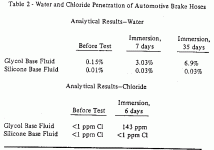
Er, I think you've got that backwards. Non-hygroscopic means it DOESN'T absorb water from the environment (including salt right through the soft lines), become corrosive, lose its boiling point, etc. DOT 5 is suitable for service for 10 years or more, while the glycol-based fluids (including 5.1) should be changed every few years, because they are hygroscopic.

You're a couple of years ahead of me (but only a couple). "Safety" is a funny thing, my biggest concern is other people not seeing me. TS39781LO was wrecked in a 4-car chain collision, caused by the driver behind me simply not watching the road in front of him. (I heard him admit that he was getting a Coke at the time.) But I came out without a scratch.
 

Attachments

  • 24743.gif
    24743.gif
    8.6 KB · Views: 159
Hi,

No, I meant what I wrote: DOT5 rejects water which accumulates in the lower recesses of the circuit and causes rust. So even if the silicone is still perfectly good, you have to purge the system to remove the water.
Among hygroscopic fluids, DOT5.1 (my favourite) lasts a bit longer than DOT4 and I change it every other year, on account of having the car at the cottage, near Paris, in a very damp marshes and lakes district.

I could change it every 4 years while DOT 4 requests yearly change for perfect function. However, I have set up a very nice car check and service routine which includes a nice senior moment in the pit under the car (speyside malt and cuban cigar). What SWMBO don't know can't hurt her.
grin.gif
 
Murieta said:
DOT5 rejects water which accumulates in the lower recesses of the circuit and causes rust. So even if the silicone is still perfectly good, you have to purge the system to remove the water.

That's a new one for me. I've heard of residual DOT 4 fluid lingering in the system after a changeover, and experienced problems with corrosion because the stuff is essentally sequestered by the silicone, but I've not heard of that on a new/clean system. But I don't drive in the rain, either.
 
Andrew Mace said:
There is, for example, that little vent hole in the master cylinder cap...where moisture can get in over time....

That's another yeah, but... Since silicone bf is not hydroscopic, it's not going to pull in moisture through that hole. And the 'breathing' like a gas tank won't happen because the reservoir is usually full. Maybe rain or wash water gets in there, but the position of the master is way up out of the way... Also, if the fluid somehow absorbed and then 'rejected' water, that would mean the 8 year old bottle on the shelf had a water layer on the bottom. Nope. 2¢
 
Welcome to Tiny

My 2 kroner:
Water can come in as humidity in the air, and later condense inside the master cylinder reservoir. Silicone doesn't absorb the water so there is a good chance the water will make it's way down to the calipers / wheel cylinders. There it will either cause rust or much worse evaporate upon hard braking. The latter will then displace the existing brake fluid back into the reservoir, leaving a big vapor bubble in the caliper. In short, instant no pedal.

With DOT5 fluid, absorbing the water will reduce the boiling temperature of the fluid, but it will take a whole lot of water to reduce it to an unusable state.

However as Randall states, silicone helps prevent ingress of water into the system simply because it rejects water.

Bottom line, I'm happy with both fluids. Though I haven't had to replace any hydraulics on my '63 Land Rover in more than 25 years, and it uses DOT5.
 
Back
Top