• Hey Guest!
    British Car Forum has been supporting enthusiasts for over 25 years by providing a great place to share our love for British cars. You can support our efforts by upgrading your membership for less than the dues of most car clubs. There are some perks with a member upgrade!

    **Upgrade Now**
    (PS: Upgraded members don't see this banner, nor will you see the Google ads that appear on the site.)
Tips
Tips

TR2/3/3A Hazard Flashers for TR3A

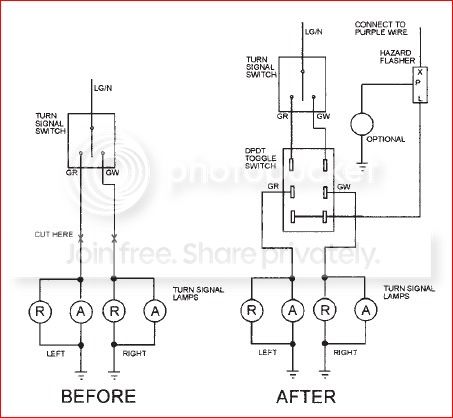
I did not do it to my TR3, but did to my Austin Healey. It required running two extra wires, a electronic turn relay, and a lot of extra time. I found the unit sold by many is not very well made and even after I had it hooked up correctly, the unit itself would not operate 100% of the time. I replaced the unit with another and it works, but there is still some poor connections inside. Look at the attached file for the wiring requirements.

Jerry
 

Attachments

  • 25153.gif
    25153.gif
    2.3 KB · Views: 223
I am not sure my attachement came through. If not, send me a message and I can email it to you. It may be too big a file.
 
Not sure if that is what Jerry means, but all you really need is a DPST (or DPDT) switch and a "heavy duty" turn flasher. Connect one side of the flasher through an in-line fuse to an "always hot" connection (like S1 on the headlight switch or one of the ammeter terminals). Connect the other side to both poles of the DPST switch. Then run a wire from each of the poles to the turn signals for one side.

It's a lot simpler than some cars (including some AH), because the TR has dedicated turn signal filaments.

"Heavy duty" is a synonym for "not load sensitive". You want a non-sensitive flasher, so it continues to flash at the same rate even if a bulb is burned out.

PS, remember to turn off the turn signal switch when using the hazard flashers. Otherwise, the power can feed backwards through the turn flasher and into the ignition circuit. Doesn't hurt anything, just extra drain on the battery. There is a way to prevent this, but it complicates the circuit somewhat (and requires a DPDT switch).

 
Back
Top