I was wondering if I take the head off if I or someone else would be able to determine if the valves were replaced with hardened valves to handle unleaded fuel? Am I correct that only the exhaust valve is replaced? I do know or was told that the engine had been rebuilt in the '80's. If I take the head off is there anything else I should look at doing? 1967 TR4A IRS.


-
 Hey Guest!
British Car Forum has been supporting enthusiasts for over 25 years by providing a great place to share our love for British cars. You can support our efforts by upgrading your membership for less than the dues of most car clubs. There are some perks with a member upgrade!**Upgrade Now**
(PS: Upgraded members don't see this banner, nor will you see the Google ads that appear on the site.)
You are using an out of date browser. It may not display this or other websites correctly.
You should upgrade or use an alternative browser.
You should upgrade or use an alternative browser.
Hardened valves
- Thread starter pacotaco
- Start date

TR3driver
Great Pumpkin - R.I.P
Offline
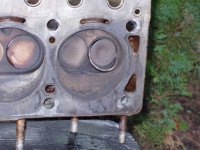
Valve seats, not valves. If they have been replaced, you will probably be able to see the transition between the new seat and the original cast iron head.
In this photo (which has a lot of deposits hiding what we are looking for), the transition can be seen as a line just outside of the dark circle where the seat is severely recessed. (Yes, I had severe valve seat recession <span style="text-decoration: underline">after</span> installing new valves and hardened seats.)

In this photo (which has a lot of deposits hiding what we are looking for), the transition can be seen as a line just outside of the dark circle where the seat is severely recessed. (Yes, I had severe valve seat recession <span style="text-decoration: underline">after</span> installing new valves and hardened seats.)

Don Elliott
Obi Wan
Offline
Between 1990 and 1994 (with a rebuilt engine wirh the original valves and the cast iron head as the valve seats), I had severe valve seat recession in the next 43,000 miles. So I had the insert seats put into the head for un-leaded gas. I also put in 8 new valves and 8 new valve guides and had these honed to the right tolerance.
Since then, I have had no issues with the valves or the seats in another 70,000 miles or so. In fact I hardly find any adjustment is needed for the valve gaps since.
But find a good engine shop to do this to avoid what happened to the TR3A of a friend where a fairly new valve seat fell down because it wasn't pressed in sufficiently.
Since then, I have had no issues with the valves or the seats in another 70,000 miles or so. In fact I hardly find any adjustment is needed for the valve gaps since.
But find a good engine shop to do this to avoid what happened to the TR3A of a friend where a fairly new valve seat fell down because it wasn't pressed in sufficiently.
Attachments
TR3driver
Great Pumpkin - R.I.P
Offline
FWIW, the VSR on my current TR3 motor stopped abruptly when I started adding 1 oz of Redline lead substitute to each tank of gas. Bit of PITA to mess with every time I buy gas, so eventually I'll rework the head, but the substitute does seem to work well for me.

I am building this up from the bare frame but as a driver not concours so I want to take care of things now that I know I eventually would do anyways. I believe I just have to go ahead and pull the head off but it's right there in front of me on the bare frame so now is the time to do it. I'll look at it and if I can't tell about the valve seats I guess I'll find a machine shop that can tell. Should be able to see if it has been machined??? Can't hardly tell from Randall's picture. Any idea what I should be looking at money wise? Would it be worth it to have the head worked on in any other way?

TR6oldtimer
Darth Vader
Offline
Not everyone agrees that there is a benefit to install hardened valve seats. I am one in that camp as was my machinist. I had driven the car for years on unleaded gas and nary a problem.
Now if your valve seats have excessive wear, well then go for it, other wise save a few bucks.
Just my opinion, not asking for a debate.
Now if your valve seats have excessive wear, well then go for it, other wise save a few bucks.
Just my opinion, not asking for a debate.
Don Elliott
Obi Wan
Offline
If you don't change the 4 seat inserts for the 4 exhaust valves, you can drive for several years - depending on whether you plan to do only a bit of driving each year.
You will know that you have a valve seat recession problem when you begin to re-set the valve gaps to 0.010" every thousand miles of so. If you find that every month, the valve gap has closed down to, say 0.001" or 0.002" then the head has to be converted to the new valve seats.
I ran my 1958 TR3A like this for 43,000 miles with no un-leaded additives before I had to change the seats. The valve clearance gaps started closing down rapidly about 5,000 miles before I eventually had them done.
Not only could I see the recession of the seats with the material removed from the cast iron head after I took off the head, but the edges of the valves where they seat were as thin as razor blades and just as sharp.
You will know that you have a valve seat recession problem when you begin to re-set the valve gaps to 0.010" every thousand miles of so. If you find that every month, the valve gap has closed down to, say 0.001" or 0.002" then the head has to be converted to the new valve seats.
I ran my 1958 TR3A like this for 43,000 miles with no un-leaded additives before I had to change the seats. The valve clearance gaps started closing down rapidly about 5,000 miles before I eventually had them done.
Not only could I see the recession of the seats with the material removed from the cast iron head after I took off the head, but the edges of the valves where they seat were as thin as razor blades and just as sharp.
OK now I am confused. I am all about saving money as any of you know building one up from the bare frame gets expensive even if I am not doing concours. I am building this to drive. Daily - no, but I will be in my retirement soon and will drive some and I don't like being out dealing with avoidable problems. (Read that - If my wife is with me and we are breaking down all the time she will lose interest in going with me). So are you guys saying that it is just a matter of time that I will have to do it anyway? Or are you saying I might not ever need to do it? Non mechanic parts changer you are talking to. I guess adding a lead additive is alot cheaper. How much am I looking at to put the hardened seats in? The car has been sitting since the 1980's and shows about 85000 miles which sounds like it could be a accurate figure but the engine was rebuilt supposedly and I wonder why it needed a rebuild with only that many miles.
TR6oldtimer
Darth Vader
Offline
pacotaco said:How much am I looking at to put the hardened seats in? The car has been sitting since the 1980's and shows about 85000 miles which sounds like it could be a accurate figure but the engine was rebuilt supposedly and I wonder why it needed a rebuild with only that many miles.
Not unusual for these cars to need a rebuild at 85K or earlier, especially if not properly maintained, most often like not changing the oil. Even with care, high mileage engine life was not a concern in the 70's.
Oh, on the valve seats, it varies with the shop, but I would guess it is probably in the neighborhood of 60-80 dollars. Not all that expensive, and if you want to do it to sleep better or have more confidence, then it is cheaper now with the head off then later.
Best to talk to your machinest, then go from there.
I just got the head off I don't think it has the hardened seats. I was going to attach a file but it won't allow me to put 2MB in the file and I don't know how to post a picture like some of you do. I guess I will go ahead and have the work done since the head is off now. Cylinder walls look good so I will leave them alone and then probably install the newest rear main seal kit the TRF has. Thanks for everyones help.

TR3driver
Great Pumpkin - R.I.P
Offline
FWIW, I mostly agree with Ray. Whether or not you will see VSR with the original valves & seats depends on a lot of factors. Many, if not most will never have a problem if the engine was ever run on unleaded fuel and you don't grind (resurface) the valve seats. Some don't even have trouble after grinding the seats. I've laid down a whole lotta TR miles on unleaded fuel and only had trouble with VSR twice (once with the head shown above, still not sure what it's problem was) and once with the current TR3 (which may have never been run on leaded fuel, not sure since it was a "barn find").
And as Don's photo so graphically shows, replacing the seats carries a certain amount of risk, too.
Just as a side comment, the piston rings are critical to engine performance, and the cylinder walls won't necessarily show a problem with the rings. They are also a consumable, meaning you know they are going to wear out eventually.
Obviously the choice is up to you and your pocketbook; but my decision would be between only two options : either button it back up with just a new head gasket and drive until something bad happens; or else tear it down, check everything, and replace or remachine anything that is significantly worn.
I chose the first option with my current TR3, mostly because I was impatient to get it back on the road in time for VTR/TRfest. I still plan to rebuild the engine (or perhaps build another one to go in, so I can keep driving the car in the meantime); and I have had a few problems with it; but I am still not sorry I decided to go that way. YMMV of course.
And as Don's photo so graphically shows, replacing the seats carries a certain amount of risk, too.
Just as a side comment, the piston rings are critical to engine performance, and the cylinder walls won't necessarily show a problem with the rings. They are also a consumable, meaning you know they are going to wear out eventually.
Obviously the choice is up to you and your pocketbook; but my decision would be between only two options : either button it back up with just a new head gasket and drive until something bad happens; or else tear it down, check everything, and replace or remachine anything that is significantly worn.
I chose the first option with my current TR3, mostly because I was impatient to get it back on the road in time for VTR/TRfest. I still plan to rebuild the engine (or perhaps build another one to go in, so I can keep driving the car in the meantime); and I have had a few problems with it; but I am still not sorry I decided to go that way. YMMV of course.
I guess I was thinking of where the seal only is replaced with the crankshaft still in place (I think that was done on a Jeep Cherokee 4.0 I had. The new kit TRF has does not need the crankshaft turned down so can you drop the crankshaft enough to put the upper housing of the seal in then bolt it back up? Remember I am a parts changer so sorry if these are dumb questions.
TR3driver
Great Pumpkin - R.I.P
Offline
Nope, doesn't work that way, at least not the first time. The seal conversion involves a new casting and the crank has to be completely out of the way in order to install and correctly position the new casting. (This includes the older conversion as well.)