

-
 Hey Guest!
British Car Forum has been supporting enthusiasts for over 25 years by providing a great place to share our love for British cars. You can support our efforts by upgrading your membership for less than the dues of most car clubs. There are some perks with a member upgrade!**Upgrade Now**
(PS: Upgraded members don't see this banner, nor will you see the Google ads that appear on the site.)

Tips
- We have a special forum called "Member Articles" where you can submit actual articles for consideration for publication. Learn More
- Don't have an Avatar? If not, your avatar will default to the 1st character in your username. Go into "Account Details" to change your Avatar.
- Some basic forum navigation info: click
 Hey - did you know if you click on the title of a thread it will take you to the first unread post since you last visited that thread?
- Hey Guest - Is your British Car Club in our Clubs database? If not, send me a PM - Basil

- Looking for a local club? Click the "Clubs" tab above and browse hundreds of clubs world-wide.
- Add Android or iPhone APP: click
- Did you know - any picture or video you add in your posts in any marque-specific forum will also get added to the Media Gallery automatically.
- A few more tips about posting and replying: click
- Hey there Guest - be sure to keep your profile page up to date with interesting info about yourself: learn more
- More tips and tricks on Posting and Replying: click
 but were afraid to ask:
  STOP!! Never post your email address in open forums. Bots can "harvest" your email! If you must share your email use a Private Message or use the
  smilie in place of the real @
- Want to mention another member in a post & get their attention? WATCH THIS

- So, you created a "Group" here at BCF and would like to invite other members to join? Watch this!
- Hey Guest - A post a day keeps Basil from visiting you in the small hours and putting a bat up your nightdress!
- Hey Guest - do you know of an upcoming British car event?
 Pretty Please - add it to our Events forum(s) and add to the calendar! >> Here's How <<
- Hey Guest - you be stylin' Change the look and feel of the forum to fit your taste. Check it out
- If you run across an inappropriate post, for example a post that breaks our rules or looks like it might be spam, you can report the post to the moderators: Learn More
- If you would like to try some different "looks" or styles for the site, scroll to the very bottom, on the left and click the Style Selector.
You are using an out of date browser. It may not display this or other websites correctly.
You should upgrade or use an alternative browser.
You should upgrade or use an alternative browser.
generator spring
- Thread starter NutmegCT
- Start date


NickMorgan
Jedi Knight
Offline
Tom,
I don't have one and like you say it doesn't seem to do anything. That is a great picture as it confirms that my fast idle connecting rod is in the same position as yours!
Nick
I don't have one and like you say it doesn't seem to do anything. That is a great picture as it confirms that my fast idle connecting rod is in the same position as yours!
Nick
T
Tinster
Guest
Guest
Offline
looks to me like it SPRUNG from nowhere,
does nothing, looks out of place, makes
no sense,is worthless and should go back
from whence it came..
Oh, my bad!
I thought we were talking about my Ee-wife.
sorry. /bcforum/images/%%GRAEMLIN_URL%%/blush.gif /bcforum/images/%%GRAEMLIN_URL%%/hammer.gif /bcforum/images/%%GRAEMLIN_URL%%/hammer.gif
d
does nothing, looks out of place, makes
no sense,is worthless and should go back
from whence it came..
Oh, my bad!
I thought we were talking about my Ee-wife.
sorry. /bcforum/images/%%GRAEMLIN_URL%%/blush.gif /bcforum/images/%%GRAEMLIN_URL%%/hammer.gif /bcforum/images/%%GRAEMLIN_URL%%/hammer.gif
d

trrdster2000
Luke Skywalker

Offline
Over the years I have seen what appears to be a complete waste of time and function, but have enjoyed trying to figure out just what they were thinking and in this case only one thing comes to mind. Check out your leakage or movement in your shaft, my bet is with the shaft pulled down there is less movement, thus a quick fix and they didn't even have to take the carb off. Weird.
Wayne
Wayne

AweMan
Jedi Knight
Offline
That spring doesn`t seem to have much, if any tension on it! In any case it doesn`t belong there.
What function it has/had only the SHADOW knows!
Looks to me like something I would remove but not discard as it might come in handy for another purpose. Probably NOT related to my TR.
But then I`m the packrat of all packrats.
What function it has/had only the SHADOW knows!
Looks to me like something I would remove but not discard as it might come in handy for another purpose. Probably NOT related to my TR.
But then I`m the packrat of all packrats.
its a throttle retun spring..aka ace hardware. OR it could be the rear generator hold position vibration damper spring. What it really is is the accelerator shaft nylon bearings are shot,carb linkage is stiff or return springs are missing or broken,dont blow your engine up get me fixed cheap reproduction option.
its a throttle retun spring..aka ace hardware. OR it could be the rear generator hold position vibration damper spring. What it really is is the accelerator shaft nylon bearings are shot,carb linkage is stiff or return springs are missing or broken,dont blow your engine up get me fixed cheap reproduction option. I use em all the time.

Don Elliott
Obi Wan
Offline
This is how it looks on my 1958 TR3A (TS 27489 LO). It looks like your throttle advance cam is too low - way below the 2nd adjusting screw shown in your photo. When you pull on the choke knob/cable, that cam is supposed to rotate to speed up the engine.
Attachments
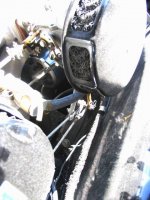
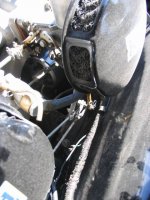
OP

Offline
I figured that spring was bogus. Off it comes tomorrow.
Don - what determines how that throttle advance cam is set? Is there a rule I should follow - or should all "stock" setups be like yours?
I wonder if my current cam setting is the reason my choke cable is nearly impossible to pull. I set the choke manually today (temp disconnecting some linkage) and the car started better than it had since I got it.
Thanks.
Tom
Don - what determines how that throttle advance cam is set? Is there a rule I should follow - or should all "stock" setups be like yours?
I wonder if my current cam setting is the reason my choke cable is nearly impossible to pull. I set the choke manually today (temp disconnecting some linkage) and the car started better than it had since I got it.
Thanks.
Tom

Geo Hahn
Yoda
Offline
Looking at these pics I am reminded we should periodically add a couple of drops of oil to the hole in the back of the generator. Failure to do so may result in a breakdown of the rear armature bearing far from home.
While you've got the minature oil can out... a drop on the ball-n-socket joints in the throttle linkage is good too, keeps them from ovalling out over the years.
Don's photo also shows very clearly the (counter-intuitive) front choke linkage connection I tried to describe in a recent thread.
While you've got the minature oil can out... a drop on the ball-n-socket joints in the throttle linkage is good too, keeps them from ovalling out over the years.
Don's photo also shows very clearly the (counter-intuitive) front choke linkage connection I tried to describe in a recent thread.
Don Elliott
Obi Wan
Offline
As someone mentioned above and George points out about my photo, the sheath for the choke cable is clamped as one would expect. But the rest on front of there in not logical. The pull cable is secured by the hex nut to the rod that then goes through the two branches of the fork, then the rod goes through the lowest hole on the brass piece that pulls down on the choke sleeve. I know this is not logical from an engineering point to have the fork outside the brass piece and I'm still of the belief that mine came with the forks around the brass extension. But TRA knocks off points if it's not done as mine is, so I have changed mine to meet the TRA requirement. Oh yes, it works better too. The way it was originally ? causes the cotter pin on the end of the rod to get tangled with the cotton on the cable harness and being closer to the inner wing, it is harder to pull out on the knob. And it tears up the cable harness too.

NickMorgan
Jedi Knight
Offline
Right, that does it. I'm going out to the garage to have another look at my choke mechanism.
OP
Offline
Nick - please let us know (a pic?) what you find.
It is more *logical* to put that fork around the base of the jet lever arm ... but if I do that the cotter pin hangs in the wiring (as Don's does). If I had the fabric harness cover that cotter pin would cause a *real* problem.
Tom
It is more *logical* to put that fork around the base of the jet lever arm ... but if I do that the cotter pin hangs in the wiring (as Don's does). If I had the fabric harness cover that cotter pin would cause a *real* problem.
Tom
NickMorgan
Jedi Knight
Offline
Tom and Don,
This is what I found. There is no guarantee that it is correct as I did take the carburettors apart about 15 years ago to rebuild them. You can see what 15 years worth of dirt looks like!
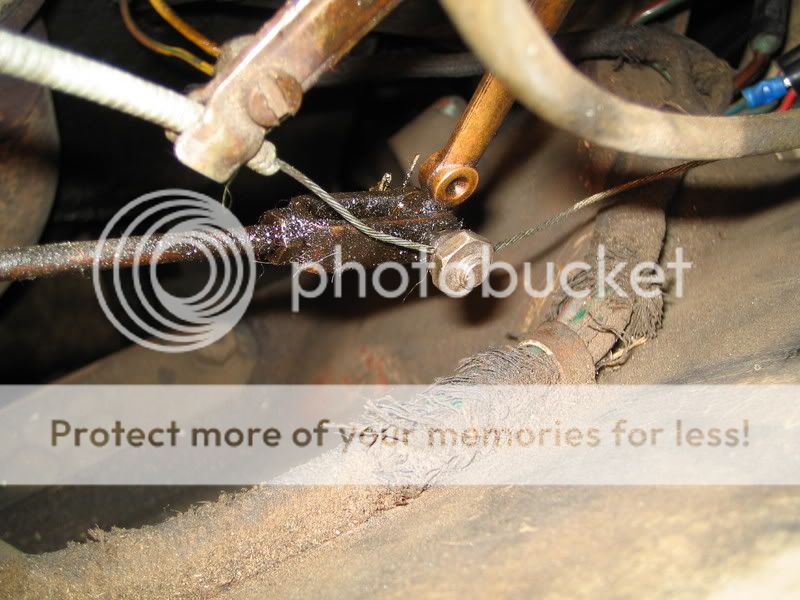
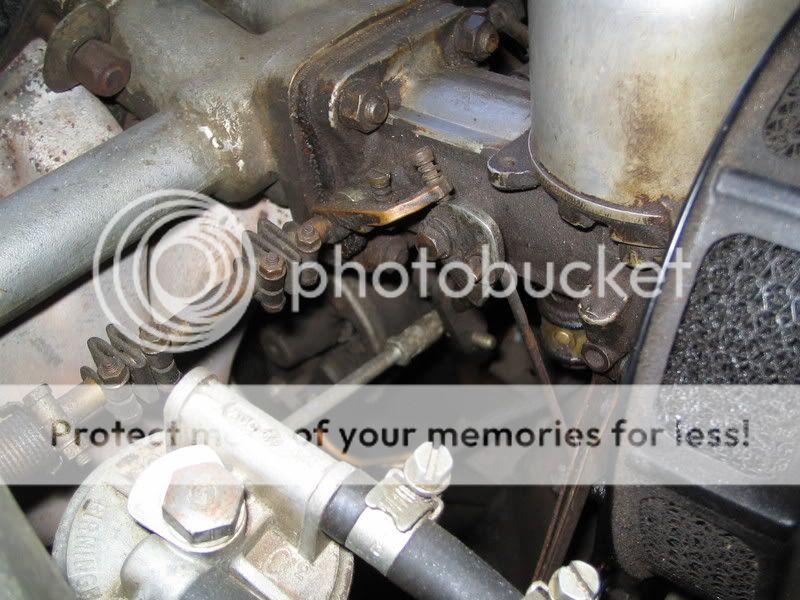
As you will see the jet lever arm is in the middle of the fork, and this is what it is like for the rear carburettor too. Also the connecting rod is in the middle hole on the cam.
I did a little experimenting while I was there as I thought that the cam didn't push the throttle open very far for the fast idle. It only moves the adjuster up about a millimetre. However once the engine is warmed up if I move the throttle that amount it increases the revs quite considerably.
You will see that my wiring harness has also suffered in the past from the end of the choke cable.
I must get around to cleaning up the engine compartment!
(Incidentally Tom, while I was playing around with the choke and throttle I noticed that the ammeter showed about 5 amps with the idle speed at about 1,000 rpm, when I raised this to 1,500 the ammeter needle flicked about between 0 and +30, but beyond 1,500 it showed 5 amps again. Maybe this is a design characteristic!)
This is what I found. There is no guarantee that it is correct as I did take the carburettors apart about 15 years ago to rebuild them. You can see what 15 years worth of dirt looks like!
As you will see the jet lever arm is in the middle of the fork, and this is what it is like for the rear carburettor too. Also the connecting rod is in the middle hole on the cam.
I did a little experimenting while I was there as I thought that the cam didn't push the throttle open very far for the fast idle. It only moves the adjuster up about a millimetre. However once the engine is warmed up if I move the throttle that amount it increases the revs quite considerably.
You will see that my wiring harness has also suffered in the past from the end of the choke cable.
I must get around to cleaning up the engine compartment!
(Incidentally Tom, while I was playing around with the choke and throttle I noticed that the ammeter showed about 5 amps with the idle speed at about 1,000 rpm, when I raised this to 1,500 the ammeter needle flicked about between 0 and +30, but beyond 1,500 it showed 5 amps again. Maybe this is a design characteristic!)

TRclassic3
Jedi Trainee
Offline
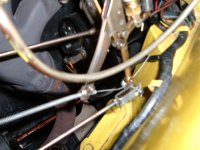
Interestingly, after much investigation this is what my understanding is of the correct conection setup.
What I can attest to is that this arrangement appears to be the cleanest link to the jets, and that it significantly improved on the effort needed to lower them.
What I can attest to is that this arrangement appears to be the cleanest link to the jets, and that it significantly improved on the effort needed to lower them.
Attachments
OP
Offline
Thanks Ed. Are you saying your choke cable was tough to pull with the fork *around* the jet lever, and that moving the fork completely to the fender side of the jet lever made it easy to pull?
(readers can tell I'm really hunting down any clue I can ...)
Tom
(readers can tell I'm really hunting down any clue I can ...)
Tom
TRclassic3
Jedi Trainee
Offline
Tom- YUP! Before I made this change it took both hands and a foot wedged on the dash to get the choke to lower the jets. This change made all the difference.
OP
Offline
Thanks Ed.
Argh. I've got the fork same place you do, and it *still* takes two hands and a foot to pull that cable. I'm not kidding!
Jet levers move easily enough when disconnected from the cable linkage, but sure don't move easily using the cable.
I don't *think* Arthur Ballard wanted it that way back in the 1950s ...
Tom
Argh. I've got the fork same place you do, and it *still* takes two hands and a foot to pull that cable. I'm not kidding!
Jet levers move easily enough when disconnected from the cable linkage, but sure don't move easily using the cable.
I don't *think* Arthur Ballard wanted it that way back in the 1950s ...
Tom