• Hi Guest!
    If you appreciate British Car Forum and our 25 years of supporting British car enthusiasts with technical and anicdotal information, collected from our thousands of great members, please support us with a low-cost subscription. You can become a supporting member for less than the dues of most car clubs.

    There are some perks with a member upgrade!
    **Upgrade Now**
    (PS: Subscribers don't see this gawd-aweful banner
Tips
Tips

Gears do not engage after gearbox O/D refurbishment

BN6_2197

Jedi Trainee
Country flag
Offline
Hi,

I once reported that it does not engage when the engine is warm. This is solved now. I brought the gearbox O/D unit to an expert who restored the unit completely. Since I had also access to the clutch I also refurbished this. While testing the gearbox O/D alone everything worked fine, but I have problems after clutch and gearbox both have been put into the car:
* I cannot engage a single gear when the engine is running
* I have to use a lot of power to engage a gear when the engine is off.


Do you have any idea what went wrong during integration of clutch and gearbox in my BN6? From my point of view it seems that the clutch does not separate engine and gearbox correctly. But I have no idea what could went wrong while putting gearbox and clutsh into my car again.


Thank you very much for your valuable help.

Volker
 
Sounds like the clutch is not disengaging. Lots of grinding in non-synchro gears?
Check adjustment and movement of arm. Then, think about the disc. Not sure on that car, but you put a disc in backwards you can have that exact issue in some makes, if not all.
 
Hi Volker,
I would go with the idea that it is the clutch causing the trouble. Assuming you have an hydralic clutch, I would check the hydralics. the bleeding process and success of the bleeding. Make sure that you can see the throwout bearing arm being moved by the slave cylinder. If it is moving, still make sure that you have a good bleed to ensure the arm is moving enough. If it appears that the throwout bearing arm is moving adequately, then review what you did when you put the throwout bearing in and that you have the clutch installed correctly. But too, since you were able to bolt up the transmissiion to the rear of the engine I would guess that you have the clutch in correctly. Many times if it were the clutch in backwards, when the engine spins the assembly it would make one heck of a noise. Dave.
 
TOC and Dave, are you talking about the release arm? How can I check whether the movement is fine and that I have "good" bleed to ensure that the arm is moving enough?

I ordered a new clutch release bearing since this is the only component which has not been refurbished in the context of the project. Clutch plate and clutch cover have been rebuild.
 
This might be a good time to install a clutch bleeding extender kit (if they're still available). This is a simple kit that extends the clutch slave cylinder bleed nipple into the engine compartment, making bleeding the clutch easier than bleeding a brake cylinder (I've done this in a restaurant parking lot waiting for it to open for dinner).

Don't know if he's still in business, but you could try contacting Doug Reid: mrfinespanner@earthlink.net
 
Remove the gear box cover and operate the clutch, you should be able to see good movement on the fork arm. If you have a left hand drive then use a mirror to view it.

Bleeding the clutch, if required, should be a simple exercise with the cover removed.

:cheers:

Bob
 
It's been sometime since I bled my clutch since the car has been apart for restoration for awhile. But when I found it difficult to bleed the slave cylinder while attached to the bell housing, I removed the slave cylinder from its mounting bolts, kept the hydralic line attached and inserted a rachet socket into the face of the cylinder and clamped it there so that the piston would not move. then went thru the bleeding routine, got all the air out and reattached the slave cylinder to the bellhousing. Dave.
 
Guys,

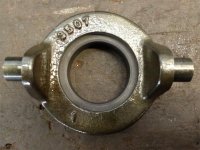
I am getting totally confused now. I ordered a new release bearing meant for a BN6 from Limora, a German supplier:

LimoraAusruecklager-skaliert.jpg

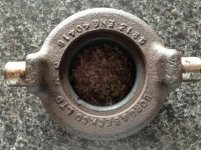
This is the one I have currently in my car:

AltesAusruecklager-skaliert.jpg

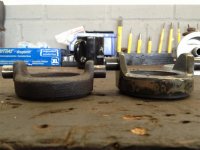
As you can see, they are different in height:

VergleichAusruecklager-skalier.jpg

Should this be the cause of the problem? If so, why could the old bearing work with the unrefubished clutch and the unrefurbished gearbox?

Does anybody know whether the old bearing is meant for Healeys. The number printed on the bearing is "3213 ENG 401416". The number on the new Limora bearing is different.

Volker
 
Don't know exactly. But it is common is other marques to have replacement T/O bearings slightly different.
That said, the T/O is NOT your problem.
Period.

Did you re-bleed?
Did you check the adjustment and throw of the arm?
Now that you have the transmission back out, pull the clutch and carefully look as you remove it to see how the disc was oriented.

Differences in height of the T/O bearing, c/l of pins to face, can be taken up with a clutch adjustment.

Also....I have seen, several times in the past, where new discs are so fuzzy, they will NOT disengage.....clutch down, brakes set, wheels choked, highest gear, and start it.
If the car tries to move but doesn't, good.
Rev it a couple of times and it should burn the fuzz down.

Look to see how the centre hub fits against the flywheel.
If you can lay the disc up to the flywheel and it wobbles, it's backwards.

Generic instructions.

Haven't done a Healey clutch in at least 20 years.
Dave
 
Volker,
I don't want to sound insulting, but are you putting the throw-out bearing in correctly. I'm not sure that it will go in more than one way but the carbon surface has to be facing the pressure plate. (towards the engine). Also, since it has been about 3 years since I looked at mine, I don't remember that the hydralic clutch has any adjustment. The only place it would be would be if the rod attaching the slave cylinder to the throwout bearing fork has an adjustable yoke. I don't remember whether it does or not. I thought mine was a fixed distance piece from the slave cylinder to the throwout bearing fork. So with all the "correct" parts and a good bleed on the hydralics the whole thing works.
If there is no adjustment yoke on the slave cylinder, then a throwout bearing with different geometry might not put enough pressure (or no pressure) on the pressure plate to release the clutch. It would depend on how much travel there is in the slave cylinder piston. If the throwout bearing seems questionable, order one from another known Austin Healey parts place. A. H. Spares ,UK would be one place i think of. Or Dennis Welsh. Or if your old one seems to have enough carbon left in it, use it again. Good Luck.
 
Non adjustable clutches are self-adjusting.
If they do not have an adjustment, and no external retraction spring, the fluid pushes the slave piston out to where the T/O contacts the fingers, and stays there.
If the bearing was installed backwards, with engine running, there would be an instant destruction of fingers on the plate, the T/O itself, and probably the fork.
Those nubs on the back the support the pins would dig right in.
I am thinking back....self adjusting clutches didn't really start until the late 60's in most marques.
My 64 Jag is manual adjustment.
Dave
 
Summarizing all your comments it seems that I have a clutch adjustment issue rather than an issue with the throwout bearing. Of course, I put in the throwout bearing correctly with the carbon facing to the engine ;-) I also bleeded the clutch hydraulics. With another test I observed that the gears seem to engage as expected when I press the clutch only the half way. The test was done without the engine running.

Unfortunately I did not get the clue on how to check the clutch adjustment. What is the procedure and what would be the correct adjustment. Currently the gearbox and the clutch are removed from the car. Please apologize my greenness.
 
Have to have it all assembled for adjustment. You looks for 1" or so of free play at the pedal, tested with your pinkie.
Seriously.
 
Do you have a return spring pulling the clutch arm on the bellhousing forward?
If you do, the adjustment is the rod between the slave cylinder piston an the clutch arm.
Should be a locknut to loosen, and extend the rod until you can feel engagement about 1" down on the clutch pedal.

Could be a bad master, not building up pressure.
Could be a non-adjustable pushrod (for self-adjusting clutch) with the return spring for manual adjustment installed.

When you had this all apart, did you look at the pushrod?
 
Please apologize that I may ask stupid things, but it is sometimes hard to understand your technical terms for a German guy ;-)
Is the "bellhousing" the part of the gearbox O/D unit facing to the engine and covering the clutch cover?
 
I have it currently all apart. Which pushrod should I look at and what is it expected?

The question still remains what changed? As I said all components worked fine together before removing them from the car. Then I decided to refurbish the gearbox since my overdrive did not engage when the engine got warm. Because I had the gearbox removed I also refurbished the clutch. When I put refurbished gearbox and clutch into the car again I faced the problems :-(
 
You put in a new clutch. Hopefully you had the flywheel surfaced. Both of those things can change the adjustment.
I think TR's you can put the slave cylinder on the opposite side of the bell and have rod length issues.

The "bell housing" is that big part that connects the transmission to the engine block, and houses the flywheel and clutch.

It is shaped like....a bell.

The "pushrod" is the only pushrod in the clutch system.
It fits between the slave hydraulic cylinder and the clutch actuating arm, the other end of which retains the throwout bearing.

Question #1: Do you have a clutch return spring that physically pulls the clutch arm towards the slave hydraulic cylinder?

If you do, then:
Question #2: Does the pushrod between the clutch slave hydraulic cylinder have any threads on it?

Followed by Question #3: Did you bleed the air out of the system?

Once air is bled, and the pushrod it lengthened by loosening the locking nut and rotating the halves in opposite directions (and, bear with me, yours may have a clevis on one end that turns on threads on the shaft to lengthen), leaving the spring off momentarily, turn the rod until you have no free play in the clutch actuating shaft, fore and aft, then back it off about a turn (360 degrees).
Then re-install the spring.
Then press down on the clutch pedal with your smallest finger until you feel the play come out of the travel. You'll know it because your finger will bend over backwards.
Do that several times to see how much travel in the clutch pedal between full up and removal or play. Should be about an inch.
Then start the vehicle and try the gears.

Now, you may still have a clutch issue. Broken spring inside the pressure plate. Fuzz on the disc. Disc in backwards. Jammed pilot bearing.

But, you must make sure the hydraulics of the clutch are bled of air and properly adjusted before you make the determination to dig deeper.

Dave
 
TOC
If his 100-6 is like the 1957 `100-6 I am restoring, it does not have any adjustment with the clutch system. The clutch master has a pre-determined length clevis rod so no pedal free play adjustment is possible. At the slave cylinder it also has a pre-made clevis that is not adjustable. The only hope I see is make sure it is properly bled. Sometimes it is necessary to unhook the clevis at the slave and fully compress it into the slave to obtain a proper bleed and get out ALL the air. If the trans has recently been removed then hopefully the tunnel cover has not been installed yet. That will make doing this easy.
JIM
 
That's what I've been asking. The way to tell adjustable and non-adjustable (self adjusting) is the spring. Still haven't got an answer on that.
IF he put a spring in on a self-adjusting clutch it will not work.
Seen it done with exactly these results.
Somebody looks in a parts book, sees a spring on earlier units, puts it in.
If self-adjusting, yes, the fluid pushes the slave piston out (I think I covered that several times two pages back) and fills the void behind the slave piston with fluid.
The working of the clutch, movement of the crank back and forth supposedly pushes the slave piston back in enough that the T/O doesn't drag.
Never liked those. Converted several cars back to adjustable over the years.
The BIG issue with them is that the piston sits out from the bottom.
You mill too much off the flywheel, wrong clutch, you can have a big puddle of brake fluid.

I asked if he had threads on the adjusting rod, too. Couple of times.
You know LBC's.....who knows if it's been converted at some point back to adjustable?
As long as it's bled, and there is no return spring around the cylinder, should release the clutch.

I also asked if he had put the disc in backwards.
Lord Knows I have seen that enough.
Cannot recall if it makes much difference on a new Big Healey...last clutch I did on one was a long, long time ago.
But a backwards disc can, depending on who made the clutch, have a hub that works in one direction, rubs on the crankshaft or the flywheel bolts in the other.

I did ask, while he had it apart, to check, and hold the disc up to the flywheel and see if it laid flat or wobbled.

Dave
 
Back
Top