• Hey Guest!
    British Car Forum has been supporting enthusiasts for over 25 years by providing a great place to share our love for British cars. You can support our efforts by upgrading your membership for less than the dues of most car clubs. There are some perks with a member upgrade!

    **Upgrade Now**
    (PS: Upgraded members don't see this banner, nor will you see the Google ads that appear on the site.)
Tips
Tips

Gauge Placement - ideas?

jjbunn

Jedi Knight
Offline
I'm going to add a couple of gauges: vacuum and Volts (the 2" round variety) and am trying to decide where to locate them.

I certainly don't want to cut holes in the dashboard, and there is very limited space for my legs as it is under the dashboard to allow mounting there.

The dash support console is an ideal place, and I'm wondering whether I could maybe mount the gauges in a box and attach it to where the radio usually mounts (I don't have a radio fitted, and don't think I want one). That would mean finding or making a suitable box, one with an angled front face (so the gauge faces can be seen), and it's not clear how it could be attached anyway, without drilling holes in the dash support (which I'm disinclined to do).

Any ideas on or suggestions or photos of extra gauge mountings would be gratefully received!

(I also asked this over on the sixpack forum.)
 
Julian, doesn't the TR-6 have air vents on each side of the dash, like a GT6??? That's where I placed a Smith's clock and a Smith's vacuum gauge on my GT6. Looked like they were made to be there. The dash vent holes are a perfect fit for the 52mm gauges and look quite original.

I removed the flexible vent material to the dash vents and diverted the heater air (blocked it off) to the foot well vents. The dash vents are essentially useless on a GT6, since they don't flow much air at all, and also the GT6 has very effective vent windows for extra air.

I've also installed a pre-fabbed "extra gauge" dash on a GT6 that I purchased on eBay, it looked great. I haven't seen one for a TR-6, though.

However, I also like your idea of a tunnel support console setup for your gauges, too. It could easily contain two or three gauges. If it's done with an eye toward originality, it would look great IMHO.

Please let us know what you do, with pics. Interesting. I, like you, just love those gauges!
 
hey julian, if you wanted you could remove the amps gauge and replace with a volt gage from a late tr6, thats what i did when i went to a bigger alternator. some wiring changes need to be made, but it wasnt bad. you could also replace the oil and temp gauges with a split oil/temp gauge from an mgb or a that would free up the room to drop in the vac. gauge with no modifications to the dashboard itself.
Randy
 
Great ideas, chaps: thanks very much!

I am a bit of a gauge/control/display nut. If I could find room for a small oscilloscope, I'd do it!

I was also wondering whether I couldn't remove the ashtray on top of the dash, and mount a twin gauge pod there, using the hole for the wire and tube routing.
 
jjbunn said:
I was also wondering whether I couldn't remove the ashtray on top of the dash, and mount a twin gauge pod there, using the hole for the wire and tube routing.
Now we're talking!
You could put the altimiter and rate of climb gauges in there!
 
Just a thought, the 240Z crowd seem to like to mount gauges to the side post of the windshield. You might be able to adapt one of the pods, which I believe are still available.
 
Julian, why add a volt gauge. Just replace the amp gauge with a volt.I did.
 
TR3driver said:
Just a thought, the 240Z crowd seem to like to mount gauges to the side post of the windshield. You might be able to adapt one of the pods, which I believe are still available.

Pillar gauge pods are popular with the Miata crowd also. (Yes, I also have a Miata). The pods are made for many different cars. You just have to find one that fits the general size of the TR6. The Miata one might be close.
 
You could replace the amps with a volt gauge, as Don has done, hard wire and remove the dash light rheostat, and drill a hole for your vacuum gauge.
Joe
 
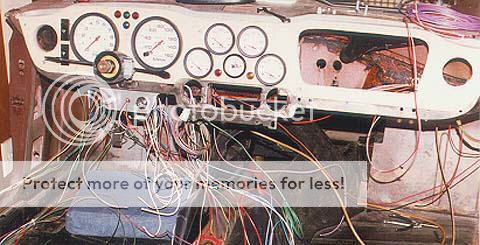
Actually the 5th gauge looks good there.Here's a photo of Dan Master's mock up dash with a 5th guage

DansDash.jpg
 
jjbunn said:
I'm going to add a couple of gauges: vacuum and Volts (the 2" round variety) and am trying to decide where to locate them.

I certainly don't want to cut holes in the dashboard, and there is very limited space for my legs as it is under the dashboard to allow mounting there.

The dash support console is an ideal place, and I'm wondering whether I could maybe mount the gauges in a box and attach it to where the radio usually mounts (I don't have a radio fitted, and don't think I want one). That would mean finding or making a suitable box, one with an angled front face (so the gauge faces can be seen), and it's not clear how it could be attached anyway, without drilling holes in the dash support (which I'm disinclined to do).

Any ideas on or suggestions or photos of extra gauge mountings would be gratefully received!

(I also asked this over on the sixpack forum.)

Julian: I don't think you'd really have to make a box. Why not just make up a plate of ~ 1/8" aluminum to cover the radio hole. Bolt it using the existing hex bolts at the upper corners , with a couple of small clips screwed to the back surface of the plate to slip over the lower edge of the radio slot. I've done something similar to mount a fan switch ,etc. but of thinner gauge mtl. The 1/8'' Al. should support the gauges I would think. Could be painted to match the support, or polished, machine-turned for bling, etc. Jost a thought.

Tom
 
I think that to use the existing support/console I would need to enlarge the slot for the radio, and what I'd like to avoid is doing anything irreversible like that. Likewise for the dash dimmer pot hole, although I think the photo posted looks fabulous.

The gauge pods that mount on the windscreen pillars are interesting, but cable routing down to under the dash would be a challenge to do well.

The point about the gauges not being very visible if mounted down behind the gearstick is well taken: I'd certainly need to have the box use an angled front face, maybe at 45 degrees so that the gauges would be clearly seen from above.

I actually like the idea of having a Voltmeter *and* an ammeter ... after all, they tell you different information :smile:

Many thanks for all the input and ideas.
 
voltmeter vs ammeter.

Information different?
Not really, the condition of the charging system.

To me the voltmeter is more informative, IF YOU"VE GOT A GOOD GAUGE.
It tells you what the system is producing, if it's above 13 volts no problem. If it is below 13 volts, uh-oh. And the wiring to the voltmeter is not nearly as dangerous as an ammeter.

Ammeter wiring carries the main load through the wires(which originally were borderline on sizing, in early 6's) through a gauge and back to the source. If one of the wires goes bye bye, the whole system can go bye bye. Can you say loss of smoke, possible flames.

Every modern mechanic uses a voltmeter as a primary diagnosing tool. Use of an ammeter as a backup tool if the voltmeter indicates a problem and the problem can't be corrected without it.
 
RonMacPherson said:
voltmeter vs ammeter.

....
Every modern mechanic uses a voltmeter as a primary diagnosing tool. Use of an ammeter as a backup tool if the voltmeter indicates a problem and the problem can't be corrected without it.


I don't need no meters, learned a long time ago, head lights dim, no charge.
Head lights bright, over charge.
:jester:

No head lights, Lucas.....
 
Somewhere I have a photo of a gauge pod that sits on top of the dash just ahead of the tray.
 
I disagree: the voltmeter tells you the state of the battery, whereas the ammeter tells you the state of the charging system :yesnod:
 
My $.02 : the ammeter tells you what's happening right now, while the voltmeter tells you what has happened in the past.

Yes, I prefer a voltmeter for trouble-shooting; but I also prefer an ammeter for the dash. Besides, I've never seen a dash voltmeter that actually reads the battery voltage. Instead, at best, they read ignition circuit voltage, which isn't necessarily the same.

And the OEM Lucas voltmeters in particular respond so slowly that, for example, it's nearly impossible to figure out how much engine rpm it takes for the generator to keep up with the current load.
 
TR3driver said:
My $.02 : the ammeter tells you what's happening right now, but I also prefer an ammeter for the dash.

Randal!!

Maybe you can help me? 1969 TR6

I have installed the Dan Masters Power Block wire harness
and a new dash ammeter with 8 ga wires. (Try fitting those beast
wires under the dash and onto the itty bitty 2" gauge!)

Neither Mike nor myself ever figured out where to install the
two 8 ga wire leads comming off the ammeter gauge. Right
now I have them stubbed off and the gauge is non-functional.

Any idea where in the wiring circuit I should install the 2 wires?

Oh yeah, GM alternator conversion as well.

thanks,

dale
 
Hi Dale :

First step always is to remove the ground cable from the battery, and put it someplace it can't sneak back to make contact.

Looking at the schematic posted at
https://aawire.blogspot.com/2005/11/instruction-manuals.html
it should be fairly easy.

You'll need to remove two wires from the starter solenoid, the heavy yellow wire that runs to the alternator, and the heavy yellow/slate that runs to the powerblock module. These wires need to be joined together with one of the wires to the ammeter. This terminal block is one good way to make the connection.

I'm not sure how the TR6 ammeter is marked, but you want the ammeter wire that was brown/white in the original wiring harness. If you don't know which one that was, don't worry. Just pick one for now, we'll sort it out later.

Now the other ammeter wire (brown in the original harness) goes to the starter solenoid terminal where you removed the two wires.

Double-check your work, then temporarily shove the battery ground cable back on it's post. Don't tighten it yet, just push it on for a temporary connection (so you can yank it back off quickly if a "smoke leak" develops). Turn on the headlights and verify which way the ammeter needle moves. It should show discharge. If it shows charge, the wires to the ammeter need to be swapped. Remove the battery ground while you swap the ammeter wires, and try again.

When it's right, check the wires one more time to ensure that they cannot chafe against anything, and tighten the bolt on the battery ground clamp.
 
Back
Top