• Hey Guest!
    British Car Forum has been supporting enthusiasts for over 25 years by providing a great place to share our love for British cars. You can support our efforts by upgrading your membership for less than the dues of most car clubs. There are some perks with a member upgrade!

    **Upgrade Now**
    (PS: Upgraded members don't see this banner, nor will you see the Google ads that appear on the site.)
  • When posting a classified ad, you MUST select a prefix from the drop-down next to the subject line. If you don't you will get an error and your ad will not be posted!
Tips
Tips

Front wheel alignment questions.

V

vagt6

Guest
Guest
Offline
Hello, all. It appears that my front tires are a bit worn on the outside edges which may indicate that my toe-in is off.

BTW, the suspension is tight, no wobbles, rattles and the front wheels have no play.

Questions for the experienced masses out there:

1) Is the Moss "alignment gauge" worth purchasing? Doe it do the job?

2) How many turns of the tie rod end locknuts in order to move the alignment? One flat; two flats???

Anything else I should know about this job?

Thanks, guys!!
 
Two nails and a long piece of 1x2 works if you can be accurate with a saw and hammer, Mark. Much cheaper, too.

The adjustment is less measured in "flats" than in small increments of rotation on the rods themselves. I haven't the reference data here but would expect the toe-in to be no more than 1/16" (1/8" difference between the front lip and the back). Measured at the forward outer edge of the wheel. To avoid having to recenter the steering wheel, turn both rods an equal amount to achieve the proper measurement then lock 'em in place with the nuts.
 
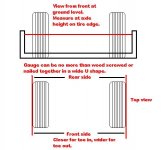
There are numerous ways to check alignment, from the string method to use of a simple toe gauge. Personally I like a simple U shaped toe gauge as I can set it up quickly and easily use it myself without help. I don't like the Moss gauge as it's design really seems to rely on a lot of operator adjustment to make sure the angle pointer is correctly set against the tire to get an accurate reading. I prefer a comparison reading from both the front and rear of the tire and comparing the two, that eliminates any uneven wear on the tires from factoring in. What you are determining is the difference between the width of the tread at the front and rear sides of the tire at axle height. As stated above about 1/16" to 1/8" toe in is the norm, most cars's I've dealt with over the years call for about 1/8" toe in. Toe out is preferable for a lot of autocrossers and some racers as it promotes more rapid turn in when cornering, but for the street I'd stick with toe in. Here's a simple drawing showing the basic process.
 

Attachments

  • 18231.jpg
    18231.jpg
    32.6 KB · Views: 174
Back
Top