• Hi Guest!
    If you appreciate British Car Forum and our 25 years of supporting British car enthusiasts with technical and anicdotal information, collected from our thousands of great members, please support us with a low-cost subscription. You can become a supporting member for less than the dues of most car clubs.

    There are some perks with a member upgrade!
    **Upgrade Now**
    (PS: Subscribers don't see this gawd-aweful banner
Tips
Tips

TR2/3/3A Early Lockheed Master Cylinders

CJD

Yoda
Country flag
Offline
I have 2 master cylinders for the TR2. They are frozen and really rusty. Now I've been boning up on them and figured out that both of the ones I have are 5 screw aftermarket replacements instead of the original style 4 screw cylinders. So now I have a choice.

The aftermarket, non-original MC's are still available new. No rebuilding, and I know they will work with no effort on my part. I can go this route, but they are noticeably NOT like the original with only 4 screws holding the top on.

I can also get an original Lockheed MC off EBay. The catch there is they are all advertised as "frozen". Having attempted rebuilds on frozen hydraulics, I fear this could be bad. As in, very bad. Re-sleeving the bores is no big deal for a decent machine shop...but that is only if the pistons can be removed at all. And, if the pistons are trash, are they even available?

I would prefer to rebuild an original MC. But does anyone have experience with these once they're frozen to give me some insight into how bad they can be...and parts availability?
 
FWIW, I believe it was Lockheed that changed the cover pattern to 5 bolts, because the 4 bolt covers always distorted and leaked. That soft "pot" metal just wasn't strong enough to hold a gasket with so little support. (Even the 5 bolt covers are somewhat troublesome from what I hear.) So perhaps it wouldn't be quite so bad to use the later improved cover.

Sorry, the only one I've owned wasn't stuck, so no experience getting them unstuck. But some of the things I would try are:
1) Soak in PB Blaster for several days or weeks. It will slowly attack and dissolve the original seal.
2) Use a BFH and suitable punch to drive the piston back into the body, against the spring. With any luck, you'll find a place where the spring will push the piston back out. Keep working it back and forth, pushing against the spring and then letting it move back, until it frees up enough to come out.
3) If the spring won't move it back out, pressurize the outlet with first compressed air, and then grease from a hand grease gun (which can develop a lot of pressure). Try working the piston around that way.
4) If you can get it out far enough that the air or grease starts flowing into the reservoir, but still can't get the piston out, build a steel cover for the reservoir and pressurize it as well.
5) Or, as a last resort, drill and tap the piston for a threaded rod puller.

I don't see replacement pistons available anywhere; but they don't look too hard to turn on a lathe.

PS, before doing step 5) above or maybe even before 3b), you might try building something that would expand and lock inside the existing hole in the piston. I'm thinking maybe some 10-32 threaded rod or a long 10-32 SHCS with nuts, flat washers and an O-ring or two. Then use that to pull on the piston.
 
Thanks Randall. That's about how I figured it will go. At any point something can go wrong that turns the MC into scrap. I missed the bid on the cheap Ebay MC. The only other one is $200....and still frozen at that price. I went ahead and ordered the aftermarket for $90.

I'll still keep my eyes open for an original MC to play with...so if anybody finds one, please let me know!
 
Quick update...with some info for anyone following my route.

I picked up a "correct" four screw master cylinder from Marv. I also received the 5 screw repo MC off Ebay. At first I was bummed that I spent money on two, but it turned out for the best.

The original came with 2 different pistons. One was correct, but the other was apparently from a long since discontinued aftermarket rebuild kit. There are no seals available for the aftermarket piston. And, after 2 days of intense searching, it turns out the original pistons are completely and forever, NLA. That means I had seals that won't work with the piston...or a piston that won't work with the seals. Either way the situation was untennable.

When it became desperate, I took apart the 5 screw repo MC, for lack of any other ideas. I had planned to use the Repo as a backup, or possibly "re gift" it back to Ebay. For once, it worked out. The repo has the "correct" style 7/8" pistons that will take either the NOS seals or the readily available new replacement seals. Hurray for that. The 5 screw repo MC even has a fairly accurate steel filler cap. So the cost of the repo MC became justified. More hurrays!

Now I am down to the problem of the bores in the original MC being rust pitted. It may work as is, but I have decided to have the bores sleeved. It sounds like it's pretty common, but this will be my first time having it done.

Has anyone had MC's sleeved, and have any tips? Bronze vs stainless...the best way to find a shop that will do it...or things to watch out for?
 
I think the place was called Apple hydraulics in NY. They at least use to rebuild all kinds of British stuff. I have had some really stuck hydraulics come apart with heat. I guess the heat burns the rubber apart.
 
The early Lockheed MC that came with my car had already been resleeved and I rebuilt from that point on. Think these guys did the resleeve https://www.whitepost.com (NFI) as I found an old receipt in one of the boxes of parts. Mine was redone in bronze (not stainless anyway). Have also used Apple Hydraulics on some TR6 stuff. Cheers, Mike

image.jpg
 
John
Do contact me on some of these things. I have a couple more early type MCs, I haven't looked to see if they are 4 or 5 screw tops. All that I sent you were cleaned and boxed up from PO. Bet I can find you an original piston.

Marv
 
Mike, thanks for the tip...I'm all set, now. I have the MC on the way to White Post Restorations. They sleeve the bores and replace all the internals, including the pistons. It even carries a lifetime warranty when they send it back. Best of all, the price is half what the local machinists were going to charge for just the sleeves!

So, to recap....in 2014. You can get repro Master cylinders with not correct 5 screw lids for as low as $90 on EBay. They are actually pretty decent, and they even take the original seal repair kits. From the big three, the identical MC goes for about $300.

Seal kits now days run from $20 to $129. From what I can tell they are the same, regardless of price.

A complete rebuild of your original MC by White Post Resto in Va runs $225. They turn a boat anchor into a lifetime guaranteed MC in 3 days. Local machine shops want about $350 just to sleeve a double cylinder.

So the TR2 pedals and MC are taken care of. Time to reach my hand into the parts pile and see what comes up next to work on. Thanks again to all of you for you inputs! SP, I did not get a response from Apple hydraulics, so I'm not sure if they are still doing our MC's or not, but thanks also for the lead.
 
Last edited:
John, glad that worked out for you. Will be interested to hear what you think of the rebuild. Three day turn around is great. Cheers, Mike
 
Still waiting for the MC to return home. In the mean time, I'm stuck on the Master Cylinder pushrods. Here is what is going on:

I have 4 pushrods. All 4 have a large hole on one side, and a small hole on the other. The pins that came with the rods do not seem to match. Since the rods had 2 size holes, I originally assumed the pins had to have a step so as to be larger at the base than at the tip. I spent several hours studying parts diagrams and pictures online. Now I don't know what the pins are supposed to look like.

The parts diagram shows a plain pin with a spring on the cotter key end. The pictures on VTR have a plain pin with no spring. If it is a plain pin, why is the hole on one side of each rod larger than the other side...that won't work with a straight pin??

Can anybody with knowledge of the original Lockheed enlighten me on what I am looking for for the pushrod pins?
 
John, I ran into the same issue. Not near car/home just now, but I will check when I get home and try to sort out what I did and post some pictures. I think I finally bought some clevis pins and had then "stepped" at a local machine shop. Cheers, Mike
 
John. Found some pictures. As I said I had this part made from a clevis pin (rough sketch attached). I ordered new pins from TRF originally but they were not stepped. I don't think I used a spring. Cheers, Mike


Thanks Mike!

I was hoping for an easier answer, but I'd rather do it right like you did. I ordered the pins from the only supplier that still lists them...VB, but I bet they arrive as just straight pins with no steps. All four of the pins that were in the rods I have were also straight. I think that accounts for the severe wallowing out of the pin holes.

I'm envious at how round the holes in your rods are! I will need to weld plugs into my rod holes and then re-drill the holes to eliminate the wallowing. By then the pins should be here and I'll decide whether to fashion stepped pins, or just drill the holes the same size.

Thanks again!
 
John, if you are going to make replacement pins, might you be able to drill out the holes in the rods just slightly to make them round and then get pins to fit slightly larger holes? Of course, you could drill out the smaller hole to same diameter as larger one and go with a straight pin. I almost did that but was stubborn enough to try making the stepped pin.

Tim, No idea about those rings. Fortunately there were four in the boxes of parts my car came in.

Cheers, Mike
 
Apparently I have that stubborn streak too! Your idea would have been much easier, although I'm not sure there is enough meat in the pedal levers to open them up too much. What I have done is take 2 of the pushrods, welded and drilled them for 9/32", which is what was in the pedal levers. I left the best of the pushrods original, so I now have 2 original and 2 for straight clevis pins. It was a pain, but now I am ready for whatever type pin VB sends.

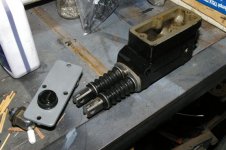
This is one of the wallowed out pushrod holes


After plug welding the hole


And these are the finshed rods, along with the pins that they came with. The re-drilled rods are on the left, with the still wallowed original rods on the right. You will notice that 2 of the pins are those screw-in types used on the handbrake forks. They are why I was really confused, as the larger hole almost took the threaded portion of the screw in pin, but was not threaded.


Tim, I don't have the boot retainer rings either, but I find that the boots are made such that they stay in place without the rings. I'll keep looking and let you know if I find a source for them...
 
The original pushrods were non adjustable and used a plain clevis pin. However, these have been unavailable for many years, so are sometimes replaced by later adjustable length pushrods which use a different pin.

With adjustable length pushrods, the larger hole in the fork is threaded. This accepts a stepped pin with a corresponding thread on the large diameter side. The pin has a coil spring which creates tension to stop it rotating freely. They are slotted on the large end for a plain screwdriver, and also have flats for a small spanner.

Viv
 
Thanks, Viv. That explains a lot. So, it looks like I have the older pushrods, and somebody tried using the later, screw-in pins, with them.
 
Viv, the pushrods on my early 56 are non adjustable and the holes were definitely different diameters and the larger one was not threaded. Wonder if they originated elsewhere or there is yet another variation in the configuration?

John, nice work. You have lots of options now.

Cheers, Mike
 
Hi John, thanks for the reply, yes I will be checking around too... it seems saddle or hand bag supply companies sell metal rings but I haven't tracked down the exact size yet...
 
Back
Top