
• Hey Guest!
    British Car Forum has been supporting enthusiasts for over 25 years by providing a great place to share our love for British cars. You can support our efforts by upgrading your membership for less than the dues of most car clubs. There are some perks with a member upgrade!

    **Upgrade Now**
    (PS: Upgraded members don't see this banner, nor will you see the Google ads that appear on the site.)
Tips
Tips

Crankshaft end float????

Gliderman8

Great Pumpkin
Gold
Country flag
Online
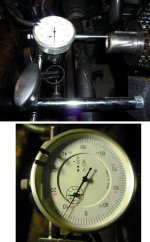
I am in the process of replacing the front oil sleeve and oil seal. While the timing cover is off, I decided to check the end float.
It measures about .009 (.0085 to .009) of travel.
Is this something I should be concerned about?
If I have to correct it, is it a big undertaking?
The car by the way is a '73 TR6. Thanks for your input!
 

Attachments

  • 24265.jpg
    24265.jpg
    61.5 KB · Views: 502
Just the "what's- a -call it's "
tween the bearings
 
I have a 73 TR6 also.
When I changed out all the bearings I also replaced the thrust bearings that control the end float.
ISTR that the float is supposed to be about 4 thou, putting new bearings in brought it back to that exactly.
In my opinion for 9 thou it's not worth tearing apart to change them; if you're in there doing something anyway then you would change them.
If you do decide to change them make sure you put the new ones in the right way round.
Changing them is simple enough, drain everything, drop the sump, unbolt the rear main bearing cap to access.
 
According to the manuals the end float spec is .006 - .008. Mine was at .012 when I changed them and still in place. Went with the bronze alloy thrust washers made by Scott Helms, and after doing the math to select the correct oversize rear washer shooting for .005 end float, wound up at .004. After a few hundred miles, it is currently at .005.
 
simpson said:
According to the manuals the end float spec is .006 - .008. Mine was at .012 when I changed them and still in place. Went with the bronze alloy thrust washers made by Scott Helms, and after doing the math to select the correct oversize rear washer shooting for .005 end float, wound up at .004. After a few hundred miles, it is currently at .005.

Any contact info for Scott Helms?

Don- What is the correct one?... Do you mean thickness?
 
AltaKnight said:
In my opinion for 9 thou it's not worth tearing apart to change them; if you're in there doing something anyway then you would change them.
:iagree:

If it gets to twice that, then it's worth dropping the pan for just that. (Then you might as well do the rod bearings while the pan's off.)
 
Thanks for your advice everyone!
I will finish up the job I started (replacing the oil sleeve and seal) then decide whether or not to drop the pan.
It's probably not a bad idea to have a look while its up on jackstands and its too cold to drive anyway!
 
If you do change them it's best to replace the aluminum crank block with the steel one. I don't have a link handy, but I'm sure it's not hard to find.
 
Thanks Keith... as a matter of fact, I already have the steel block sitting on my bench.
 
I just did mine and measured .010" end float and the old TW both measured .092". I sent the info to Scott Helms and he recommended going with .097" for the rear and staying with .092" for the front which will give me an end float of .005".

I'll also be installing Marc Goldblatt's steel saddle block when I put everything back together. Be forewarned that it's very difficult to get the old aluminum block out without destroying the front plate gasket. I tried and failed so that meant pulling everything off of the front.
 
TR3driver said:
AltaKnight said:
In my opinion for 9 thou it's not worth tearing apart to change them; if you're in there doing something anyway then you would change them.
:iagree:

If it gets to twice that, then it's worth dropping the pan for just that. (Then you might as well do the rod bearings while the pan's off.)

Agree completely. The loads on the thrust bearings are minuscule compared to the loads on other bearings, mains, rods, and cam. They should be the last things to go. Unless you know that the above-spec end float was caused by a poor rebuild in the past, too much end float would probably indicate that more bearing work will be needed. It is unlikely that dropping the pan to fix just end float would make much sense.
Tom
 
BobbyD said:
Be forewarned that it's very difficult to get the old aluminum block out without destroying the front plate gasket. I tried and failed so that meant pulling everything off of the front.

Thanks for the "heads-up" on the front plate gasket. I have everything removed up to the plate at this point since I'm doing the front oil seal... maybe I should just bite the bullet and remove the front plate now so I don't have to do it all again.

Don- I did send Scott an email about his thrust washers... thanks.
 
Elliot- Might as well get the new steel sealing block that is on the market. Good investment
 
I don't know if you'll messup the front engine plate gasket or not. I've removed 2 sealing blocks without even removing the front engine plate and done no damage.
On the other hand you may have to replace Moss# 697-490.
The only reason I can think of to consider the steel sealing block is if you've already stripped threads in the aluminum. If you haven't already stripped them, just don't in the future and you'll be just fine.
Why over torque in the first place ?
I think there are 24 or 25 bolts holding the sump in place, overtightening those 2 aren't going to stop a leak from the timing cover.
 
poolboy said:
Why over torque in the first place ?
I think there are 24 or 25 bolts holding the sump in place, overtightening those 2 aren't going to stop a leak from the timing cover.
:iagree:
Overtightening is more apt to <span style="font-weight: bold">cause</span> a leak (or make an existing leak worse) than to stop it.

FWIW, although I don't work on TR6 motors, there is an equivalent block on the TR3. To replace it without doing the front plate, I just trim the gasket off neatly and then butter the block with Hylomar (or your favorite form-a-gasket).
 
Back
Top
