

-
 Hey Guest!
British Car Forum has been supporting enthusiasts for over 25 years by providing a great place to share our love for British cars. You can support our efforts by upgrading your membership for less than the dues of most car clubs. There are some perks with a member upgrade!**Upgrade Now**
(PS: Upgraded members don't see this banner, nor will you see the Google ads that appear on the site.)
You are using an out of date browser. It may not display this or other websites correctly.
You should upgrade or use an alternative browser.
You should upgrade or use an alternative browser.
Clicking sounds
- Thread starter doughairfield
- Start date


TR3driver
Great Pumpkin - R.I.P
Offline
 Back off the adjuster as far as it will go. Sometimes it also helps to tap the slave cylinder around a bit. Rarely, I've had to really beat on the drums to move the shoes away enough to get the drums off. Hit the cylindrical part, not an edge or corner (otherwise you may chip or crack the drum). Some blows on the face may help too, if the drum is rusted to the hub.
OP

doughairfield
Jedi Trainee
Offline
Ok, good to know. So the drums do have a fair bit of rust on the surface. Do you recommend any type of treatment on them to remove it and then painting to prevent? Or just live with it.
TR3driver
Great Pumpkin - R.I.P
Offline
Personally, I've just always lived with the rust. I've tried "high temp" rattle-can paint in the past, but it seems to burn off anyway. Might try some high-temperature powder coating if the time seems right, but I'm usually in a hurry to get the car back on the road and my wheels don't let the drums show much. I've never replaced a drum because it was rusty, so I regard it as purely a cosmetic issue. (Some 'moly' spray on the hub will help the drum come off easier next time.)
No doubt others will have some suggestions, though.
No doubt others will have some suggestions, though.

CinneaghTR
Jedi Warrior
Offline
I've had Eastwood's brake drum paint on for two years and they still look new.
I'm still investigating my clicks...
I'm still investigating my clicks...

bgbassplyr
Darth Vader
Offline
2 screws AND back off the brake adjusters. Drum will sometimes hang up on the brake shoes. Release the emergency brake. Drum sometines will rust onto the axle, so whack it with a rubber hammer (gently at first, but harder if required), first at 12 o'clock, then 6, 3, and 9. Repeat as necessary. Cotter pin and nut to remain in place.
G
Guest
Guest
Guest
Offline
Click Beetles. Nasty little buggers. :hammer:
OP
doughairfield
Jedi Trainee
Offline
I pulled the passenger side caliper off last night and spun the wheel, very smooth, no grinding. When the caliper was on, it was grinding pretty bad. So bad in fact that with the wheel off, it was very difficult to trun the hub. Is it possible the brake calipers need to be rebuilt? It seems like the pads are partially engaged all the time on the front wheels. I do know that the master cylinder leaks a bit, but a couple pumps on the pedal and it's fine for a while.
TR3driver
Great Pumpkin - R.I.P
Offline
"Grinding" suggests that the caliper itself is dragging on the rotor (unless your pads are shot). Perhaps the shims are missing?
Also, does your car have the residual pressure valve in the top of the 4 or 5 way connector? It's function is to keep some pressure in the brakes all the time, but sometimes they get gummed up and keep too much pressure. One way to check would be to crack open the bleed screw and close it again, see if that affects how much the rotor drags.
Or it could be a stuck caliper, as you say.
Another possibility might be mismatched components. Your car should have the later 10.75" rotors I believe, but early TR4 used the same 11" rotors as the TR3/A/B. The early rotors might hit the calipers on later cars.
Also, does your car have the residual pressure valve in the top of the 4 or 5 way connector? It's function is to keep some pressure in the brakes all the time, but sometimes they get gummed up and keep too much pressure. One way to check would be to crack open the bleed screw and close it again, see if that affects how much the rotor drags.
Or it could be a stuck caliper, as you say.
Another possibility might be mismatched components. Your car should have the later 10.75" rotors I believe, but early TR4 used the same 11" rotors as the TR3/A/B. The early rotors might hit the calipers on later cars.
OP
doughairfield
Jedi Trainee
Offline
The pads seem to be fine. I'll have to look at a diagram to see if the shims are missing, I admittedly am not that familiar with disk brakes.
I looked in there this morning and could not see the caliper anywhere, the pads just seem to loosely float in the caliper. I'll have to recruit some help tonight to step on the brake and see how the pistons react.
I have not found the 4 or 5 way connector, is that near the wheel or near the master cylinder?
I looked in there this morning and could not see the caliper anywhere, the pads just seem to loosely float in the caliper. I'll have to recruit some help tonight to step on the brake and see how the pistons react.
I have not found the 4 or 5 way connector, is that near the wheel or near the master cylinder?
TR3driver
Great Pumpkin - R.I.P
Offline
The shims I was referring to would be between the caliper and it's mount. They were an "as required" item, so not all cars have them. But many more cars had them originally, there is a strong temptation to misplace them when reinstalling the calipers, because they can be er, difficult, to replace.
I'm not sure just where the 4/5 way connector is on a TR4. From the diagram tho, it looks similar to the TR3 location, which is on top of the frame somewhat behind where the RF suspension is attached to the frame. If you trace the line from the brake MC, it goes into the top of the connector (which went from being a 5-way to a 4-way when the brake light switch was moved from there to the pedal box at CT22712).
Hmm, I thought the RPV was discontinued during the TR4 run, but it appears I was mistaken. My catalogs seem to indicate it was either at the introduction of the 4A, or during the 4A.
I'm not sure just where the 4/5 way connector is on a TR4. From the diagram tho, it looks similar to the TR3 location, which is on top of the frame somewhat behind where the RF suspension is attached to the frame. If you trace the line from the brake MC, it goes into the top of the connector (which went from being a 5-way to a 4-way when the brake light switch was moved from there to the pedal box at CT22712).
Hmm, I thought the RPV was discontinued during the TR4 run, but it appears I was mistaken. My catalogs seem to indicate it was either at the introduction of the 4A, or during the 4A.
OP
doughairfield
Jedi Trainee
Offline
I found the connector, it is behind the front passenger side, on top of the frame. It is the 4 way, with a 5th point for what I assume is the brake light.
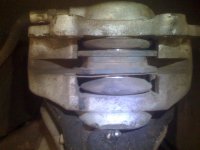
Here's a pic of the caliper. Can you tell me if you see the shim?
Also, after pressing the bake pedal a few times, the caliper engaged, but then never seems to disengage, and I can't push it back in. It's the one on the bottom of the picture. Is this normal?
I don't see that pressure valve anywhere on the 4 way connector.
Here's a pic of the caliper. Can you tell me if you see the shim?
Also, after pressing the bake pedal a few times, the caliper engaged, but then never seems to disengage, and I can't push it back in. It's the one on the bottom of the picture. Is this normal?
I don't see that pressure valve anywhere on the 4 way connector.
OP
doughairfield
Jedi Trainee
Offline
bgbassplyr
Darth Vader
Offline
Pedal should not,IMHO, be depressed when the caliper is off. This is because the two pistons will not move in unison, one of those path of least resistance things. The result is one of the pistons may be pushed out of caliper. It appears that you have one very close to being 'out'.
I suggest that you open the bleeder to remove fluid resistance, and carefully try to pry the pistons back into the caliper. This will have to be done carefully and with even pressure on the piston so that you don't 'cock' it going into the bore. As you push on one, the other will try to come out of its bore. Need at least 3 hands, but 4 would be better.
I think the shim you are looking for can be found between the mounting ears of the caliper and the vertical link. If you had one, it should have fallen out when you removed the two mounting bolts. It's function is to center the caliper over the disc. Without it, the inside half of the caliper will (could) be closer to the disc than the outside half. As shims are added, the inside half will move, by the thickness of the shim, away from the disc and the outside half will move closer. Just add or subtract shims until the caliper is more or less centered, that is so that the disc is centered in the caliper slot.
Don't know if any of this is understandable but I hope it helps. Would be better if I could draw a picture, but alas.....
I suggest that you open the bleeder to remove fluid resistance, and carefully try to pry the pistons back into the caliper. This will have to be done carefully and with even pressure on the piston so that you don't 'cock' it going into the bore. As you push on one, the other will try to come out of its bore. Need at least 3 hands, but 4 would be better.
I think the shim you are looking for can be found between the mounting ears of the caliper and the vertical link. If you had one, it should have fallen out when you removed the two mounting bolts. It's function is to center the caliper over the disc. Without it, the inside half of the caliper will (could) be closer to the disc than the outside half. As shims are added, the inside half will move, by the thickness of the shim, away from the disc and the outside half will move closer. Just add or subtract shims until the caliper is more or less centered, that is so that the disc is centered in the caliper slot.
Don't know if any of this is understandable but I hope it helps. Would be better if I could draw a picture, but alas.....
TR3driver
Great Pumpkin - R.I.P
Offline
Shouldn't happen if you still have the bleed valve open. Of course that means you will have fluid running all over the place, which isn't such a wonderful thing either.bgbassplyr said:As you push on one, the other will try to come out of its bore.
Even if the piston isn't out far enough to cock and bind, they frequently won't move with just finger pressure. If you can pry between the tabs and force it back in; it's probably OK. Then use a big C-clamp or similar to hold that piston back while you extend and retract the other one. That should help work some fluid between the seal and piston, which will help them work easier.
OP
doughairfield
Jedi Trainee
Offline
Re: Clicking sounds - SOLVED
AGH, I wish I could say it was something more clever than what I'm about to write. I had both front wheels off, and put the caliper back on the passenger side. I notice that one of the pins holding the brake pad on had some strange wear on it. I then noticed that the rotor also had a strange wear pattern, the top quarter inch and never been touched by the brake pad, and I could feel a scrape as I turned the hub and the rotor came by the caliper. I went to the other side and the disc was worn all the way to the edge. Then it hit me, I remember reading in the Moss catalog, you could get an 11" of 10 3/4 inch rotor for the TR4, but you had to have the right caliper for each. I measured, one is 10 3/4 and the other is 11 inches. as the 11" rotor turned with the wheel, a high spot on it was hitting the caliper, at speed it sounds like a click.
So, I'll be changing 2 perfectly good rotors out next weekend b/c one is the wrong size.
AGH, I wish I could say it was something more clever than what I'm about to write. I had both front wheels off, and put the caliper back on the passenger side. I notice that one of the pins holding the brake pad on had some strange wear on it. I then noticed that the rotor also had a strange wear pattern, the top quarter inch and never been touched by the brake pad, and I could feel a scrape as I turned the hub and the rotor came by the caliper. I went to the other side and the disc was worn all the way to the edge. Then it hit me, I remember reading in the Moss catalog, you could get an 11" of 10 3/4 inch rotor for the TR4, but you had to have the right caliper for each. I measured, one is 10 3/4 and the other is 11 inches. as the 11" rotor turned with the wheel, a high spot on it was hitting the caliper, at speed it sounds like a click.
So, I'll be changing 2 perfectly good rotors out next weekend b/c one is the wrong size.
TR3driver
Great Pumpkin - R.I.P
Offline
Re: Clicking sounds - SOLVED
You could have also read that in this thread; I mentioned it above.doughairfield said:I remember reading in the Moss catalog, you could get an 11" of 10 3/4 inch rotor for the TR4, but you had to have the right caliper for each.
OP
doughairfield
Jedi Trainee
Offline
Re: Clicking sounds - SOLVED
You are completely correct on that, I can't believe I missed that line, sorry.
You are completely correct on that, I can't believe I missed that line, sorry.
OP
doughairfield
Jedi Trainee
Offline
Re: Clicking sounds - SOLVED
Ok, last question. When I pull the hubs off to change out the rotors, is there any special consideration I need to give to the inner and outer bearings? I assume the outer one will have to come off when I pull the hub off, but the inner one should not have to come off. Is there any special procedure when when the outer one comes off?
Ok, last question. When I pull the hubs off to change out the rotors, is there any special consideration I need to give to the inner and outer bearings? I assume the outer one will have to come off when I pull the hub off, but the inner one should not have to come off. Is there any special procedure when when the outer one comes off?