• Hey Guest!
    British Car Forum has been supporting enthusiasts for over 25 years by providing a great place to share our love for British cars. You can support our efforts by upgrading your membership for less than the dues of most car clubs. There are some perks with a member upgrade!

    **Upgrade Now**
    (PS: Upgraded members don't see this banner, nor will you see the Google ads that appear on the site.)
Tips
Tips

Charging System Failure

Well, note that it is normal for the needle to bounce around under some circumstances; generally lower rpm (below about 2000 engine rpm) where the generator output is just slightly more than what the regulator is calling for. Also be sure to check for any loose connections at the generator or control box; or any damage to the wires between the two. The 'Lucar' connectors on later cars are particularly suspect, IMO.

Next you can try a light cleaning of the regulator (not cutout) contacts. (Unless you are having "red light" problems, I'd suggest leaving the cutout relay alone.) I soak a piece of common newspaper with carb cleaner, open the contacts (engine stopped), slide the paper in, then let the contacts close against it and pull the paper out. Repeat at different places (or additional pieces) until the paper comes out clean. Then try again.

If the ammeter still jumps around when it shouldn't, then it's probably time to disassemble the regulator relay and clean the contacts thoroughly. I use a "relay contact burnishing tool" (available from any good electronics supply store, not Radio Shack); but fine emery cloth will do if you have it. Just be sure not to use other types of abrasive (like the more common aluminum oxide cloth) as they can supposedly damage the contacts.

The workshop manual has the adjustment information, so does this booklet https://docs.google.com/file/d/0B2H...NDNmLWI0YTYtNjY5ZjQxZTA2NGFm/edit?usp=sharing

Since you've had the regulator apart to thoroughly clean the contacts, the first step (given later in the books for some odd reason) is to do the mechanical adjustment. In the Lucas book (link above), the regulator adjustment is on page 8 (unless you have a very early car with the RB106/1 regulator, page 7).

Then follow the voltage adjustment (page 6).
 
:fat:please allow me control of my original thread for this final report.

Well we spent a couple of hours Thursday evening removing the failed generator and installing the backup. The backup runs great.

Autopsy Report

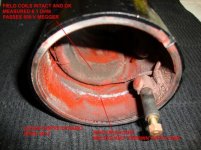
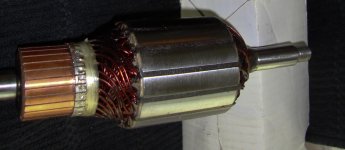
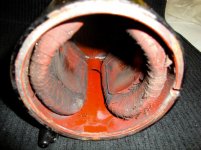
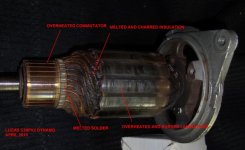
As far as the bad one goes, the armature got completely toasted and roasted. The copper winding got so hot that the insulation is burned black! The silver solder which connects the windings to the commutator got so hot that it melted producing a solder ring around the inside of the yoke.

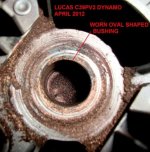
The shaft has a distinct wobble and I believe the rear bushing failed because it was not properly oiled. The hole in the bushing is now egg shaped and that end of the shaft is not round anymore!

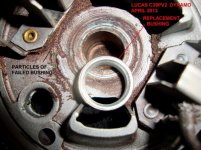
The unit was serviced by an auto electric shop a few years ago and put in storage until we needed it. Our theory is that they forgot to soak the 'oilite' bronze bushing in oil prior to installing it. This caused premature bushing failure and subsequent failure of the commutator, arcing, high temp, ect, etc. Too bad because this particular shop had done several dynamos and starters with excellent results. Note: The replacement armature came with a steel replacement bushing. We do not intend to use this and will fit a proper 'oilite' bronze type.

This failure spared the field coils which measure in spec at 6.1 ohms. I meggered (500 volt) the windings to earth and they pass.

Obtained a new armature (Lucas India) plus bushing and brushes from Moss USA to put in this unit and use for a spare.

Additional thoughts: The suspect solid state regulator was a red herring. There was never anything wrong with it. It was returned to Wilton who tested it and verified it as OK. However, a clarification is in order. When I first spoke with the people at Wilton Auto Electric, I made an error in describing my dynamo as a C40. This resulted in a current limit setting of 22 amps. My C39 has a maximum capacity of 19 amps. Thus the regulator was set to allow a 16 percent overload which probably helped to cook the unit.

Here are some photos.
C39PV2 Dynamo Failure-R2.jpgC39PV2 Dynamo Failure-8-R2.jpgC39PV2 Dynamo Failure-10-R2.jpgC39PV2 Dynamo Failure-2.jpgC39PV2 Dynamo Failure-11-R2.jpg
 
Interesting. I take it the other end of the pole pieces (the one not visible in your photo) were also torn up?

I've run them until the armature was dragging on the pole pieces, but the racket was fairly extreme. Many years ago, I recall my wife resting in the shade while I fought with that bearing and filled the gap with paper torn from a McDonald's cup found along the road! Strictly Mickey Mouse, but it got us home to change the bearing.

Also a good time to point out that you are supposed to oil that bearing every 6000 miles. I bought an oil can with a long spout just for that purpose.
 
Interesting. I take it the other end of the pole pieces (the one not visible in your photo) were also torn up?

I've run them until the armature was dragging on the pole pieces, but the racket was fairly extreme. Many years ago, I recall my wife resting in the shade while I fought with that bearing and filled the gap with paper torn from a McDonald's cup found along the road! Strictly Mickey Mouse, but it got us home to change the bearing.


Also a good time to point out that you are supposed to oil that bearing every 6000 miles. I bought an oil can with a long spout just for that purpose.

Yes, but not too bad and perhaps could be re-built.

C39PV2 Dynamo Failure-9.jpg
 
Yeah, that's not bad at all. Almost makes me think that the overcurrent was the main contributor to the overheating; I don't see how there could have been much heat generated from the armature rubbing on the pole pieces without getting the poles at least hot enough to discolor the paint. But likely they both contributed.

And I know from bitter experience that just a little extra current can cause problems exactly like the others you described. Thrown solder, blackened wires, etc. There was a time, many years ago, when most of my disposable income was going into rebuilt generators!

I had turned the adjustment up, trying to keep the battery better charged in the winter time. Eventually I realized why that was a bad idea :smile:
 
So, then you can decide whether to replace generators or batteries!:smile:
Yeah, I got really tired of having to charge the battery every day before I could drive to work. That's why that car wound up wearing a 60 amp Ford alternator. Fortunately now, "winter" is 50F and dry so it's much less of an issue. Don't even have the wipers and heater installed!
 
Back
Top