
• Hey Guest!
    British Car Forum has been supporting enthusiasts for over 25 years by providing a great place to share our love for British cars. You can support our efforts by upgrading your membership for less than the dues of most car clubs. There are some perks with a member upgrade!

    **Upgrade Now**
    (PS: Upgraded members don't see this banner, nor will you see the Google ads that appear on the site.)
Tips
Tips

Cam shaft early demise

2wrench

Luke Skywalker
Country flag
Offline
I received a line drawing with engine parts for my engine
rebuild. I took a photo for reference. It will follow.

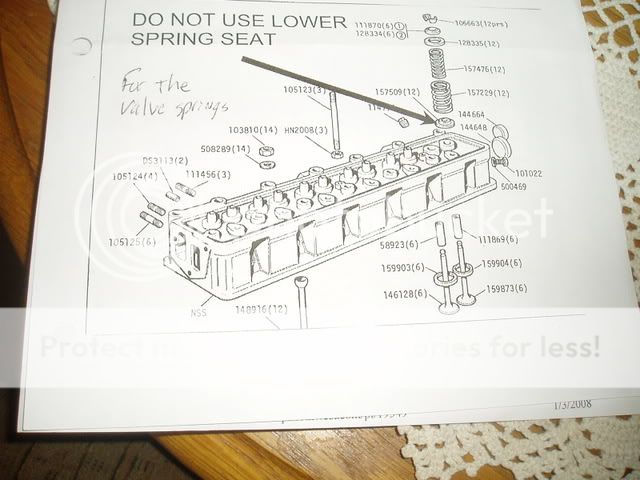
Note in big letters: "DO NOT USE LOWER SPRING SEAT," with
an arrow pointing to the part not to install.

Now, I did shave the head down to increase compression.
Got different springs for the head (which are larger than
were stock) to go with the upgrade.

See the line drawing now to show what not to install
when the larger upgraded springs are installed in lieu
of the OEM's:
P1010001-16.jpg


Out of abundance of caution, I visited the machine shop to
view the head and verify that these parts were not on my
head.

Now the plot thickens as follows:

"2WRENCH Question: So what happens if these little do-dads
(spring seats) get installed with the longer springs?"

"MACHINIST Answer: Excessive pressure from the springs
causing excessive wear on the cam shaft and valve train
parts."

Okay. I aint gonna say this is it, but doesn't this sound
familiar to anybody.....say.....Bill, maybe?

So the line drawing spring seat looks different than the
originals that came off my head (poor drawing? Different design?) Don't know.

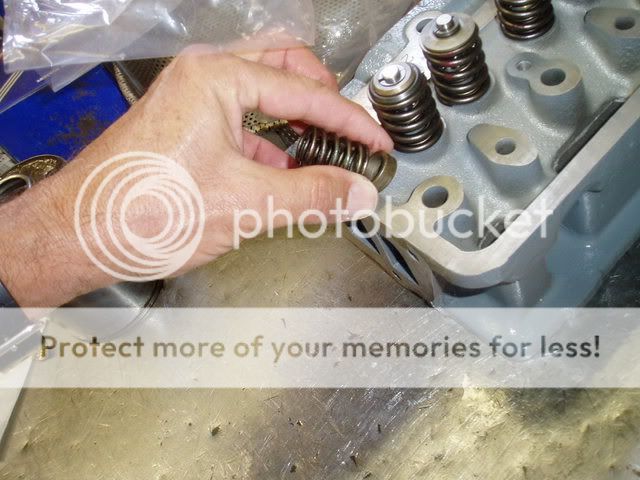
Here is a photo of my rebuilt head (no lower spring seats).
Just the new upgraded springs.
P1010004-15.jpg


I am holding an old spring with the spring seat to show
the heights are equal from old install to new install.

Possible Conclusion?

If new upgraded (larger springs) are installed and the
old lower spring seat is reinstalled as well....could
result in too much spring pressure and undesirable/excessive
wear to cam shaft and valve train parts.

Something to consider.
 
Reaching, really reaching.

The wear that was shown to the cam lobes and lifters is NOT what you will experience with excessive spring pressure. And the wear on the cam lobes will take a LOT longer to occur with excessive spring pressure. Plus, how much increase in spring pressure is being incurred.

The spring seats purpose is to provide slight rotation on the spring which will get transferred up to the keeper/retainer and turn the valve stem slightly in the guide. Helps prevent burning of the valve.

Modern engine design(well modern still including tappets and pushrods) has pretty well done away with spring seats.

Have you ever seen a cam lobe "rounded" off. Or what was called a "flat cam". Kinda like someone took the cam lobe and held it up to a bench grinder.

What TR6Bill encountered was pitting and galling, which is a metallurgical problem, usually brought about by a lubrication failure. Either metal treatment improper or lack of SUFFICIENT lube to the metal contacting surfaces.

Have you seen the mail trucks over the last few years. The little white USPS trucks. The ones that are on Ford Explorer chassis?
Well, FoMoCo just spent a massive amount of money repairing the engines on those... Low mileage but the engine bearings, crank journals, cam journals, and lobes suffered accelerated wear. One would wonder how that occurred because the usage of the delivery trucks sure wouldn't fit in anyone's mind as being harsh. But that's exactly what happened.


The trucks would be driven from house to house, engine idling extensively, then heavy throttle to the next stop. Even though oil changes were being performed every 6 months, the engines were being beat to death. THE oil was NOT sufficiently capable of protecting the engine.

So after Ford spent big bucks repairing, replacing the engines, they have upgraded the oil used by USPS trucks..

HTH.
 
Depending on the number and diameter of the spring coils on the new springs the collapsed spring could be longer than the space available when the valve is open if the seat is installed. This is called spring bind and can destroy the valve train quickly.
 
With a high lift cam I think you are flirting more with failure from coil bind rather than cam wear issues. There is just so much space for the coils to fill before disaster strikes. Any extra wear from increased spring pressure will not manifest itself for 1000's of miles. Once on my Chevy, with extra strong springs the pushrods got a habit of pokeing THROUGH the stamped steel rockers waaaay before I finally lost a cam lobe. Bob
 
Depends on the rockers too... High dollar ones are almost always made from milled aluminum.

When I had my Small Block Chevy dynoed, the guy doing it asked if I had removed the inner springs in the coils. This is done to lessen the load on the cam during break in (and hopefully, avoid wiping lobes). They should be reinstalled post break in and before doing a full pull.

I'm not sure how much of that is useful information, but if there have been a bunch of wiped cam lobes, then perhaps it's time to consider removing the inner springs during break-in.

Rob
 
Interestingly, the machine shop that is overhauling my head called today and said the spring pressure they measured was way low of what it should have been. Go figure. Now, these are new double high performance springs. Went ahead and ordered new ones from Ted Schumacher. Should have about 80 lbs at rest, up to 170 under full load. I am in a conundrum.
 
Bill,

Was that reading low for the stock cam or for the higher lift GP-2?
 
Didn't mean to suggest this was it at all, but it
sure did ring in my ears when I heard it, so I
thought I'd share and ask.

I suppose too little pressure could also be bad.
That sounds reasonable. Too much, too little.

This is what happens when we stray from OEM, huh?

Oh, well, I've jumped in. You know it's a stretch
for me.

My son gives me a hard time for going with stock
parts all the time. Guess I wanna make him proud.
 
I concerned about the valve springs now that my head was cut for 9.5 CR. All old parts were reused including the spings, seats and keepers. The only tests were 5.5k RPM's on the dyno. It did not come apart and there was no valve float. I hope the OEM springs are not too tall when the head is cut to 9.5 CR.
 
vettedog72 said:
I concerned about the valve springs now that my head was cut for 9.5 CR. All old parts were reused including the spings, seats and keepers. The only tests were 5.5k RPM's on the dyno. It did not come apart and there was no valve float. I hope the OEM springs are not too tall when the head is cut to 9.5 CR.

Did you use shorter pushrods?
 
vettedog72 said:
I concerned about the valve springs now that my head was cut for 9.5 CR. All old parts were reused including the spings,
Milling the head for compression has no effect on correct spring length. But reusing old springs can be a mistake, especially when doing a performance rebuild. They definitely get 'tired' over time, and even sometimes break.
 
When I put it back together, I did not change the OEM pushrods. It took some real effort to teach me why it was necessary and I still appreciate piman's patients through my education. Geomertry was not my favorite subject but I see the light with shorter push rods if you cut the head. I'm thankful it will not over compress the valve springs, right? :confuse:
 
We're talking THOUSANDTHS here. Sure your geometry will be off a little with a head milling but be realistic, unless it's an all out racing engine running at consistently mega revs the engine will never notice. On my 1300 Spitfire, some rediculous mill job of around .25, stock pushrods, stock rockers, five seasons racing and never a valve train problem . If you don't have valve bind forget about it. I think sometime we collectively overthink things. Bob
 
Bob Claffie said:
Sure your geometry will be off a little with a head milling
I disagree. Head milling doesn't even change the valve/rocker geometry on engines like ours with fixed rocker pivots. All that stuff about shaving the heads changing geometry comes from engines where the pivot moves to adjust the valves (which includes most American V8s).

For our engines, you only need shorter pushrods if you run out of valve adjustment. Even then it doesn't change the rocker/valve geometry, just allow you to set the valve clearance.
 
My head is shaved to get a 9.5:1 cr and I used shorter, custom made chromoly pushrods.
 
Mine was only cut and cc'd to 9.0 and I was at the end of the adjustment on my stock rods. I ordered the .120" shorter rods for the new engine due to more being removed from the head and the block.
 
If you drove the car or ran the engine to break in the new camshaft with an oil that was low on Zinc, it may have been the oil that ruined the parts.
 
TR3driver said:
Bob Claffie said:
Sure your geometry will be off a little with a head milling
I disagree. Head milling doesn't even change the valve/rocker geometry on engines like ours with fixed rocker pivots.
Depends on whether the lash adjuster is on the push rod end or on the valve stem end of the rocker arm.
D
 
Back
Top
