• Hey Guest!
    British Car Forum has been supporting enthusiasts for over 25 years by providing a great place to share our love for British cars. You can support our efforts by upgrading your membership for less than the dues of most car clubs. There are some perks with a member upgrade!

    **Upgrade Now**
    (PS: Upgraded members don't see this banner, nor will you see the Google ads that appear on the site.)
Tips
Tips

TR2/3/3A Buffing out paint.

.... I sanded the run with some very wet 1000, and the run came right out no problem, so then I sanded the dull areas also with 1000 wet and they came out, and it looked like things were going good, so I started to buff with the 3M Finesse ll to see where I was at. The problem I am having now is the orange peel looks to be very deep and is not coming out. However, at the run area where the orange peel was just as deep and I sanded more it looks like more of the orange peel came out. I am not sure what the problem is, but my gut tells me to wet sand the fender more with 500 or 1000 a lot more ...
If the runs came out with #1000 then you surely don't need (and definitely don't want) to sand the orange peel with #500. What kind of sanding block are you using?


...The pros I watched only used 600 grit, and then went right to the buffer....
That was common a long, long time ago when finer grit abrasives weren't common and very soft paints like lacquers and high solvent enamels were.

Nowadays you only see that in high volume collision repair where they get paid by the job, not the hour and quality expectations are very low. They'll cut any corners they can knowing that few customers can tell the difference.


.... Working through 600 to 1000, 1500, etc. is just a technique I started picking up to reduce the buffing time. ...

It also raises quality substantially. Which is why every paint manufacturer calls it out in their process instructions.
 
What I used was 1000 paper folded around a rectangular very soft wet sponge. I tried to free hand the paper but was getting very small lines from the edge of the paper; they came right out, but that is what moved me to the sponge. The product information sheet says 16 hours at 70 degrees to polish and put into service, so I believe the paint is cured. Today I am going to use the 1000 again and just do more work with it and change the paper more and then try some more buffing. I did however use too much buffing compound, so maybe that is why I am not cutting down. I laid a pencil size bead about 6 inches long which is a lot more that suggested. Coming in at 10:00 o’clock made the compound stay on the panel better

The paint must be soft because the run came out with not too much work, maybe 5 minutes. Perhaps the sponge block is too soft and I should try one of my soft blocks to get the high points off the peel more evenly. I went with the sponge because of the constant water coming out plus I felt it would have less of a chance cutting into curve on the panel.
 
PC...I’ve never seen process instructions. Is that different from the data sheet? I’ve been using PPG with the DCU clear for a decade or so. On those data sheets it says when you can buff, but doesn’t specify any paper recommendations. Am I missing another sheet...I love studying tech sheets!?!
 
I said process instructions as a sort of generic way of referring to wherever the manufacturer chooses to put that info. It's often in the data sheets but not always. Some manufacturers put in in separate publications and some seem to leave out bits here and there. There's no consistency across the industry or sometimes even across product lines from one manufacturer.

As you point out, PPG doesn't even mention sanding in DCU data sheets. But in the sheet for DC CeramiClear they call out P800 - P1200.
 
The 3M Finesse ll part number I am using is #39003. It came highly recommended for what I am doing.

Good luck, hope it works out. Keep us posted.

Interestingly, If you do a search for 39003 on 3M's website, nothing shows up in the way of instructions or technical descriptions. Only the SDS comes up.

The only thing even vaguely resembling something useful I found was the short description at detailing.com:

Description:


3M Finesse-It II Finishing Material Machine Polish, 39003 - 16 oz.

Is an entry level machine polish designed for us on OEM and fully cured automotive paints. Removes microfine scratches and swirl marks while leaving a high gloss finish. Quickly and effectively removes minor scratches, producing a brilliant, deep, wet look shine. For best results use by machine. Contains no wax or silicone and is clear coat safe.

Directions:


  1. Shake container well before using.
  2. Apply enough polish to work a 2' by 2' area
  3. Polish area using light to medium pressure. Reduce pressure as material begins to dry and polish to a high gloss.
  4. Remove spatter from adjacent panels before polishing the next panel.
 
Well things were going kinda good on my sacrificial panel, but not perfect. I sanded 2 more times with the 1000 paper and buffed. This time I cut the paper into an oval shape so not to have any edges. Then sanded by hand. I got some areas to look perfect with no orange peel and high gloss, but in one spot I got some paint build up and sanded again and buffed again, but this time I started going through. I could see some gray shadow it would no show in the pictures.

I took the panel outside from the well light garage to see better and in the sun light the panel looked excellent other than the burn through and the spot I missed in the initial painting, so the panel will be a re-spray, but again it only had 2 coats because I ran out of paint and it had a run, so I knew I was in trouble, but did not I could fix it!

On the next one, I will start sanding with 1500 or 2000 to knock the paint down like John suggested using the oval shaped paper because I was able to get an evener dulling of the finish that way. You are correct bnw it is so painful to take the shine off, and thanks bnw for your story I was able to work that in and gain some knowledge and comfort.
Moreover, thanks PC for the 10:00 clock tip and info page that sure saved some material flying around the room.

My foundation is still rocky but that is better than sand, and I might be getting it a little, but every time I thought that I had it, I would burn through or something. So John what causes “Orange Peel” anyway too much air pressure, crappie paint, not moving fast enough when painting or all the above?
 
Well, on the bright side, that panel should be perfect after the next spraying!

The short answer for orange peal is the paint is drying on the panel before it has an opportunity to flow into itself. The cause can be simple, or complex...

1). If you are spraying dry, by having the paint control turned too low or wrong air pressure.
2). Moving the gun too fast, or at an angle other than perpendicular.
3). Painting with too cold of a reducer (cold is designed to evaporate quicker than warm reducers).
4). Painting in too high a temperature or spraying in direct sunlight.

It could be one or all of the above causing your peel. I would start by carefully reviewing the data sheet for your paint, to make sure your reducer is correct for the temperature you will spray, your tip is in the recommended size range, and your air pressure is good with the trigger pulled.

Remember Low Pressure High Volume is a bit of a misnomer. The low pressure is at the tip, but hose pressure will still be considerably higher. I run 90 psi in the hose, all the way to the gun. I then use a small regulator at the gun inlet. The small reg reads 90 when the trigger is off...but with the trigger pulled I adjust to read 16-22psi. That number usually comes off the data sheet. If there is no number on the sheet, then I default to about 20 psi.

If you get the above dialed in, then you should have eliminated every issue down to your spraying technique.

I always start my spray by having a cardboard box or the like to set up the spray pattern and paint amount. Use the box to set the paint control to the speed you want to comfortably sweep each pass over the panel. If you use a round pattern, you get a lot of paint on one spot. If you add air to the fan control, then the paint will reduce, so you have to bump it back up. When all is good, you should be able to move at a comfortable speed across your work, and leave a nice, wet stripe.

Keep the gun perpendicular as you sweep along the panel. Plan ahead how you will work edges and all in. If you do an edge, and immediately do the adjacent panel, it will leave a lot of paint and may cause a run. So, I often run the edges and then step back for a couple minutes before laying the main panel. You can see you have to plan the panel before you start your spray.

With non-metallic paint, like you are using, you can paint all panels laid flat, which will reduce runs. With metallic paint you should orient the panel the way it will sit on the car, so the metallic chips set the same way. Solid colors can be painted at any angle, so flat often makes sense...
 
Well a couple of things jump out about my application of the paint. I am using a 1.2 tip and the sheet says to use between a 1.3 and 1.6—I do have a 1.4. I am also using about 25 to 29 psi into the gun after the trigger is pulled and 80 to the gun. I have the same set up as you with the 2 psi gauges. I will take your advice because there is something wrong with my technique. The paint work I put down looks more like hair follicles in skin; you know those little tiny holes where the hair comes out, so basically it is a dimple in the paint with a high spot. My temperature is 70 degrees and the sheet suggests, between coats 5 -10 minutes at 70 so I should be good there and I am out of the sun.

Next time I spray I will use the bigger tip and slow down the air flow. I have put the panels vertical because I felt I could get the paint gun perpendicular to the work better that way. However, my gut tells me something like the panels at a 45 would be the better of 2 worlds because I could see the edges better and not have to bend down as much for the longer panels. I enjoy this work but wish I would has started it at 25 not 65

Ah the base coat- clear coat sounds like the way to go. However, I will say I see these new cars like the Fiats around town and they have that solid enamel look like I was going for and liked. Deep down I knew I would never get this the first time. I have been a journeyman too long for that and built too many things. The Buddhistic principle of the experience having the real value is a truth for someone like me. It is odd however that I still take a set back with such personal impact. A collaborator once told me that the pain of failure and joy of success are the same thing; they are both perfectionism.
Peace out
 
See...small tip and a bit high on the air pressure likely solves the problem. Just be ready, as you will have more paint laying down faster than you are used to once you set the tip and pressure. When right it will lay down with an orange peel at first, but the paint will be thick enough to flow out into itself within 5-10 seconds. So it will always lay with the orange peel, but the key is that it should be just wet enough to smooth out right after.

If you lay a stripe and then watch closely, you will see it flow out smooth. If it doesn't, you can make another quick pass immediately to give it a bit more volume to aid the flow. Also, if don't see if flow out...then you need to up the paint control and/or slow your speed across the panel.

When you get just the amount to get it to flow out...then do NOT be tempted to add more!! That's when you get the runs (no pun intended). I can't tell you how many times I had a dry spray...then upped the amount and resprayed, so it looked So much better!!...and then thought, if it worked once, lets add some more!?!...only to get a huge slow motion run!! Bummer. So, just enough to get it to flow, but not more than that until you wait your 10-15 minutes between coats.

Good lighting is really important...and I find more so as my eyes get worse. I used to be able to see a light spray on , say, an edge. Now days I have to study the tricky areas up close with coke-bottle lenses to make sure I didn't miss a spot. Getting old sucks...but it's better than the alternative?!?

You are almost to the point of bringing it all together, so don't think you can't have a great finish...look how far your bodywork came in a short time!!

Oh, a couple more things that may, may not help:

My personal "comfort speed" when spraying is about 1 foot every second. So if I start on a 3 foot door, I start the spray about 6 inches off the panel, once I hit the panel I could count thousand 1, thousand 2, thousand 3, and I am off the panel and stop the spray about 6 inches after. I pause for time to think about the next line, and then repeat in the opposite direction...spray, 1, 2, 3, past and release. This is just to give you a reference until you find your own comfort speed.

I usually start spraying too thin (since runs are worse in my mind than orange peel), so after the first pass, look at your line and see if it is flowing correctly. If it is I keep going. If not, I dial up the paint...re-run that pass faster (since it already has paint), and then re-check the flow. Run the next adjacent pass, study it, and so on...until you are happy the paint is going down just thick enough to flow, but no more.

You do have a decent "spread" between flow and run with most paints. And that is fortunate! Many times you can't help doubling a pass over an area, especially when some intricate body lines come together. The area around the rear bumpers comes to mind...you have to spray in a couple different directions to get everything, and therefore some of the passes end up over-lapping. I'd estimate the "spread" between flow and run is about half an average pass, if the flow and speed is right. So I double my arm speed over the intricate areas to allow for the overlap...and often lay a couple fast passes rather one normal. Hope that makes sense?!?

Anyway...enough for now...Good luck and Godspeed John Glenn!

 
Cutting and buffing paint is still un-mastered by me anyway. The use of enamel probably was not my best choice either, but I never figured I would get the body as straight as I did. Anyway if you look at the picture of the hood you can see some stripes on the passenger side. One guy tells me I need to use cutting compound and another guy tells me to keep using 1200 paper and sand down and buff and sand down and buff, but the going is very very slow. My question is what and how do you cut. I mean everyone calls it cutting and buffing, so I am thinking on the other panels I should maybe try some of this cutting compound, but it sounds like I could do real damage at least I can see the possibilities of cutting through to primmer because I have will the paper. . Just looking for suggestions.
 
When you hear “cut”, think “wet sand”. 1200 will not remove the dry areas very fast. About 5 minutes with 600-800 would equated to about 30 minutes sanding with 1200. Start slowly with 600-800 around the worst spots. Work up to the 1200 right before firing up the buffer.
 
"Cutting" is just common slang for using an aggressive compound. So there isn't "a" cutting compound. There are lots and lots and lots of them. And I'm sure many of them could be useful to you when used with the right buffer, pad and technique.

Everybody has their favorites. Which is why you may be getting conflicting recommendations.

I may be off base, but I'm getting the impression that you may be getting too much advice from too many people (myself include). Some of these folks may be giving you bad advice. Some may be giving you good advice for what they think you need but may or may not represent what you actually need. Some may be giving you good advice that may or may not play well in conjunction with the advice others are giving you.

My advice would be stand back and take a deep breath.

Then, when you come up with an idea of how you want to try to proceed, try it out on a very small area, what we call a "test spot," to see if it works. The test spot should be small, no bigger than about 1ft x 1ft. And you should not do any larger an area until you have the whole process, beginning to end, dialed in. After and only after you have a working and efficient process should you start replicating it on the rest of the car.


I take it the "stripes" are from sanding in long, straight lines? What paper (brand, product name, part#) did you use?

I apologize, the earlier post where you mentioned that started sanding with a soft sponge and then switched to no block didn't really sink in to my brain. Now that my brain is back on line I need to say that that's not the best technique. Your fingers are not flat. As you sand some areas with get higher pressure than others and cause the grit to dig in, making deeper scratches that are harder to buff out. Sometimes you can literally get ghost images of your hand showing up as holograms in your finish. The sanding blocks they make for this process are dense, stiff, closed cell foam.

Assuming the stripes are sanding scratch, some possible causes could be the aforementioned fingers, sanding with too coarse abrasives, sanding with common general purpose abrasives (as opposed to specifically engineered finishing abrasives), not progressing to fine enough abrasives, using an insufficiently aggressive compound, using a pad that's not well matched to the compound, using the wrong buffer speed, etc, etc...
 
Oh, and another tip,

When hand sanding, especially when doing your test spots, sand along only one direction with each grit.

Let's say you trying three grits, a, b and c. If you sand side to side with a, up and down with b and at a 45 degree angle with c, any residual scratch left over after buffing with tell you exactly which steps worked and which didn't.

And never hand sand in a circular motion. Circular scratch doesn't buff out cleanly.
 
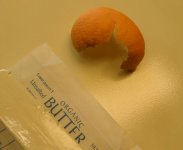
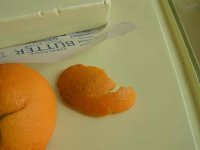
Since we've established that you're probably getting too much input and advice, I'll chime in too. -I have only painted one car, and only used base-coat/clear-coat but I had a very good coach living across the street. He made it clear to me that the difference between a $2,000 paint job and a $20,000 paint job is not the paint, prep or ability of the painter. It's the way the paint is finished -or- what he called 'color sanding'. I had tons of orange peel because I was unable to do at least one of the things mentioned by John. But I put enough paint down, that it could all be sanded flat and polished smooth. His approach was to wet sand with finer grit until a wet spot lost all shine,including the low spots (of the orange peel). Always use a small flexible sanding block and keep it wet. Keep changing out the water when it gets cloudy from constantly rinsing the paper. Keep checking for 'all dull' surface because you don't want to go farther than you have to. Tape off all corners, edges and do them last and very carefully. I 'color-sanded' areas less than a foot square at a time. Most people think I paid much more than $2,000 for my paint job -but it took time.

You are on track. It looks great.
 

Attachments

  • smooth_as_orange.jpg
    smooth_as_orange.jpg
    33.5 KB · Views: 105
  • butter_orange.jpg
    butter_orange.jpg
    31.5 KB · Views: 106
All good advice.

But I do have to disagree with the idea that "the difference between a $2,000 paint job and a $20,000 paint job is not the paint, prep or ability of the painter. It's the way the paint is finished." I believe every step counts.

I've seen many defects that couldn't be fixed after the fact. For example, I see a lot of finishes where there are defects below the the base coat, usually from sanding primer or filler with too coarse paper or before the layer has set. If there's a problem below the base coat there's nothing you can do to the top coat to fix it.
 
I believe every step counts.

I totally agree. I could have said that better. Each step is as important -no amount of color-sanding will take the warp out of a panel, or hide poor body work. But given a perfect body or perfect body work... that being said, a better painter would have had to spend much less time removing the orange peel that I had. But (I think) even the best painters know how to 'fix' their imperfections.
 
Thanks for the encouragement you guys; I really appreciate it. The strips are from the paint gun; they have been there all the time. Maybe I moved my wrist or something or stepped back a few inches when spraying. I believe they are called dry strips or spots in the painting world, and often people put more paint right over them at first, but I was scared of running. The strips are way better than when I stated working them. The good news is I have 3 good even coats on the hood both back and front with no runs, except one very very tiny droplet one on the top edge that came right off. I almost think 4 coats might be better or possible, but I was afraid that could be too much and sage. The paint sheet said 3 coats or until covered, but does that mean stop at 2 if covered?

Is that your car behind the orange Tex-N? I like all the information I can get; I just need to synthesize it for my way of working. And please speak up. I must say John that is what my gut was telling me to do and I believe you sand something like that in the beginning, but I can only hear it when it is in front of me sometimes and I called the guy that painted my green tr3 and he basically said the same thing, but I do not like bothering him because he has a custom shop with employees and stuff. PC I hear you about the primmer imperfections and Tex-N I hear on the 2K to 20K it is so true.

I am just out in shop like a nervous cat not wanting to make mistakes, but again that is perhaps the main reason I wanted to learn this trade was so I would not feel intimated by it. My upper neck and back are very tight from sanding and buffing, and I am sure much of it is psychosomatic tension. Heck I have a 20 year cat with one tooth left and she comes out and looks at me like relax.
 
Texasknucklehead I think I just figured out your pictures. It is your yellow car with orange peel, and then the white looking picture with the orange is your car ready for buffing after wet sanding the orange peel off for a week. Learning car painting is the lunatic fringe; I love it!!! It is the life force; well at least for old guys.
 
Steve, I’ve told you many times that doing a spray is the most stressful thing I have ever done...and it never seems to get easier. I was never as stressed teaching newbies to fly T-38’s, and I’m convinced they were trying to kill me!

You are trying to control so many little things, so many of which are simply beyond our control unless you are fortunate enough to have access to a paint booth. Thankfully many small errors are repairable during the buffing stage. And if they are too big, then the layer of paint becomes an extra layer of primer, making the finished job even even straighter in the end.

I think you have all the pieces you need to do this. The confidence will come as you knock off each good panel!
 
Back
Top