

-
 Hey Guest!
British Car Forum has been supporting enthusiasts for over 25 years by providing a great place to share our love for British cars. You can support our efforts by upgrading your membership for less than the dues of most car clubs. There are some perks with a member upgrade!**Upgrade Now**
(PS: Upgraded members don't see this banner, nor will you see the Google ads that appear on the site.)
You are using an out of date browser. It may not display this or other websites correctly.
You should upgrade or use an alternative browser.
You should upgrade or use an alternative browser.
TR2/3/3A Buffing out paint.
- Thread starter sp53
- Start date


CJD
Yoda
Offline
Uncle PC. I had no idea a discussion of linear vs circular sanding patterns would turn into ellipse, and Spirograph, and whatever. I can’t keep up...you win!!
But, a parting thought...what shape orbit does a geosynchronous satellite have? And...would that still be considered an orbit?? So...is an orbital sander truly “orbital” in pattern???
That oughta get your OCD crankin’!
But, a parting thought...what shape orbit does a geosynchronous satellite have? And...would that still be considered an orbit?? So...is an orbital sander truly “orbital” in pattern???
That oughta get your OCD crankin’!

PC
Darth Vader
Offline
I’d say we both win. The fact that we can throw opposing ideas back and forth on a subject we both have very strong opinions about, while keeping it friendly, shows what a great forum this is. How often does that happen on the internet?
A geosynchronous satellite has an elliptical orbit. All objects whirling about in space, held by gravity, move in elliptical arcs.
Here’s the part where my OCD caused confusion. A circle is just a special kind of ellipse. All circles are ellipses. But not all ellipses are circles.
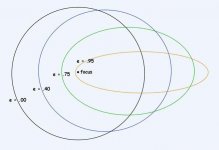
Most people think of an ellipse as a squashed circle. But mathematically, a circle is an ellipse whose wide part has been squished until it’s exactly the same as its narrow part. The eccentricity of an ellipse is how squashed it is. Zero eccentricity would be a circle.
The orbits of geostationary satellites are as close to zero eccentricity, perfectly round circles as we can make them. That way they don’t appear to move when we look up at them.

You can also have geosynchronous satellite orbits that aren’t round, tracing out more pronounced ellipses. In that case they would appear to move in and out, back and forth when we look at them. But they would always occupy the same patch of the sky.
So is the circular orbit still an orbit? Definitely. But keep in mind that the word orbit has different meanings in different fields of study. There are always textbook definitions in each field of study that are more specific than the way words are used in common language.
And I have to apologize for saying circular planetary orbits don’t occur in nature. That was overly picky. It would be more accurate to say that the orbits of the planets in our solar system are ellipses, not circles. The orbits of our local planets are only a little squashed. Some, like Venus’ and Neptune’s are pretty darn close to circles. Comets’ orbits, on the other hand, are super duper squashed.
And just to confuse things even more, back to the DA sander…. With more math! (Yeah, you got my OCD crankin’.)
We said that mathematically, circles are special ellipses. Well, ellipses are special versions of yet a larger group of shapes called trochoids.
So, all circles are ellipses. And all ellipses (and therefore circles too) are trochoids. And then there are whole boatload of trochoids that aren’t ellipses or circles.
The DA sander produces an “orbit” that’s trochoidal. It’s sort of a distant cousin of a satellite’s orbit.
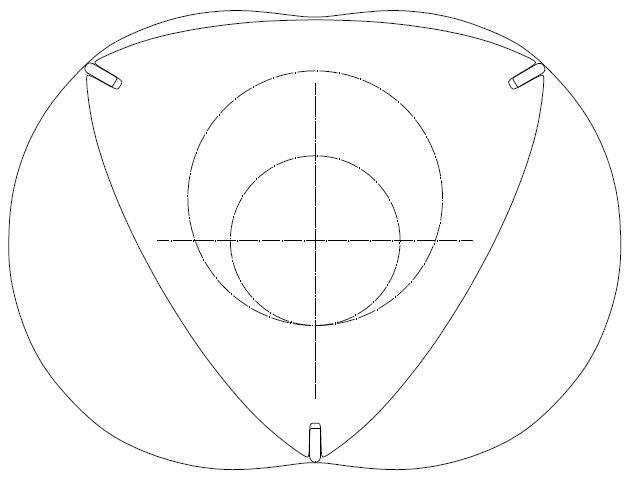
Here’s a pic of a trochoid that’s like the motion of a DA sander.

And for all you Zoom Zoom fans, the housing of a Wankel motor is yet another kind of trochoid.
A geosynchronous satellite has an elliptical orbit. All objects whirling about in space, held by gravity, move in elliptical arcs.
Here’s the part where my OCD caused confusion. A circle is just a special kind of ellipse. All circles are ellipses. But not all ellipses are circles.
Most people think of an ellipse as a squashed circle. But mathematically, a circle is an ellipse whose wide part has been squished until it’s exactly the same as its narrow part. The eccentricity of an ellipse is how squashed it is. Zero eccentricity would be a circle.
The orbits of geostationary satellites are as close to zero eccentricity, perfectly round circles as we can make them. That way they don’t appear to move when we look up at them.
You can also have geosynchronous satellite orbits that aren’t round, tracing out more pronounced ellipses. In that case they would appear to move in and out, back and forth when we look at them. But they would always occupy the same patch of the sky.
So is the circular orbit still an orbit? Definitely. But keep in mind that the word orbit has different meanings in different fields of study. There are always textbook definitions in each field of study that are more specific than the way words are used in common language.
And I have to apologize for saying circular planetary orbits don’t occur in nature. That was overly picky. It would be more accurate to say that the orbits of the planets in our solar system are ellipses, not circles. The orbits of our local planets are only a little squashed. Some, like Venus’ and Neptune’s are pretty darn close to circles. Comets’ orbits, on the other hand, are super duper squashed.
And just to confuse things even more, back to the DA sander…. With more math! (Yeah, you got my OCD crankin’.)
We said that mathematically, circles are special ellipses. Well, ellipses are special versions of yet a larger group of shapes called trochoids.
So, all circles are ellipses. And all ellipses (and therefore circles too) are trochoids. And then there are whole boatload of trochoids that aren’t ellipses or circles.
The DA sander produces an “orbit” that’s trochoidal. It’s sort of a distant cousin of a satellite’s orbit.
Here’s a pic of a trochoid that’s like the motion of a DA sander.
And for all you Zoom Zoom fans, the housing of a Wankel motor is yet another kind of trochoid.
Attachments
Last edited:
