• Hey Guest!
    British Car Forum has been supporting enthusiasts for over 25 years by providing a great place to share our love for British cars. You can support our efforts by upgrading your membership for less than the dues of most car clubs. There are some perks with a member upgrade!

    **Upgrade Now**
    (PS: Upgraded members don't see this banner, nor will you see the Google ads that appear on the site.)
  • When posting a classified ad, you MUST select a prefix from the drop-down next to the subject line. If you don't you will get an error and your ad will not be posted!
Tips
Tips

Basic toolbox

One thing that no one has mentioned - the roster of your (fill in your marque here) club. Always good to have contact info for 'friends' when away from home.
 
Lex, your mechanic friend spoke wisely: it's always what you DIDN'T bring that will be the key part!

My tools consist of a molded plastic tool kit I purchased years ago at Sears, a "64-piece" kit that contains a great array of wrenches, sockets, drivers, and other hand tools. It goes with me everywhere the LBC goes. It's compact and easy to store.

Carrying extra parts depends on the condition of your car. My LBC is in great shape, but I do carry a set of radiator hoses; spark plugs; a length of fuel hose; an extra fan belt and a spare fuel pump thrown in for extra measure. I don't carry a spare tire, but do have a puncture repair kit and a small tire inflator that runs off the cig lighter.

What IS important is safety gear. Alway take extra lighting (flashlights/batteries) and road flares (I like the chemical ones), and it's a great idea to take safety triangles and markers to make your broken down car visible to other drivers. Include eye protection (goggles, etc.), as you should always wear eye protection when working on your car. It's also great to have a fire extinguisher, too.

And of course, that modern invention that's the biggest safety item of all: A CELL PHONE! :yesnod:
 
Hi, Randall,

It wasn't the bellows hose that blew but the bypass hose. Sorry; I didn't make that clear. You are right, of course, the bellows hose needs to be replaced with a bellows hose.

When I had my new aluminum radiator installed, the person who installed it installed a new bypass hose. The hose had no reinforcing strands in it and was very soft and -- how should I describe it -- "slick." The hose slipped right off the connection to the radiator no matter how we tried to tighten it. As a temporary fix, the guy installed a NOS TR3 bypass hose, but it was so old that a problem with the radiator cap caused it to blow. And that is when we installed a modified hose for an American car.
 

Attachments

  • 23597.jpg
    23597.jpg
    59.5 KB · Views: 268
The Wedge quit on me about 1.5 miles from the house.
Here is all I use in my toolbox
mbr11.jpg
 
DNK said:
The Wedge quit on me about 1.5 miles from the house.
Here is all I use in my toolbox
mbr11.jpg
I am ready with my Hagerty 120 mile flatbed package that also covers my daily drivers.
 
Didn't add that to my Haggerty since I have it on my AAA. But it was such a hassle getting a Flat bed with AAA I am rethinking my choice.
 
DNK said:
Here is all I use in my toolbox
Well, I feel there is something to be said for trying to deal with at least some emergencies on your own.

Not sure if it is still there, but there used to be a sign on I-10 in western Texas : "Next services 104 miles". And they closed at 7PM !

PS, last time I called AAA, they asked me if I wanted a flat bed or not. No hassle at all, although it did take a bit longer for him to get there. And he even knew to lay down some boards so my exhaust didn't drag getting on (or more importantly getting off).
 
I notice that many of you who responded to this question have written that you carry a spare fuel pump with you. Are they that unreliable? Do you have any tips on replacing them by the side of the road? Seems like a big job to me, but then I am pretty new at this. Would welcome any guidance on this -- or reference to good manuals.
 
AAA has always sent a flat bed for me without ever asking, regardless of the car being towed. Then again, in this area 95% of the tow trucks are flatbeds so it is usually not a problem.

The nicest part of AAA is that it doesn't matter what car it is because it is tied to the member, not a car or policy. It is also not a reimbursement type of policy so you never have to pay anything (as long as it is in your mileage range) other than tipping the driver if your so inclined. I have a 100 mile range on my AAA membership. If you use it once it pays for itself.
 
LexTR3 said:
I notice that many of you who responded to this question have written that you carry a spare fuel pump with you. Are they that unreliable? Do you have any tips on replacing them by the side of the road? Seems like a big job to me, but then I am pretty new at this. Would welcome any guidance on this -- or reference to good manuals.

I've never had a fuel pump problem, but have had fuel filter problems. I would carry a spare filter, or at least have a way to bypass it. Of course, regular attention to the fuel filter is probably better!
 
Darrell,

Sounds good. Replacing the fuel pump on the side of the road seems a bit "major" to me, but checking, cleaning, replacing the filter sounds doable. Any guidance on how best to do this?
 
LexTR3 said:
...Replacing the fuel pump on the side of the road seems a bit "major" to me, but checking, cleaning, replacing the filter sounds doable. Any guidance on how best to do this?

The 'spare' fuel pump I carry is a simple electric that splices into the existing lines and takes power from the white wire side of the coil.

Electric%20Pump%201.JPG


Hooks up in a minute. Fuel pump failures aren't common but over the course of 38 years of driving TR3s I have known a few.

I only use the stock filter -- to clean that I clamp off the input fuel hose (I use clamping pliers), run the engine for a couple of moments to take up some fuel from the outlet line, then undo the thumb nut on the bail beneath the glass bowl. If you're careful you can get that bowl down, out and away w/o spilling gas, but it is probably a good idea to do this outside when possible.

BTW -- for the bypass hose -- as I recall TRF sells the one I think is superior, better shape and fit and has that fiber 'sock' over it. Anyway, the one I got from them seemed to me to be the better version.
 
LexTR3 said:
I notice that many of you who responded to this question have written that you carry a spare fuel pump with you. Are they that unreliable?
IMO the original mechanical pumps used on most TRs are very reliable, assuming they have been rebuilt with components that will withstand modern fuel. The original diaphragms (at least for the TR2-4A pump, might not apply to others) would slowly dissolve in MTBE or ethanol and develop serious leaks. Other than that, I have never had an original mechanical pump fail to get me home, in perhaps 300,000 lifetime miles covered in various TR3s.

As with most parts, there have also been some replacement pumps that were not properly made. The most common (and most destructive) of these are the ones where the pivot pin is only staked to the soft pump body. Over time, the pin can come loose and fall out. In at least one case, it jammed the lever and caused a broken camshaft!

However, Stags had electric pumps originally, and they were somewhat less reliable.
<div class="ubbcode-block"><div class="ubbcode-header">Quote:] Do you have any tips on replacing them by the side of the road? [/QUOTE]
I would not bother trying to replace the pump on the side of the road. It is rather difficult if you don't have the magic tool https://www.jmwagnersales.com/fpit.jpg and not a lot of fun even if you do (especially if the motor is hot). Instead, just bypass it with an electric pump. Along with the pump, you'll need some rubber fuel line (which is also handy for other things), some clip leads (ditto), and maybe a couple of tie wraps. Lash the pump some place convenient with the tie wraps; rob power from the coil with a clip lead, hook up the rubber lines and away you go. When you get home, rebuild the original and stow the electric back in the spare tire.

A spare electric pump can also come in handy if someone has a fuel tank leak (transfer the fuel into some other tank before it runs out on the ground); or if someone in the group needs to borrow a few gallons. I also used mine to drain the tank on my wife's Dodge when it's fuel pump went out (full tank of gas, tank had to be removed to replace the pump).

A little poking about on eBay should produce a suitable pump for under $30 or so. Last time I bought a used Facet for $25. But be sure you get the low pressure version, as TR carbs will not hold back more than about 4 psi; while most American cars use 7 psi.
 
Many warm thanks for all the good guidance. I'll need to take a good look at my fuel pump to make sure I understand the instructions on replacing the filter. It seems pretty straight forward.

George: In your photo of the electric pump, I see two wires: a black and white one and a white an black one. Which clip goes on the coil" And where does the other clip go (a ground?).

Also, can you tell me where the tube hooks up. It appears to be to the outlet, but I just want to make sure I understand which side of the fuel pump that would be.

Basic stuff... but I am learning. I hope.

Ref bypass hose: Yes, George,a number of people have told me that the TRF bypass hose is far superior to the squirmy Moss one.

Randall -- Many thanks for all the information. I will be careful in selecting a low pressure electric fuel pump.
 
LexTR3 said:
Darrell,

Sounds good. Replacing the fuel pump on the side of the road seems a bit "major" to me, but checking, cleaning, replacing the filter sounds doable. Any guidance on how best to do this?

In my car, I had a in-line filter before the pump. This was before I had the tank cleaned, so I would get a lot of junk. One time I went to long between changing the filter, and found myself on the freeway with the engine losing power over about 30 MPH. In this case, I was just able to connect the feed from the tank directly to the pump (removing the filter). As I recall, I didn't even clamp the hose, just did a quick switch and was back on the road.
 
LexTR3 said:
...In your photo of the electric pump, I see two wires... Which clip goes on the coil" And where does the other clip go (a ground?).

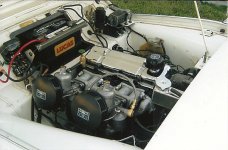
Most fuel pumps will have leads labelled + & -. Connect based on how your car is grounded, i.e. if positive ground car then the negative pump lead goes to the coil (other connections are possible but this one shuts the pump off when the ignition is switched off). Any ground will do for the other lead.

<div class="ubbcode-block"><div class="ubbcode-header">Quote:] Also, can you tell me where the tube hooks up...[/QUOTE]

The pump I used has 5/16" fittings on each end. If you look at the photo you'll see that the hose gets reduced to 1/4" using a couple of brass fittings:

Electric%20Pump%202.JPG


To use this pump you disconnect the fuel hose from the short hard line that goes into the stock pump inlet. The 5/16" inlet on the electric pump connects to that hose.

You also disconnect the fuel hose that goes to the front carb. The 1/4" end of the hose from the electric gets connected there. After that you let the fumes clear a bit then make your electrical connections and hopefully have a heartbeat.

All that assumes that: 1) you have a pump like mine 2) you have hard and rubber lines like mine (which I think are 'correct') 3) you made the hose on the electric long enough to reach the front carb.

There are many ways to do this and in any case will have to be adapted to whatever electric pump you get. As Randall notes, you want a low pressure pump.

On the fuel filter, be wary of over-tightening the thumb nut on the bail that holds the bowl. If the bowl doesn't properly seal it is most likely a problem with the gasket. Tightening the bail too much in an effort to stop a leak can distort the soft metal casting that is the top of the bowl and prevent it from ever sealing.
 
All this really helps. I will put all this information together and assemble an "emergency" electric fuel pump to carry with me.

And on that topic, I have searched the Internet a bit and found that J. C. Whitney has a number of electric fuel pumps available. The best thing about the Whitney site is that you can type in information about your car and the site gives you a list of pumps that will work with your car. For a 58 TR3, it recommends, among others, the Facet/Purolater Cube Solid-State Electric Fuel Pump (FEP42sv). This is a low pressure pump, as Randall stipulated, and the price is reasonable.

Has anyone had any experience with this unit?
 
Something strange there, Ed. I like the little Facet pumps (for stock or nearly stock engines) and that is what I use. However, according to the Facet site, FEP42sv is a package that includes a model 40106 pump
https://www.facet-purolator.com/index.php...8&Itemid=62
and the 40106 is the 4-7 psi model, not 1.5-4 psi as Whitney states.
https://www.facet-purolator.com/index.php...6&Itemid=31

FWIW, if you don't need the hardware in the kit, Aircraft Spruce has the bare pump for only $32. Model 40104 is not shown on their pump info page, but they do stock it (P/N 05-00799).
https://www.aircraftspruce.com/search/search.php?query=05-00799&searchsubmit=Search&search=1
 
Back
Top
