• Hey Guest!
    British Car Forum has been supporting enthusiasts for over 25 years by providing a great place to share our love for British cars. You can support our efforts by upgrading your membership for less than the dues of most car clubs. There are some perks with a member upgrade!

    **Upgrade Now**
    (PS: Upgraded members don't see this banner, nor will you see the Google ads that appear on the site.)
Tips
Tips

TR2/3/3A backfiring tr3

I had the same thing after my rebuild. Several posters said "make sure you have the firing order correct." I looked and verified that the firing order was correct. No joy. Still had the problem. They kept saying the same thing. I started to think they were nuts.

Well, after bashing my head against the wall, I looked closer. I had the firing order correct, but in the wrong direction. 1-3-4-2 but it should be COUNTER_CLOCKWISE around the rotor. I had gone clockwise, so my firing order was actually 1-2-4-3. It backfired randomly and loudly before and ran like a striped a$$ ape when I corrected it.

Not saying that is your problem, but you might give it a look-see.
 
Hi Jim,

I recently had a similar occurance with my TR.

"Some symptoms were": Back firing thru Carb(s); Plugs were very wet (Too Rich one would think); "Underload", She ran fine but as soon as I started downshifting to slow down or come to a light; She would start stalling on me.

"Remedy/Cure": Brought my car into my Brit Guru Mech!! She was running "Way to Lean"!! He set the "Jet adjusting Nut" from its Orig. position (Marked with Red Nail polish); "6 Flats" & then settled in at "3 Flats" on ea. Carb. I was a bit low on the Oil in the Pot & He suggested putting "Marvel Mystery Oil" for the Summer & "10-30/10-40 Engine Oil" for Winter driving. I topped off the Carbs with "Mavel Mystery Oil" & She`s just fine. I use to use "Moss`s" blend but thought that was pretty costly. "Gear Oil" is probably "Too Heavy" to allow the piston to flow freely.

On my Front Carb; The piston was slow in returning down which resulted in the "RPM`s" to stay up a bit (1200) till it settled in. The cause of that was the "JET" was`nt centered which can cause all sorts of questionable problems.

All is well now!! Hope this helps a bit.

Happy Motoring,

Russ
 
Ok guys and gals. I appreciate your maintaining interest in my odyessy to tame my TR3.

66.3 issue description:

While in the midst of testing fuel/air mixtures I find that when I kicked my starter using my solenoid button I could hear the starter turning but quite obviously NOT engaging with the flywheel. In fact it turned until I could yank the ground cable off my battery and turn off everything. Then I started it up again and while starter did in fact turn over the engine AND start it...I let it run for a few seconds and then when it stalled out my starter is making a noise like it is still turning but not engaged with the engine. I assume it was turning, without being engaged to the flywheel, the entire time it was running.

SO....I am afraid that I have a bad flywheel at this point. I have multiple solenoids and have had at least two starters on since I started hearing the obnoxious noise of the starter turning without the engine turning. Does this not have to call for a flywheel replacement? I have heard the same 'grrrrrring' sound on attempted starts earlier but just ignored them because it would start after I release the solenoid button and pushed it a second time. So I do believe this has been an underlying issue for some time now but in the past I was able to get by without investigating.

If this is the flywheel...how incredibly difficult would it be to get a usable replacement?

I may be getting ahead of myself but I would imagine that replacing the flywheel, assuming I can find another in decent shape, would at least require the not so
small matter of seperating the engine from the transmission.

Any discussion would be most appreciated.

Thanks very much,
Jim Lee
 
Fearing a spun flywheel

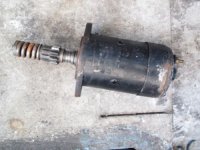
I have the post TS50000 starter like this $(KGrHqRHJFQE88fB,pYTBPT4t0hjig~~60_12.JPG
I would love for it to be a problem with the starter but my previous starter did the same thing....as in spinning freely on very few starter attempts.
This is the first time it spinned (spanned?) continuously where I had to shut down the electrical power. Or continued to spin while running.

Thanks very much,
Jim Lee
 
May not be your problem, but on my TR4A, the ring gear came off of the flywheel. It would start sometimes when the ring gear would catch the flywheel a bit, but other times it would just spin. The TR4A uses a bolt-on ring gear, and I was able to get it back on and rebolted through the starter hole and where it is exposed on the bottom. I do recall getting the ring gear partly on, and then pushing the car in gear to rotate it to another spot to push on.
 
Post-50k TR3A/B also uses the bolt-on ring gear. Replacements are available I believe, but as noted you have to pull the transmission to change the gear. And although changing the flywheel with the engine still in the car is quite doable; I promised myself last time that I would pull the engine if I ever had to do it again. Not my idea of fun, trying to work that far under the dash (or under the dash at all, for that matter).

If the starter kept spinning under it's own power, though, that is clearly a solenoid problem. And since a bad solenoid can also cause the starter to not engage, I would look at that first. Then double-check the condition of the flywheel teeth. If they are really that bad, the problem will be obvious. Getting two bad starters in a row would be unusual, but not entirely improbable. Just as an example, a few years ago we went through 6 different "rebuilt" alternators on the wife's Camry before finding one that would actually last more than a few months. Fortunately they were all replaced under warranty with no argument, but I still had to R&R each one and take it to the store for the next one. Not to mention all the time I spent looking for some other problem!

But my guess is that you'll find that the starter pinion was not fully engaging with the ring gear, and so only part of the ring gear is damaged. The factory supposedly used shims to adjust the engagement on later cars, but the shims are almost always missing. If most of the ring gear teeth are still there, you might consider switching to one of the "gear drive" starters instead. Lots easier to install than a ring gear, and since they come in from the other side, they use the other half of the ring gear teeth. Plus, being a pre-engaged design (the teeth are engaged before the motor starts to turn), they are a lot gentler on ring gear teeth.
 
The ring gear teeth are on the starter or the flywheel? The gear reduction route sound best if the two other solenoids that I have make no difference. I see ring gear starters on ebay all the time for about $200. Any particular starter to look for, or look out for? Are some those made in China and some not?

Is is it possible for a weakened battery to cause the non turning symptoms I described. Like it has enough power to actuate the starter engagement mechanism but not fully engage with the flywheel to turn the engine? I had been turning the engine over quite a few times without running it for very long.

Thanks very much,
Jim Lee
 
The ring gear mounts on the flywheel and is shaped like a big ring (hence the name). TRF has the bolt-on variety listed on sale for $50 (regular price $60).

I'm not sure which starters to recommend. The one I got from TRF only lasted about 10 years of daily driving, but I'm pretty sure all it needs are some new bearings to be good for another 10. With a heat shield added to deflect some of the exhaust heat, it might go longer.

A weak battery could definitely aggravate any predisposition for the Bendix to not engage the pinion gear (the little one on the starter) with the ring gear. It relies on the inertia of the pinion gear (which isn't much, as it isn't very large or very heavy) to extend the gear against the flywheel. If the starter isn't getting enough juice to snap the gear out quickly, it might just hit the ring gear and grind without turning.

It's also quite common for the Bendix to "kick out" while trying to crank an engine that doesn't want to start. It only takes one cylinder firing to kick the Bendix back, and if the next cylinder doesn't fire, you have the engine not running, the starter motor spinning (mine made a kind of moaning noise) and no inertia left to kick in the Bendix. So you have to let go the button, wait for the starter to stop spinning, and try again. I've had to go through that dance a dozen times or more (back when I lived where it snowed and never had money for fresh points, etc.) Just one more reason I like the gear drive starter!
 
Hey Jim,

Interesting thread...I've enjoyed following your progress! Here's my 2 bits...

I really doubt you have a flywheel issue. It's possible, but I would put it lower on the list of things to check first. With all the starting you have been doing, I would check the battery charge and the solenoid first. The starter uses an inertial engagement, so it has to start spinning hard and fast to drive the gear out on the nose to engage the ring gear on the flywheel. If the battery is weak, or the solenoid is old...it can reduce the amperage available to spin the starter fast enough.

This is easy to check. First, charge the battery completely and try to start the car again. If that is a no-go, then just disconnect the batter cabel from the solenoid and manually drive it to the stud on the solenoid going to the starter. You are manually bypassing the solenoid (be careful and use gloves). If the solenoid contacts are oxidized, this will get the engine turning. If it does, you have isolated the solenoid as the problem.

The next thing I'd try is to manually rotate the engine 1/8th turn or so and try to: A) listen for the flywheel ring gear rattling as the engine turns (very NOT likely) and B) Try starting again normally. By turning the engine, if you are missing a few teeth, this will align the starter with good teeth and should allow at least one good start.

The next thing to check, in the order of difficulty, is to remove the starter and check it on the bench to make sure the gear drives outward when you first apply 12 volts to it. If it doesn't, it may just have a dirty snout and need some cleaning. Clean it up and try again.

If these fairly easy items don't fix it...then it's time to get under the car and look at the flywheel teeth. I truely think you would have had some indication if your ring teeth are bad...like skipping and banging during the starts. If the ring gear came off the flywheel, you likely would have heard some awful noises!

Now for my 4 bits on the backfiring. As I see it, there are 3 possible causes:

1) Sticking valve...rule that out, as your idle is too consistent and it would backfire frequently instead of only on acceleration

2) Plug wires reversed...easily checked. Note...WAY too much advance can cause the intake backfire. A bad plug or wire will not.

3) You are lean. For the lean, first use at least 30w oil in the dashpots and pull the choke about 3-4 clicks...then repeat your experiment with the acceleration to make it backfire. If it stops backfiring...you need to find a way to richen it. Could be a mixture issue, but also could be a vacuum leak.

Personally, I would not be concerned about the rich looking plugs. If you have a lean misfire, that can also soot the plugs and fool you. Once you get it to run without missing or backfiring, then the plugs will tell the true tail of what the mixture is.

 
Back
Top