

-
 Hey Guest!
British Car Forum has been supporting enthusiasts for over 25 years by providing a great place to share our love for British cars. You can support our efforts by upgrading your membership for less than the dues of most car clubs. There are some perks with a member upgrade!**Upgrade Now**
(PS: Upgraded members don't see this banner, nor will you see the Google ads that appear on the site.)
You are using an out of date browser. It may not display this or other websites correctly.
You should upgrade or use an alternative browser.
You should upgrade or use an alternative browser.
ARP Studs
- Thread starter DNK
- Start date

OP

DNK
Great Pumpkin
Offline
billspit said:I am having a problem comprehending something here. Surely you are not torquing the head stud into the block at 80 ft/lbs. It's the nut that is supposed to be torqued onto the stud at 80ft/lbs. I'm not sure how tightly the studs are to be torqued.
Bill- Just the nuts. The studs were first done finger tight with oil. Then I pulled them and put cam lube on em and just snugged them with an allen wrench.
Marks6 said:Don't forget, you can get your torque wrench checked and recalibrated. Especially handy if it's been sitting for a long time with some tension on it.
I bought a new one just for the reason you stated, Mark

TR3driver
Great Pumpkin - R.I.P
Offline
Not a safe assumption. They can be laying on the store shelf mis-calibrated just as easy as laying in your toolbox.DNK said:I bought a new one just for the reason you stated, Mark

PeterK
Yoda
Offline
I replaced my Craftsman click wrench for engine work with a 1/2" split beam click from Precision Instruments https://www.torqwrench.com/tools/C.php
No need to set to zero when storing it and it is US made and included the calibration results. Cost was about $200 (this is their least expensive tw.)
No need to set to zero when storing it and it is US made and included the calibration results. Cost was about $200 (this is their least expensive tw.)
OP
DNK
Great Pumpkin
Offline
TR3driver said:Not a safe assumption. They can be laying on the store shelf mis-calibrated just as easy as laying in your toolbox.DNK said:I bought a new one just for the reason you stated, Mark
So Randall , I guess we might as well not even by one if we can't tell if they are correct.
TR3driver
Great Pumpkin - R.I.P
Offline
Your choice, Don. I worked that way when I was younger, but around the time I started shaving it occurred to me that maybe there was a reason the professionals have their torque wrenches (and calipers, and micrometers) calibrated at least every blue moon or three. Beam-type wrenches are much better, but clickers are notoriously inaccurate.

Online
I have ARP head studs I just installed on my Spitfire engine and my studs did come with the "special sauce". After talking to the guys there, I've decided to just use oil for lube on the studs. When you use the special lube, the torque setting is much lower I seem to recall and you have to torque and untorque the head nuts three times (I assume to ensure the stuff is all spread evenly in the threads?).

bgbassplyr
Darth Vader
Offline
not for the stuff to spread but to strech the studs.
OP
DNK
Great Pumpkin
Offline
So he it is 3 weeks later and I am working on it again. Removed the ARP studs from the drivers side and reinstalled the factory bolts. Torqued them to 70lbs. and all is good,on that side.
Removed the studs from the previously mentioned Fubared side. Removed the head and the good news is I think there is only 1 bad hole.The drill bit I needed for the repair inserts is 37/64's and when I pulled it out of it's case "Man that's a big bit". I think I will buy a couple of in between sizes to help step it up.
Next step is tricky. Keeping the bit perpendicular to the hole. Wish me luck.
Removed the studs from the previously mentioned Fubared side. Removed the head and the good news is I think there is only 1 bad hole.The drill bit I needed for the repair inserts is 37/64's and when I pulled it out of it's case "Man that's a big bit". I think I will buy a couple of in between sizes to help step it up.
Next step is tricky. Keeping the bit perpendicular to the hole. Wish me luck.

Brosky
Great Pumpkin
Offline
Don,
How about one of these or something similar? Do you have room?
Rockler Drill Guide
It's not dirt cheap, but if it will fit, it's better than messing up the hole.
How about one of these or something similar? Do you have room?
Rockler Drill Guide
It's not dirt cheap, but if it will fit, it's better than messing up the hole.


Offline
I will HIGHLY agree with Paul here. It's been weeks of aggro already, the fixture in that link will come in days... and you have a tool for many other similar tasks later. Keeping a drill bit perpendicular to a machined surface is not easily done "by eye". Too many variables. And a wonky fit there will put added stresses on the stud, for sure.
TR3driver
Great Pumpkin - R.I.P
Offline
Don, are these Helicoils you are installing? That would mean the studs are 9/16" diameter, so those stripped threads are already at 36/64". My suggestion would be to skip drilling, and just run the tap in, using short strokes and plenty of lube. It will act as a reamer to remove the excess metal, and the hole itself will help guide it.
I've repaired several holes that way (including intake manifold bolts on my Stag) and it's worked great for me. Taking out that tiny bit of metal with a hand-held drill motor is a recipe for disaster IMO, as the bit is bound to grab and twist.
Another option might be a straight flute reamer instead of a drill bit (in a tap holder instead of a drill motor). If you wanted, you could even grind down the edges of the flutes for a bit, to act as a pilot; but then you'd need a second reamer to finish the bottom of the hole.
I've repaired several holes that way (including intake manifold bolts on my Stag) and it's worked great for me. Taking out that tiny bit of metal with a hand-held drill motor is a recipe for disaster IMO, as the bit is bound to grab and twist.
Another option might be a straight flute reamer instead of a drill bit (in a tap holder instead of a drill motor). If you wanted, you could even grind down the edges of the flutes for a bit, to act as a pilot; but then you'd need a second reamer to finish the bottom of the hole.
How in the heck do you make that little smiley with the"I agree" sign.
I would have a go at using just the tap. In aluminum you can use the tap as it's own ream for a lot more than in iron.
Your only other choice would be your own fixture, piece of steel, drill for the other studs close by, and a bush over the hole you need to drill out,
Do you have/access to a drill press? If so the above fixture should be easy.
pucker time. Till I know it works this kind of fix always runs my sphincter up near my adam's apple somewhere.
I would have a go at using just the tap. In aluminum you can use the tap as it's own ream for a lot more than in iron.
Your only other choice would be your own fixture, piece of steel, drill for the other studs close by, and a bush over the hole you need to drill out,
Do you have/access to a drill press? If so the above fixture should be easy.
pucker time. Till I know it works this kind of fix always runs my sphincter up near my adam's apple somewhere.
PS, back in my airplane days I have used hardware store denatured alcohol for aluminum tapping fluid with some success.
The other choice is Tap Magic, which is 25 bucks for a half pint can, when you can find it, because it's still made from all of the stuff that have been proven to cause cancer if you drink and sit in it for 30 years, which means it actually works like it's supposed to.
The other choice is Tap Magic, which is 25 bucks for a half pint can, when you can find it, because it's still made from all of the stuff that have been proven to cause cancer if you drink and sit in it for 30 years, which means it actually works like it's supposed to.
TR3driver
Great Pumpkin - R.I.P
Offline
I've been using ordinary tapping oil for hand-tapping aluminum, seems to work fine for me.
Or of course just click on the smiley
One way is to just type ": agree :" without the quotes and spaces. Or you can hit the 'Reply' or 'Quote' buttons to get the full posting form page, which includes lots of tools including a suite of smileys. If you click on the smiley tool, then hover over the smiley you're interested in, it should show you the text equivalent.71MKIV said:How in the heck do you make that little smiley with the"I agree" sign.
Or of course just click on the smiley
OP
DNK
Great Pumpkin
Offline
The bolts are 7/16 for the head. I mic'd the hole out at about .431 and I am using Keen Serts. The tap is a 5/8's 11 The drill is the correct one so I have about .189 or 3/16ths of material to take away. Don't think the tap will do that.
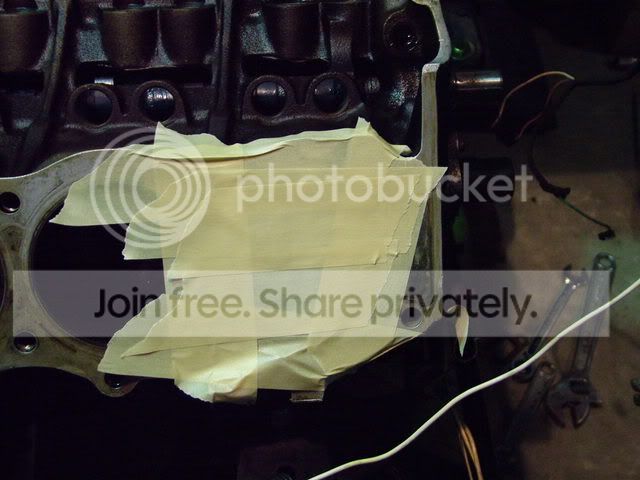
And as you can tell,the motor is still in the car.
And as you can tell,the motor is still in the car.