• Hey Guest!
    British Car Forum has been supporting enthusiasts for over 25 years by providing a great place to share our love for British cars. You can support our efforts by upgrading your membership for less than the dues of most car clubs. There are some perks with a member upgrade!

    **Upgrade Now**
    (PS: Upgraded members don't see this banner, nor will you see the Google ads that appear on the site.)
Tips
Tips

TR4/4A Are these axles and hubs usable?

Sarastro

Yoda
Silver
Country flag
Offline
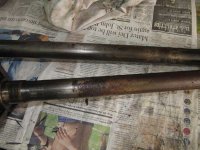
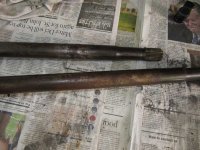
I've attached a couple pictures of the axles from my solid-axle TR4A. A couple questions:

1. The pictures show rust patches on the axles, the lower one being the worse of the two. Can I just sand this off, or will that leave me with a weak area that might eventually lead to cracking and breaking?

2. I've measured the hub runout as 4 mils on one axle and 10 on the other. This was measured at the outer edge. 4 mils might be OK, but 10 strikes me as too much. I can't find a spec for this in the shop manual. Does anyone know the spec, or lacking that, I'll take opinions?

3. The rear axle had only a few ounces of oil in it, so I'm a bit worried about the differential bearings. Is there any easy way to check these short of taking it all apart? I can't feel any looseness, but that doesn't always mean something.

Thanks for any ideas, either hard info or just opinions.
 

Attachments

  • a_IMG_7601.jpg
    a_IMG_7601.jpg
    65 KB · Views: 150
  • a_IMG_7602.jpg
    a_IMG_7602.jpg
    62.3 KB · Views: 152
No, they're not welds, just big patches of rust. Sorry, I tried a couple times to get good, revealing photos, but it's hard with my limited skill and simple camera.

In the first picture, you can see a large patch of rust on the lower axle. That's the worst of it. The lower axle has more toward the right end, which is visible in the second picture, and in the second pic you can see a rust patch on the upper one. Those latter patches are not as bad as the first, but still bad enough to make me worry.

I worked on the axle runout a bit today. The one with the 4 mils is actually no worse than 2. The bearing is badly worn, though, so it's hard to measure. The other one's runout was high near two lugs on opposite sides, making me think it was warped by someone trying to remove the hub with a conventional hub puller. But I'll look at it more closely when I get a minute.

The outer bearings had NO grease at all. Not a big surprise that they are worn. Sigh.
 
The axle failures I've seen are right next to the splines. The splines add stress risers, and that is also the smallest diameter for the entire axle. I have not seen an axle break in the middle, where your rust is. So long as it's a light surface rust I would polish them, rust proof them with paint or LPS3, and use them.

Now, if I wanted to use them hard (and this applies to any axle, not just yours), I would take them and have them mil-spec shot peened to reduce the chance of failure. Getting proper shot peening can be hard in some areas...you need some kind of aerospace factory nearby that you can slip your parts in with their's for very low cost!
 
Thanks. I was hoping you'd provide an answer.

I really am not going to drive this car hard. I don't drive any car hard, in fact. I just want a mechanically sound, good-looking car when I finish the restoration. In particular, I don't want any time bombs hiding in it, like an axle about to break. I broke one once in my Bugeye Sprite, and it really wasn't fun at all.

Now, I need to get those #@!^$#* hubs apart. Wish me luck....!
 
Steve,
I once owned a 67 TR4a solid axle in the late 60s and early 70s and I was really hard on that car, spinning the tires every time I drove it. I really think you're golden with what you've got because I never broke anything on the car other than a front suspension mount.
Rut
 
Berry, that's a neat idea. I did a search but didn't find that one. I do have a HF 12-ton press, and it wasn't able to separate the hub and axle; I think I need something where I can apply force on the hub and then whack it with a large hammer.

Rut, thanks for your input. Good to have an opinion from someone with your level of experience.
 
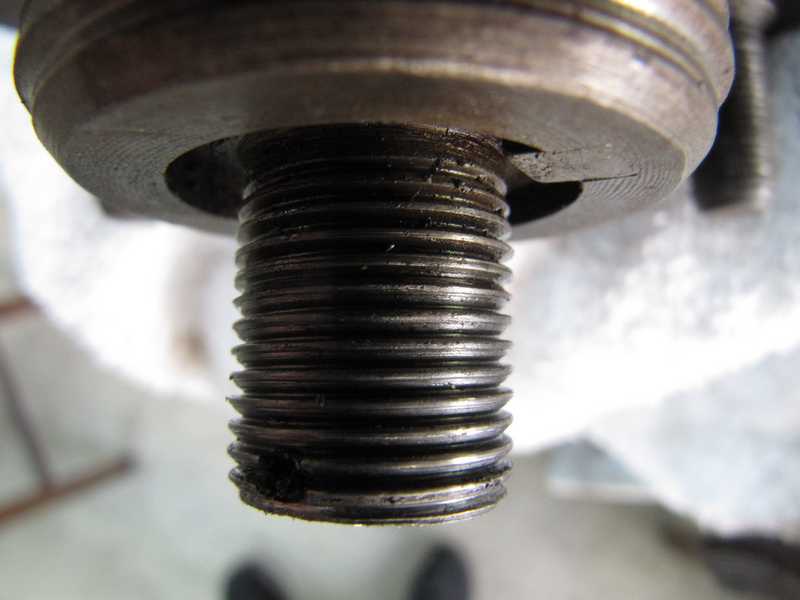
Here's something else interesting that I found. The nut on one axle was hard to remove, and once removed, was rather hard to thread onto the axle. I tried another nut, which had the same problem, so it clearly was the axle, not the nut.

The threads looked OK to me, so I was puzzled. Close inspection, however, showed that the thread profile is more like a sawtooth than the 60-degree symmetrical shape it should be.

I suspect that someone tried to remove the axle by putting the force on the nut instead of the axle, and bent the threads. Now to take stock: the threads are boogered, the bearing is shot, and the flange is warped. I think it's time to replace this axle assembly.

axle_7616.jpg
 
Yeah...every now and again the odds just keep stacking against you. I've tried truing threads like that with a die in the past. It did not end well. Once they're deformed you can never repair them...and holding the hub on is rather important!?! I would think the strange rust marks are likely from the same PO work...using too much heat or some such no-no.
 
Well, of course, Maas's Law of the Innate Perversity of Everyday Life states, in this case, that you will sweat pickles trying to get the hubs off to service them, but if you install an axle with imperfect threads, the wheel will come off in the first fifty miles. There are some things you just don't mess with.
 
I had the thread of a 4A axle repaired at the machine shop with thread files. Someone in the past whacked it with a BFH and deformed the outer threads. Came back undetectable.
 
Back
Top