
• Hi Guest!
    If you appreciate British Car Forum and our 25 years of supporting British car enthusiasts with technical and anicdotal information, collected from our thousands of great members, please support us with a low-cost subscription. You can become a supporting member for less than the dues of most car clubs.

    There are some perks with a member upgrade!
    **Upgrade Now**
    (PS: Subscribers don't see this gawd-aweful banner
Tips
Tips

Are 3-Point Seat Belts Safe in a Healey?

RAC68

Darth Vader
Offline
Hi All,

I appreciate that many have made a decision to install 3-point seat belts and, one who is/was considering this installation, I would appreciate knowing their safety basis for doing so.

I have had 2-point seat belts installed in my BJ8P1 the day after I drove out of the dealer and at a time when seat belts were just beginning to be used. Over the years, when considering an change to 3-point belts, I had postponed by consideration due to inconclusive benefits/concerns for their advantage.

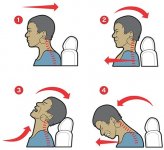
When previously considering the 3-point change, either I read or heard that 3-point belts were not recommended for installation in cars with low-backed seats without head rests. The comments indicated that, unlike 2-point belts which transfers the force through the full body, a 3-point belt would restrict the full force of a collision to the upper back and neck. Without head rests present to restrict head movement, whiplash is more likely.

Recently, a friend was considering the installation of 3-point belts and brought up my concerns. Although I could not find a statement indicating a safety belt recommendation for low-backed seats without head rests, I did find an article in Consumer Reports (CR - 2012) discussing the incorrect adjustment of head rests in a modern car that could possibly be considered equivalent to not having head rests. Although the seats were not low backed as in the Healey, it indicated the potential for whiplash was potential even if hit from behind at speeds as low as 10 MPH.
collision-combo_jpg.jpg

Other then impression, innuendo or style, does anyone have, or can direct me to, information that presents a factual safety recommendation for either 2-point or 3-point seat belts for cars with low backed seats and no head rests? Although here we are talking Healey, it seems to me that this recommendation will also apply to many other early sports cars with low backed seats and no head rests.

Thanks,
Ray(64BJ8P1)
 
"... a 3-point belt would restrict the full force of a collision to the upper back and neck. Without head rests present to restrict head movement, whiplash is more likely."

I think you answered your own question. You hear it all the time: 'So-and-so was not wearing a seat belt and was thrown from the car.' So, we know even 2-point belts will usually--but not always--keep a body in the car. 3- and 4-belt belts are arguably better, but no matter how well you secure your upper body, you still run the risk of 'submarining;' i.e. having your body slide under the belts (I have no data, but suspect it may be a bit more likely with 3- and 4-point belts). The absolute best crash survival rig--or at least the best rig for securing your body--is with a 5-point harness (damage to the family jewels notwithstanding). If you install 3-point belts it MAY reduce injury from your upper body from being thrown into the steering wheel or dash but you would likely suffer whiplash as CR points out (unlike some, I have never had a concern with the solid steering shaft 'spearing' me in the chest; the steering box and shaft are so low to the ground--the box is barely a foot off the ground, if that--the greater likelihood is that the box and shaft will 'submarine' under any other vehicle's chassis and be forced downward). Also, even the best harness system isn't going to help you if you get T-boned by an Escalade. So while 3-point belts MAY help in some circumstances, Healeys are so un-crashworthy that I don't feel 3-point belts are worth the trouble of installation (I DO think a collapsible steering column would be advantageous, however). IMO, anything other than 5-point harnesses with a solid roll/crash cage may make you feel 'safer,' but that's about it.

As an aside, I have never liked the word 'safe' (except in baseball). As a (dormant) private pilot I used to hear 'Oh, those little planes are so UNSAFE (and Volvos are 'SAFE').' The fact is, no aspect of life is entirely 'safe;' you can be taken out while sitting in your living room by fire, CO poisoning, earthquake, flood, you name it. Life is risk, what matters is 'risk vs. reward' and 'risk management;' i.e. does the benefit of a given activity outweigh the risks and are the risks at least somewhat manageable? Flying a light aircraft is extremely risky--don't let anyone tell you otherwise--but, to a greater extent than many of life's other pursuits the risks are manageable; i.e. your life is almost entirely in your hands. And that's part of what makes it so rewarding. I got reminded of the trade-offs recently when I had the airbag in my Mustang replaced by the recall. This is a device that is supposed to increase 'safety,' yet it was killing people (in rather gruesome fashion if you saw any of the photos).

"The only reason they put seat belts in a Healey is so the coroner can tell who was driving."
 
Not sure if this is applicable, but my stock 89 Ford F150 has shoulder harness /seat belts with low seat backs (no head rests). So at least one major vehicle manufacturer considered it to be a viable configuration.
 
Did not the BJ7 and BJ8 Healeys come with anchors - two protruding bolts capped with acorn nuts - on the rear quarter panels? Did they come from the factory with three point belts installed, or did dealers install them? Or??

I'm trying to decide whether to go with three point or two point belts on the BJ7, and will watch this discussion with interest.
 
Bob, I totally agree if I am interpreting your comments correctly. Picking the belt will allow the related option of defining how you prefer to be injured in a crash as neither is sufficiently protecting in a major accident.

Nevets, I don't know how much validation Ford provided in its decision to install 3-point belts in 1989. Remember, in 1964 my BJ8P1 was equipped with 3-point belt mounts and I would not be surprised that those in the company also felt them to be a good idea based upon the limited information available then.

Thanks Guys. I appreciate your input,
Ray(64BJ8P1)
 
Another point about belts: Even the 2-point belts do a reasonable job--at least they're better than nothing--at keeping your butt in the seat while cornering (and driving over 'wavy' roads). 4-point, of course would be better, but I don't feel 3-point are much if any better than 2-point. The shoulder belt in my Mustang does a better job at abrading my neck than anything else.
 
None of the belts will provide protection from whiplash when hit from the rear. In a Healey, the very low seatback will allow some force to be transferred to spine in the upper back. A higher seatback with no head support will keep all the force in the neck.

The idea of 3-point belts is to keep you from eating the steering wheel in a frontal crash. They also spread the restraining force somewhat over the upper torso instead of only the hips. On the other hand, they make it harder to duck when a semi-trailer passes over the car, with the trailer bottom at the height of the beltline (base of the windshield).

As for the steering column, one of the Healey books on the competition cars discussed the lack of safety features "back in the day", and the steering column was certainly mentioned. However, the author, someone who was well familiar with the competition scene, had never heard of anyone dying from being speared by a Healey steering shaft.

BTW, I have the 3-point belts and a roll bar in my BN4.
 
So while 3-point belts MAY help in some circumstances, Healeys are so un-crashworthy that I don't feel 3-point belts are worth the trouble of installation (I DO think a collapsible steering column would be advantageous, however). IMO, anything other than 5-point harnesses with a solid roll/crash cage may make you feel 'safer,' but that's about it.

This.

Driving a vintage car has risks, and we accept those risks when we pull out of the driveway.
If the risk bothers you, I'd highly suggest buying a brand new Miata instead which is far, far safer than any vintage Healey that exists. Same idea, similar configuration, much safer.

I'd suggest that unless one adds a roll cage to support it, adding a 3 point harness may add as much potential harm as potential benefit. I'll be adding two point belts to my Healey as right now it has none, but I know that it's still far less safe than even my vintage Corvettes or Cutlass. As a result, I drive my old cars differently, and much more defensively, than my 4 year old pickup truck. ;)
 
Hi All,

It seems to be the consensus that we are driving in egg shells and are now discussing what seat belt will keep us safer in a crash. Yes, our Healeys were not designed with the knowledge and safety considerations of today's built vehicles. It seems to me that our Healeys were built with a crush section but, unlike todays cars that designate crush areas separate from a survival cage, our total Healey is a crush area. With this said, I am beginning to feel that it makes no real safety difference whether you choose 2-point or 3-point belts and what makes you feel more comfortable. As Bob has mentioned, with either choice, the only thing you can count on is that belts will Assist in keeping you, and your seat, in the car....

Although I appreciate and thank you for your contributions in this discussion, I guess there is no official recommendation for the type of seat belt to select for a low backed seat without head rests and, even if there was, I doubt it would apply significantly when considered within the context of our Healey's construction.

Thanks again for your comments and contributions as I always learn.
Ray(64BJ8P1)
 
[FONT=&quot]Lap Belts v Three Point Belts[/FONT]

  • Lap belts are less effective than three point belts, but nevertheless provide significant levels of protection.
  • In frontal impacts compared to being unrestrained, wearing a lap belt reduces the injury rate by 23% whereas wearing a three point belt reduces the injury rate by 53%.
  • In side impacts, compared to being unrestrained, lap belts reduce the injury rate by 40%, whereas three point belts reduce it by 59%.
  • Lap belts are estimated to be 57% effective in reducing serious injuries in the rear seats of vehicles.
  • Lap belts are estimated to be 32% effective in reducing fatal injuries, compared with when not using a seat belt. Three point belts are estimated to be 44% effective.
  • In side impacts lap belts were found to be 48% effective in reducing fatal injuries. Three point belts were found to be 53% effective in reducing fatal injuries.
  • Both lap belts and lap and shoulder belts are both very effective in reducing fatal injuries in roll-over accidents, by 76% and 77% respectively.
  • A 1999 study found that the fatality rate among people in vehicles fitted with lap belts was higher than those with the three point belt, for all age groups.

    https://www.roadsafetyobservatory.com/Summary/vehicles/seat-belts
 
Rick,

I suspect the above data is true when comparing cars designed to use 2 point vs. 3-point safety belts.
However, in taking a car not designed for any belts, much less 3 points, I don't think the comparisons hold to the degree your numbers reference.
 
Could be, I'm no expert. I did have a Volvo 122S which was the first car that came standard with 3 point belts. That car didn't have headrests. I have lapbelts on the bugeye and three points on the big Healey. I've read 2 points can cause abdomen damage, still allow you to hit the dash and will get you a little closer to the "javelin" steering column in a front end crash. But as has been said, it's all a crapshoot in a Healey. My sig has often been "Madman in a Death Machine."
 
Just a comment in general: Back in high school, when I bought the TR4, my dad made a rather strong suggestion that I install lap belts, even though we NEVER wore them in any appliance car back then. When he was in college, a friend of his was killed riding in the passenger seat of another friend's RHD XK120. To avoid an accident, the driver had to suddenly swerve onto a high curbing along side the expressway's fast (left) lane. The jolt threw the passenger out of the car, into the adjacent lane, where he was struck. I guess the driver saw what was coming, and had the wheel to hang on to.

My high school/college days (mid-late'70's) were also the time lifted trucks were starting to appear, and I remember looking at one, thinking that a collision with one of those would be "all she wrote"!

Driving these cars is an accepted, calculated risk. I'm all for the added safety of belts, but I also understand that unless I install a full cage and racing harness, I won't be protected like I would be in my old Volvo 240. Paying attention, defensive driving, and avoiding high-traffic areas - if at all possible - are the best choices, IMO.
 
Interesting Topic:
I never really investigated just added Racing seat belts to my BJ8's and drove care full as--:devilgrin:
 
We've got a factory Bugeye Shop Manual and Owners Manual (both later publications, specific to the BE, but referring to it as the Mk I). The shop manual provides instructions as to the installation of the factory three point seat belt kit, and the owners manual has an illustration showing the driver (RHD!) wearing a three point belt.
We have a BJ7, which came with mounting points for three point seat belts, and we have added the three pointers. So, by at least 1962, the Austin-Healey factory was supportive of three point belts in both the 3000 and the Spridget.

A lap belt keeps me in the car - which I want - in case of an accidnet and (my perception) the third strap keeps my face & head from getting hammered into the dash/whatever.
We have lap belts in our Bugeye, but I want to add a roll bar (protection in case of getting t-boned in an intersection) and will add three (maybe 4) point belts when I've got that installed.
We also have a Meyers Manx clone VW based dune buggy that has a race certified roll cage in it - again, I'm not at all concerned about rolling the vehicle but would like some protection from the equivalent of our 7000 pound Ford F350 diesel crewcab long box dually rolling over it in an intersection. The buggy has four point belts as well, as the cage provided the necessary mounting points. Before that, it was just lap belts.
When I think of 'whiplash', I think only in terms of being rear-ended, and the type of belt doesn't appear to make any difference (again, IMHO). Doug
 
When I think of 'whiplash', I think only in terms of being rear-ended,

YEP:
That is where you most likely to get hit.:angel2:

Thanks BOB"
Accident avoidance definitely best solution.:encouragement:
 
Last edited:
This discussion confirms that the best plan for a Healey and driver/passenger is accident avoidance. They don't stand up well to any collision - front, rear, or side. A rollover also likely will not end well. Fortunately, the cars do handle well, which helps avoid difficult situations. And the low centre of gravity makes them less likely to roll.
 
Accident avoidance definitely.

From the drivers point of view, there is a spear waiting to pass right through you in a head on and seatbelts serve to keep you in front of it, you can of course convert to a collapsible steering column, with all the trouble - horn and signal turn, that that causes.

:cheers:

Bob
 
Back
Top