
• Hey Guest!
    British Car Forum has been supporting enthusiasts for over 25 years by providing a great place to share our love for British cars. You can support our efforts by upgrading your membership for less than the dues of most car clubs. There are some perks with a member upgrade!

    **Upgrade Now**
    (PS: Upgraded members don't see this banner, nor will you see the Google ads that appear on the site.)
Tips
Tips

Another Timing Question

T

Tinster

Guest
Guest
Offline
I really hate always being the stupid kid on
the block, I really do.

I still don't quite have this timing procedure down pat.
My car either dies at stop signs or idles at 1500 rpms.
The 3 rear plugs are black no matter what it seems I
attempt. I think I have a timing issue.

My dizzy has two "ears".
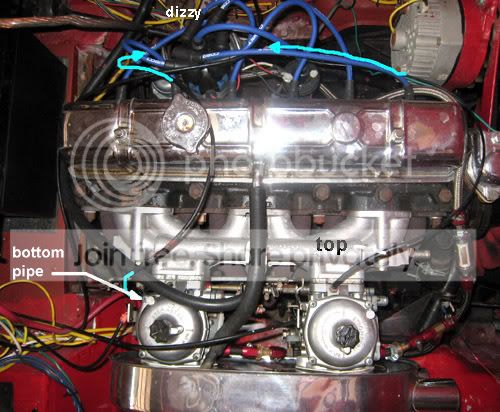
There are two small pipes on my carbs that run to the
ears on the dizzy.

The pipe on the front carb originates on top.
The pipe on the rear carb originates on the bottom.

1. Which pipe do I pull off to set my timing?
top pipe or bottom pipe?

2. I set my timing gun to 12, is this correct?

3. My timing wheel has two marks. Big one, small one.

After I disconnect the correct timing pipe--

Do I rotate the dizzy until the big line hits the marker
with the gun set at 12?

Or set the gun a zero, turn the dizzy to get the line and
marker together and then turn the timing gun knob to 12
and line up the small mark?

Sorry to be so dense on this one. I really can't fool with
the carbs until I am certain I have timed the beast
correctly.


PS: Crypty being Crypty! The car actually started today
and I moved it to the street to clean up the mess that
under it. beautiful blue sky above. Turned my back, Crypty
brought in a black cloud and filled himself with rainwater
while i was recycling a cup of coffee in the john.
engine.jpg


tin
 
Hello Tin,

I think I am in the same place you are on the timing issue. I have a 69 TR6. My brother in law is a mechanic and works on Volvos with the same SU carbs. He is going to be giving me carb adjustment lessons this weekend.(I sure wish there were workshops on this kind of stuff.) In the meantime, since the carbs/idle speed will effect my timing, I set my timing using the static method. Have you considered doing this to start with? From what you wrote about the rear plugs being black, it sounds like the rear carb is an issue.

I posted some of the same questions you asked last week about dynamic timing. I set my points to .015 inches (don't have a dwell meter at the moment.) I was told you disconnect the vacuum advance (on the left side as you are facing the carbs) and turn the distributor so that it is at 4 ATDC. Of course this is provided you can get the idle down to 800+/- 100. I have not been able to get my idle low enough to do this yet, and I am still working on vacuum problems.

Kevin
 
Dale,

Sounds like, with three cylinders rich, that a carb problem is occurring.

But let's get a quick catch up on the timing.

1 make sure the crank dampener is not loose, that the rubber contct between the outer and inner on the pulley hasn't started coming apart. Easy to check(in my experience, if others have a better way, hope they pipe in) Loosen the belt, don't need to take it all the way off, just loosen, grab the pulley(one hand on both sides) and turn it(either direction) if the outer steel turns and the inner stays in place.....

If good, check the advances, Your car has both a vacuum advance and a retard. The vacuum advance should be on the lower left of the distributor, the distributor rotates CCW and when you apply vacuum to the advance(pop the cap off and watch the breaker plate move) the breaker plate will turn clockwise a few degrees. The other can is vacuum retard, vacuum applied to it and it should pull the breaker plate CCW also.
The vacuum retard should be getting manifold vacuum; i.e. when you start the engine up and pull the hose from the vacuum can you should feel(or hear) vacuum from the hose, this nipple is USUALLY the one after the carburetor throttle blades,or close to it. The vacuum advance should be the one getting vacuum on acceleration. Take the hose off check for vacuum when you are accelerating the engine.

Main thing is to make sure that total ignition advance is no more than 32 degrees at 3500 rpm. Ideally, with the changes in todays fuel you want to have advance starting just after idle speed and full in by 2200 or so rpm. If you still have the stock distributor it was set up with slower advance curve. But that's something to focus on down the road.

After the timing is under control. check the oil levels in the dashpots, and might want to pop the tops off of the carbs and visually inspect(with a bright light and a magnifying glass) the diaphragms.

And you are NOT the stupid kid on the block!

Inexperienced somewhat, but these vehicle systems are a lot to learn, I am still learning something about cars each day.(course they are a lot more complex than TR6's) but to me that's one of the reasons I enjoy my work!
 
Thanks Ron,

Dizzy and carbs professionally rebuilt by the two
Jeffs less than 200 miles ago.

I'm just a bit fuzzy on using a timing light.

In order to crank the car up for the first time,
required setting the dizzy position (timing) with
the valve cover off and a small test light while
rotating the crank by hand to find TDC.
UFFFFF that was difficult.

d
 
Dale,

I think that we established that your damper pulley assembly was OK when David was there. With that being said, when did these carb problems come back up again? I thought after the tank clean out and the filters, that they were OK?

As far as the timing goes, both lines should be disconnected and plugged, to prevent any vacuum leaks, which will screw up your base idle speed. Then you can set the idle down as far as you can to the 850-950 range and look at it either way with the timing light. Use the advance mechanism or do it the old way to 12BTDC.

After that, if you install the retard line, the idle should come down a bit and the timing will move closer to "0" or TDC. Might even go to 1 or 2 ATDC. That proves that it works.

You can do the same with the advance line and when you throttle the car, it will move the timing ahead much quicker than the centrifugal will on it's own, but only for a short time, then the cent will take over for total advance allowed.

It looks like Pedro has struck again with another conundrum. Timing or carbs, which will be first? Both are interdependant, yet must be set on their own. Yes, my friend, another fine pickle that Pedro has you in again....

Keep us posted...
 
You might try opening up you idle air (trimming) screws, sounds like the rear carb is idling too rich. With the car running turn them all the way in and then start opening them and see if you notice a change in idle rpm, (when I had strombergs I kept mine screwed out 4 turns for a lean as possible idle mixture) if it makes a big difference (usually it doesnt) you might be able to raise your idle with them and then dial in your idle with the idle adjustment screws.--( just a possibility). Also make sure all your linkages (from pedal to carbs) are not hanging up somewhere
 
With the ZS carbs, the advance line is the one on top; the retard line is on the bottom.

In regards to the retard, you have a choice to make. If you are going to retain the retard function; then I would suggest setting the timing with the retard connected, as specified by Triumph and US law at the time. That means you will be shooting for 4 ATDC. But first make sure it is working, by pulling the line with the engine idling and listening to the rpm. You should hear a sharp rise of several hundred rpm.

OTOH, if as many others have decided to do, you opt to eliminate the retard; then pull the line & set the timing to 12 BTDC (or whatever the book "static" value is, maybe it was 10 instead of 12 for a 69).

I've never had one of those fancy timing lights, so my suggestion would be to just set it to zero and ignore it. Use the marks on the timing cover instead.
 
Dale, try coming over to the dark side. Permanently block off the vacuum ports on the carbs (using some rubber caps you can get at any auto store, usually come in variety packs) and flip your timing over to about 8* BTDC. Do this while the engine is running by loosening the pinch retainer on the bottom of the dizzy and rotating the dizzy till the timing shows up past at the 8* mark, Before the large line on your pulley in the direction of rotation of the crank. Use some white paint to mark the number 8 on the crank pulley. Of course you will need your timing light to do this. You don't need no stinking vacuums on you dizzy. You should be able to get it to idle at about 1000 at this setting. And I agree, three dark plugs in the back means you have the back carb set too rich. Has nothing to do with timing.
 
[quote=

OTOH, if as many others have decided to do, you opt to eliminate the retard; then pull the line & set the timing to 12 BTDC (or whatever the book "static" value is, maybe it was 10 instead of 12 for a 69).


I really agree with the above, the retard is not good for anything (not even cleaner air)----One thing Ive noticed in the Haynes book it doesnt show an ATDC setting for any of the years, under specs. shown it is all BTDC ??
 
Pretty reasonable advice, I'd say.

Now for the execution. Which is what Dale would probably like to do to Pedro right now......

And as for me, I'm going back to sleep. This sun will be going down in another couple of hours and I don't want to miss a good snooze opportunity.

The laptop is off and I'll be dreaming of setting up Crypty on the dyno next weekend....
 
A little more help Bill,

I must be brain dead today.

"rotating the dizzy till the timing shows up past at the 8*
mark, Before the large line on your pulley in the direction
of rotation of the crank. Use some white paint to mark the
number 8 on the crank pulley."

My pulley has no degrees marked on it. Just one large line
and a shorter line. How do I determine where the 8* line is?

Pulley wheel diameter in inches times 3.14 divided by
8/360 = inches away from large line to paint new line?
That does not seem very accurate to me.

What am I missing here?

thanks,

d
 
Are you sure, Dale? Looking really closely. Sometimes these marks are painted over. Should read 4, 6, 8, and on.
Otherwise, just move the dizzy till the timing light shows the big mark (which outta be TDC) and rotate the dizzy till the big mark (marking it also with paint is helpful, if not necessary) is now behind the flashing strobe. 8* is about 3/4" in front of TDC or the big line. If the engine "sounds right", you might be close enough. I still think the marks are there. Have your reading glasses on?
 
Paul, what were your HP readings on the dyno. I am dying to know. (not sure why)
 
The readings were somewhat disappointing, but John felt that I lost about 15-20 HP with the lean/rich condition. I'm obviously compensating the power with timing that is pushing the max, but only because it's too rich. I was pulling 78 HP at the rear wheels and we all felt that it should have been closer to 95.

As soon as I get a chance to check out the lean condition and the rich on the high end, I'll run it again. I have a guy with a CO2 analyzer that I'll use to get the carbs much closer before blowing dyno hours on preliminary work.
 
Tinster said:
My pulley has no degrees marked on it. Just one large line and a shorter line. How do I determine where the 8* line is?
I may have the TR6 confuddled with another car; but I thought the timing divisions were on the pointer on the timing cover. Looks kind of like a saw blade, with a deep notch (or point, forget which) for TDC then finer notches for each 4 degrees away from TDC (with the point between the notches being 2 degrees).

If they are missing, you'll need to either measure and mark the pulley (which can be quite accurate if you are careful), or use that timing gizmo in your timing light. Another way would be to attach a proper timing wheel :
https://www.cranecams.com/index.php?show=browseParts&lvl=4&prt=46
Or scale and print the attached file, and paste it on your pulley.
 
Okay, another way to set your timing for maximum idle efficiency. Is use a vacuum gauge. Hook it up to manifold vacuum, the one reading at idle(I used to tee into the booster hose with my SK's and Webers.) Set your distributor to the highest vacuum. Remember that the idle will probably change and you will need to keep readjusting your idle speed.
 
Ok Bill, Remember my block is a 1968 TR250

I looked REALLY close at the timing wheel.

I used paint stripper.
I used a wire brush
I used steel wool
Then I used rust remover
Then I used a wire brush
Then I used steel wool
Then I washed the wheel clean and dried it.
There are no numbers, only 2 notches.

I have one deep notch cut into the wheel from side to side.

About 1/4 inch beside the big notch is a smaller notch, cut
maybe 1/3 of the way across the wheel.

Standing at the dizzy and looking down, this is what I see.
There is an arrowhead floating above the timing wheel.

l l
l l
l___ l
l <<<<<<<<< arrowhead
l__________l
l l
l l
l l
l l

So what do the notches represent?

thanks
D
 
The larger notch usually represents Top Dead Center. Forward of this, in the direction of the engine rotation (left), the smaller notches would represent the different degrees.
 
I believe that they are in 4 degree increments. BTDC is on the bottom of your chart and ATDC is above the line.
 
Back
Top