
The vacuum line from the distributor leads to the front carb going to a tiny hole in the throttle bore. On the H6 I'm rebuilding that hole was full of crud. If this tiny hole was completely blocked when installed on an engine how would that affect it's running?????


-
 Hey Guest!
British Car Forum has been supporting enthusiasts for over 25 years by providing a great place to share our love for British cars. You can support our efforts by upgrading your membership for less than the dues of most car clubs. There are some perks with a member upgrade!**Upgrade Now**
(PS: Upgraded members don't see this banner, nor will you see the Google ads that appear on the site.)
You are using an out of date browser. It may not display this or other websites correctly.
You should upgrade or use an alternative browser.
You should upgrade or use an alternative browser.
An SU observation.
- Thread starter karls59tr
- Start date

TR3driver
Great Pumpkin - R.I.P
Offline
Not much. Little worse fuel economy (like maybe 10%); maybe a bit more heat (due to more fuel burned); just a bit less mid-throttle crispness.
Not unusual for the vacuum advance to be broken, and the owner unaware. Most TR6 didn't even have one to begin with.
Not unusual for the vacuum advance to be broken, and the owner unaware. Most TR6 didn't even have one to begin with.

CJD
Yoda
Offline
The vacuum signal increases the idle speed by advancing the ignition spark. If your vacuum line was plugged, I am sure the idle screws were raised long ago to compensate for the lower idle. Once the idle was re-adjusted, like Randall said, there would mainly be a decrease in gas mileage at cruise.
Full power would be unchanged, as the vacuum is near zero at wide open throttle anyway, and the spark is fully retarded...plugged line or not.
John
Full power would be unchanged, as the vacuum is near zero at wide open throttle anyway, and the spark is fully retarded...plugged line or not.
John
TR3driver
Great Pumpkin - R.I.P
Offline
Not on TR2-4. Like most cars, the vacuum advance port is located in the carb bore such that, with the throttle closed, the port is in front of the throttle plate and the vacuum is much too low to operate the advance mechanism. As the throttle is opened slightly, the edge of the throttle plate moves across the port, making it on the manifold side of the plate (and of course full manifold vacuum).CJD said:The vacuum signal increases the idle speed by advancing the ignition spark.

poolboy
Yoda
Online
About halfway down this pdf page you'll see the Lucas explanation of what Randall's talking about.
https://mgaguru.com/mgtech/books/lts_otcc/Session3_CoilIgnition.pdf
https://mgaguru.com/mgtech/books/lts_otcc/Session3_CoilIgnition.pdf
I see. So a plugged port would have a somewhat detrimental affect on performance but may not even be noticeable. So there may be old British cars out there that are being driven with a non functioning vacuum advance or plugged port and the driver may not be aware that the engine is not performing optimally!

CJD
Yoda
Offline
When a car is cruising, the cylinders only recieve a partial charge of air and fuel. The timing can be advanced without causing pre-ignition (pinking???). The advanced timing gives the burned gas a longer time to transmit energy, so better efficiency...at partial throttle.
Race cars do not cruise at part throttle - it's either all on or all off. If you punch the throttle with a lot of vacuum advance, the engine will rattle for a split second until the vacuum has a chance to bleed out of the actuator. That's very bad for rings,etc. For racing you mechanically set your timing as far advanced as possible without causing preignition, and you don't care about idle or coasting mileage.
Randall, I agree, as many cars ar ported "upstream" of the throttle valve - the manual Luke posted even shows this. I went out and checked my carb before I posted. Mine is not, but rather the port is located just downstream of my throttle valve. Replacement carb on mine maybe?
John
Race cars do not cruise at part throttle - it's either all on or all off. If you punch the throttle with a lot of vacuum advance, the engine will rattle for a split second until the vacuum has a chance to bleed out of the actuator. That's very bad for rings,etc. For racing you mechanically set your timing as far advanced as possible without causing preignition, and you don't care about idle or coasting mileage.
Randall, I agree, as many cars ar ported "upstream" of the throttle valve - the manual Luke posted even shows this. I went out and checked my carb before I posted. Mine is not, but rather the port is located just downstream of my throttle valve. Replacement carb on mine maybe?
John
poolboy
Yoda
Online
Quoting John:
"Randall, I agree, as many cars ar ported "upstream" of the throttle valve - the manual Luke posted even shows this. I went out and checked my carb before I posted. Mine is not, but rather the port is located just downstream of my throttle valve. Replacement carb on mine maybe?"
That sounds like the location for a Vacuum Retard's vacuum source.
"Randall, I agree, as many cars ar ported "upstream" of the throttle valve - the manual Luke posted even shows this. I went out and checked my carb before I posted. Mine is not, but rather the port is located just downstream of my throttle valve. Replacement carb on mine maybe?"
That sounds like the location for a Vacuum Retard's vacuum source.
TR3driver
Great Pumpkin - R.I.P
Offline
My thought exactly.poolboy said:That sounds like the location for a Vacuum Retard's vacuum source.
However, I've never heard of an SU H6 with a retard port ... are you looking at an H6, John?
TR3driver
Great Pumpkin - R.I.P
Offline
CJD said:Race cars do not cruise at part throttle - it's either all on or all off. If you punch the throttle with a lot of vacuum advance, the engine will rattle for a split second until the vacuum has a chance to bleed out of the actuator. That's very bad for rings,etc. For racing you mechanically set your timing as far advanced as possible without causing preignition, and you don't care about idle or coasting mileage.

In addition, it's one more thing to go wrong during a race. A race car should not be wearing anything that doesn't add to performance on the track.
TR3driver
Great Pumpkin - R.I.P
Offline
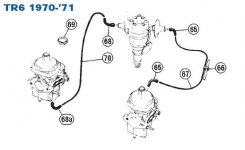
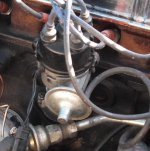
It's an emissions thing. By retarding the spark at idle (usually to 4 degrees AFTER TDC), supposedly the combustion is more complete and fewer unburned hydrocarbons (HC) go out the tail pipe.CJD said:Now you got me...never dealt with a retard port. How's that work?
But the effect is only needed at idle. So for most cars (TR250 and some 69 TR6 being a notable exception), they cut a special 'retard' port into the carb that supplies vacuum only when the throttle is closed. Then there is a special vacuum module on the distributor that retards the spark when vacuum is applied, instead of advancing it. Usually (tho not always), the retard port will be on the "back" of the capsule.
Some cars even have both advance and retard.
Attachments
TR3driver
Great Pumpkin - R.I.P
Offline
Can't really blame that one on the British. They just copied American cars of the period. And I believe it was our EPA that mandated the 4 ATDC timing at idle.CJD said:Interesting! The British ability to complicate things never ceases to amaze me...
CJD
Yoda
Offline
Guess that explains why I have never seen it. I avoid the early emmissions vehicles like the plague. I love pre-emmission cars, and tolerate the mid 90's on - when they went to electronic control of, well, everything.
On a different note, I'm wondering if my rebuilt throttle plate changed location to put the port behind the plate. I'll have to wait and see how it runs...
John
On a different note, I'm wondering if my rebuilt throttle plate changed location to put the port behind the plate. I'll have to wait and see how it runs...
John