• Hey Guest!
    British Car Forum has been supporting enthusiasts for over 25 years by providing a great place to share our love for British cars. You can support our efforts by upgrading your membership for less than the dues of most car clubs. There are some perks with a member upgrade!

    **Upgrade Now**
    (PS: Upgraded members don't see this banner, nor will you see the Google ads that appear on the site.)

TR2/3/3A Commission Number Plates Stamps

OP
K

kindacreeky

Freshman Member
Offline
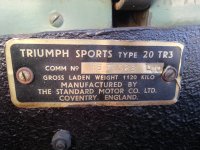
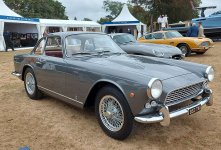
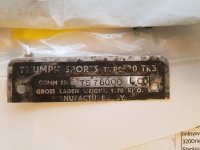
I am trying to make a reproduction commission plate for my Triumph Italia (TR3). The font of the stamped numbers and letters is an odd height. I tried 5/32" Hanson, but they were a bit too tall. The original figures measure 4.85/32" (0.152") or 3.85mm tall. I am guessing that Triumph Standard used these special height characters so that they could not be exactly duplicated. Does anybody know for sure? The fonts match vintage sets from a UK brand named "Imperial". The 1 has no bottom. The 3 is flat top. The 4 is closed. The 5 has a curved top. If anybody has a set of these special stamps, I need to possibly borrow. I am trying to help a bunch of Triumph Italia owners with this issue. If they are special, possibly only a Triumph collector would have a set.
 
For the Italia, there were three variations of the Commission Plate. One said 1120 KILO (no period). One said 1170 KILO. (with period) and has (1959) in the manufactured line. The third has the same 1170 KILO. but has abbreviations in the CO. and LTD. (TSF cars)
Type 3, TSF.jpg
type 1 .jpg
type 2.jpg
 
Last edited:
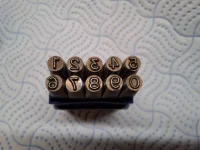
The font for the letters and numbers is the problem. We can have the plates properly etched and blanks made. We need the steel stamps to stamp the numbers and letters on the blank plates. The font is unusual and the height is odd. I found a set of stamps on ebay that had the correct font, numbers only. A vintage set made by Imperial in the UK. Here is a pic. it has long top on 1, also no bottom on 1. 3 is flat top. 4 is closed. 5 has curved top. 7 has curved diagonal (not unusual).
 

Attachments

  • proper stamp font Imperial brand antique.webp
    proper stamp font Imperial brand antique.webp
    172.3 KB · Views: 67
If you are a real perfectionist, the originals are not etched. The background is painted, but the lettering is raised and polished through the paint. I can look at one in a second and tell you if it's an original or an etched repop. (In your pictures, the first is a repop, while the 2nd and 3rd are original) Or...another way to look at it...if you cannot get the original raised lettering for the plate, why worry so much about a few fractions of a mm for the stamping?!?

PS, the first is confirmed as a repop in the screw used to fasten it. Triumph used larger style pop-rivets. It can be tricky, as many of these cars are in their 2nd or 3rd restoration, so even the repop parts look patinaed like an original would. I made this thread on restoring your original...but photobucket makes it difficult to see.

 
Last edited:
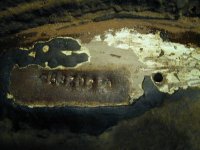
For the Italia, the plates were attached with screws. Not all had the same type screws. None had rivets. My car (#184) had the plate attached like the first pic below, with the interior trim type countersunk washers. The L meant Left. The CO meant Chassis only as chassis' were shipped to Italy for the Italian body. If there was a second O, with a space before, it meant Overdrive. The second plate shown is from Vignale car number 3, one of the show cars. It's plate just says C with no O. My car has had the plate modified. The previous owner cut off the bottom of the plate below where it says "Manufactured By". Not sure exactly why, but one of his buddies told me that he would claim the car was a Maserati. That's why I would like to get the proper stamps for marking the chassis number. The car shown is Vignale #235 just completed in the UK.
 

Attachments

  • 215CommissionNumber.jpg
    215CommissionNumber.jpg
    1.4 MB · Views: 66
  • 312.jpg
    312.jpg
    539.7 KB · Views: 63
  • 716788309_1571765787942153_4976611801817645964_n.jpg
    716788309_1571765787942153_4976611801817645964_n.jpg
    358.2 KB · Views: 53
  • 184 Commission Number Plate.jpg
    184 Commission Number Plate.jpg
    194.4 KB · Views: 78
I just noticed that one of the pics in the previous post used Phillips screws to secure the plate. That is not original. The Italia had almost no Phillips type screws used. (found 6 securing the dash below windscreen) Almost everything slotted, metric of course in the body. Chassis straight TR3.
 
Screws were never used on commission plates...slotted or phillips.
The Italia body was manufactured in Turin Italy. That factory attached the plates supplied by Triumph Standard, who supplied the finished chassis. I assure you that screws were used on all Italias' plates. This is well documented by Italia experts.
 
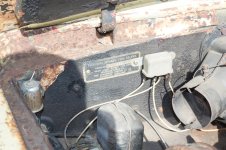
An interesting aspect of the Vignale-made Triumph Italia was that the body was stamped on the top of the inner fender well with the chassis number. This is usually covered with the goopy undercoat that covered all of the engine bay. It was not discovered that this number was on all Italia bodies until about 2016. The number is preceeded with the Greek letter Phi, and then ended with another Phi. Example in the pic below.
This car had lost its Commission Plate but this number will allow proper re-creation.
 

Attachments

  • P1011774.JPG
    P1011774.JPG
    348.7 KB · Views: 80
I wanted to correct some incorrect information in the previous post. The body stamps on the Vignale bodied Italias was not the chassis number preceeded by a Phi. It was the number (without the TS and any post descriptors) preceeded by a T with an oval or O on it side overstrike. This T-O was an abbreviation for Torino, or Turin as this is where the bodies were made. As these stamps were not easy to read, I had mis-read the first and last strike as a Greek letter Phi.
 
Allow me to impart some info as a former Standard Motor Company employee. I have a set of stamps used for making commission number plates which I obtained from a man who used them extensively and is now long dead - sadly, but none of us last forever.
For the record, these commission plates (to give them their proper name) were punched by a number of war-wounded employees who survived WW2 and had been guaranteed a job by CEO Sir John Black when they joined up to serve their country and on the assumption they would survive at wars end. Those that did survive and returned to work were happy to take any job that took full allowance for any injuries (mental or physical) they had sustained in the conflict. By their own admission, tHey were also extremely well paid, bearing in mind their injuries and how those injuries were incurred. I well remember six or seven men who had suffered horrendous injuries creating commission plates and the letter and number dies they used were all different. Therefore there’s no ‘proper’ or official font type. As long as the number was legible and was reasonably consistent in terms of digit spacing, it was considered acceptable for fitting to the car. Regarding whether or not punctuation is consistent - or not, depends very much on which supplier printed the plate. Standard always used more than one supplier for lots of consumable items. Again, as long as the plate said the same thing, no-one was particularly worried about incidental punctuation. Hope this helps. If you require further info, write me at johnbmacartney:at:gmx.com

John Macartney
 
Last edited by a moderator:
Allow me to impart some info as a former Standard Motor Company employee. I have a set of stamps used for making commission number plates which I obtained from a man who used them extensively and is now long dead - sadly, but none of us last forever.
For the record, these commission plates (to give them their proper name) were punched by a number of war-wounded employees who survived WW2 and had been guaranteed a job by CEO Sir John Black when they joined up to serve their country and on the assumption they would survive at wars end. Those that did survive and returned to work were happy to take any job that took full allowance for any injuries (mental or physical) they had sustained in the conflict. By their own admission, tHey were also extremely well paid, bearing in mind their injuries and how those injuries were incurred. I well remember six or seven men who had suffered horrendous injuries creating commission plates and the letter and number dies they used were all different. Therefore there’s no ‘proper’ or official font type. As long as the number was legible and was reasonably consistent in terms of digit spacing, it was considered acceptable for fitting to the car. Regarding whether or not punctuation is consistent - or not, depends very much on which supplier printed the plate. Standard always used more than one supplier for lots of consumable items. Again, as long as the plate said the same thing, no-one was particularly worried about incidental punctuation. Hope this helps. If you require further info, write me at johnbmacartney:at:gmx.com

John Macartney
I too appreciate your recounting of the history surrounding the veterans who were assigned the task of striking the plates. Like Many others here, as an aging baby boomer, both my parents were in military service, my mother in the European theater and my father in the Pacific. This detail of history should not be forgotten. This forum is the perfect place for your post.
 
Back
Top