• Hi Guest!
    If you appreciate British Car Forum and our 25 years of supporting British car enthusiasts with technical and anicdotal information, collected from our thousands of great members, please support us with a low-cost subscription. You can become a supporting member for less than the dues of most car clubs.

    There are some perks with a member upgrade!
    **Upgrade Now**
    (PS: Subscribers don't see this gawd-aweful banner
Tips
Tips

TR2/3/3A Thrust washer gap

sp53

Yoda
Country flag
Offline
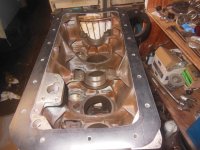
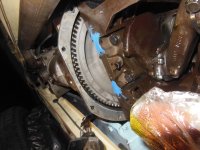
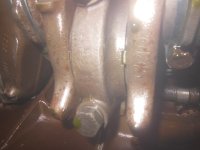
I finally got back to the oil pan gasket and got looking around for whatever. I noticed one thrust would move and the other did not. This is probably because the engine is jacket up. Anyways, I used the old thrust washers on this engine because I am afraid of aftermarket parts. Are thrust washers something that is a potential problem on a tr3 engine? I think when I let the engine down the crank shaft will go back to a floating position.

I am now just looking into the gap on thrust washers for a tr3 because I know so little about them, but my hope is the engine is built strongly in an old style and a little more play in the thrust washers should not matter……..

I made the gasket out of a 3mm rubber sheet from across the pond.


Thanks for looking I am concerned about the rubber gasket; time will tell

steve
 

Attachments

  • DSCN0840.JPG
    DSCN0840.JPG
    3.3 MB · Views: 45
  • DSCN0838.JPG
    DSCN0838.JPG
    3.3 MB · Views: 42
Nice gasket! I would be inclined to install that one to the pan dry, with only a touch of sealant at the front and rear bearing cap splits.

The engine sits in the car tilted to the rear. This means when it is running, the crank leans against the forward thrust washer...so all the way to the rear-most position. When you press the clutch, the pressure from the clutch pushes the crank against the rear thrust washer, so fully forward.

I might accept a few thousandths crank motion for and aft, above the spec. If it gets to be too much play, then the constant for and aft motion of the crank during use will start to put stress on the rod bearings, and could affect clutch operation and/or rubbing of the front crank sprocket inside the cam chain cover. Since you pan is off, you can check for most of these potential problems, and decide if the play is an issue or not.
 
I never thought about not using any sealer. I like the idea. I bought the large permatex non-hardening, but yeh sure would be a lot less messy.

The one problem I potentially see with the gasket is I punched the holes into it with a ¼ punch that leaves a slightly under 5/16 hole to keep the holes closed up as much as I could. I am thinking I should have given more wiggle room for the bolt. Without using gasket sealer, doing a dry run without the sealer might be the way to go.

I guess I could pull the main cap off and measure and check the gap of the trust washers. Overthinking is typical for me when I start getting too close to finishing something I started. When I get to the other side of this one, I will be happier…….

Thank you Steve
 
Steve, have you considered measuring your crankshaft float? That would answer your thrust washer clearance questions without having to remove a bearing cap.
Steve Baker
 
I must admit I have never measured the float before. I just used the old parts. What is a good way to measure the float? I would imagine a feeler gauge on each side of the cap or maybe when the engine is up like this I could simply measure one side.

What is the measurement and method commonly used to measure the float?

Thanks steve
 
There is a method to measure it with a feeler gauge in the manual. You are looking at .004-.006"
 
After I rebuilt my engine about 1.5 years back, I did one of those things where you stand there and stare, asking yourself if you installed the thrust washers correctly or backwards. There must be a name for that ailment, and I sure have it. I can’t remember what I disassembled to check, but I did. But, back to your question. I used a dial gauge to check my end float. It was perfect. I believe I used oil and a fine abrasive wet or dry paper to get the thrust washers to just the right thickness. I’m sure I checked with a feeler gauge as well. The manual shows that procedure.
 
Last edited:
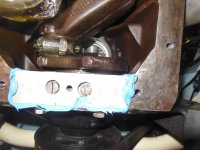
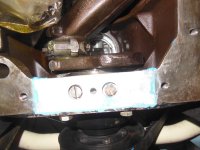
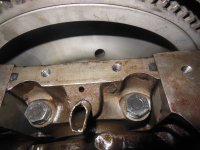
Ok I got the oil pan back on and sealed the seams in the aluminum piece and rear cap with some sealer on the seams. It was clearly leaking before at the aluminum piece. I removed the piece, cleaned the area up with Brake clean and rags a few times then gooped the piece up with the sealer and carefully put it back, letting the sealer squish out and then trimmed the sealer with a new razor.

Now I need to torque the pan down, but not sure if I can make the book's torque speciation without freaking out. The book wants 16ft to 18 foot pounds. I have an old memory of the problem about torquing pan and KVH mention the same thing.

I have a nice ratcheting torque wrench that goes up to I think 150ft pounds, but again perhaps the lower ends calibration might be off. I torqued the bolts down to wrist strength which could be 5 to 10lbs I do not.

I really would like some success here because I have fought leaky Triumph pans for too long. Any ideas on the torquing problem please speak up.

Thanks Steve
 

Attachments

  • DSCN0843.JPG
    DSCN0843.JPG
    3.4 MB · Views: 33
  • DSCN0845.JPG
    DSCN0845.JPG
    3.3 MB · Views: 31
  • DSCN0846.JPG
    DSCN0846.JPG
    3.3 MB · Views: 32
  • DSCN0848.JPG
    DSCN0848.JPG
    3.3 MB · Views: 32
Ok I got the oil pan back on and sealed the seams in the aluminum piece and rear cap with some sealer on the seams. It was clearly leaking before at the aluminum piece. I removed the piece, cleaned the area up with Brake clean and rags a few times then gooped the piece up with the sealer and carefully put it back, letting the sealer squish out and then trimmed the sealer with a new razor.

Now I need to torque the pan down, but not sure if I can make the book's torque speciation without freaking out. The book wants 16ft to 18 foot pounds. I have an old memory of the problem about torquing pan and KVH mention the same thing.

I have a nice ratcheting torque wrench that goes up to I think 150ft pounds, but again perhaps the lower ends calibration might be off. I torqued the bolts down to wrist strength which could be 5 to 10lbs I do not.

I really would like some success here because I have fought leaky Triumph pans for too long. Any ideas on the torquing problem please speak up.

Thanks Steve
I guess the manual spec at 18-20 ft/lbs for a TR4 makes sense but I’m so gun shy because I’ve sheared the heads off two bolts in my TR car istory, and it was no fun. I also worry about stripping the threads in the block. So, truthfully, I torque lower, like about 15 ft/lbs or “to feel.” And here’s the reality for me—that pan will leak no matter what I do, and so will the RMS.

All the care in the world, at least for me, and I still get leaks. So I just do my best and use Permatex High Tack with a Moss gasket. I see yours in 3mm rubber or silicone so you’ll be in a different zone.

I hesitate to say this but I once used that gray Ford Motorcraft gasket sealer, and it seemed it was the best I’d ever used, but it gets hard, and I paid the price in labor cleaning that stuff off at the next pan service. For me, therefore, it’s working the pan carefully on a piece of glass, getting the flanges are true and square, leveling out the bolt holes, and picking out a gasket sealer.
 
If you measure the send float and it is in excess(more than .006) an over size thrust washer is available.(.005)
It is permissible to use one side a standard and the otherside an oversized to achieve the desired spec of .004
If this is too tight, the steel side of the bearing can be sanded on a piece of glass to get it to .004 oversize.
And always use an assy lube and make double sure the washers face correctly.If done wrong they will spin and
damage both block and crank (usually fatally).
Mad dog
 
Thanks all for the information on the thrust-washers. I left the washers alone. The thought of going any further into fixing things that I am kinda of sure I at least looked at years ago, stopped me from diving into the thrust washer play. And besides years of oil leaks has made me senseless or numb to getting things just perfect. However, I probably like the battle deep down inside and the challenge auto mechanic provides.

Steve
 
The thrust washers are easily replaced with the pan off. The center main cap is removed,
and the upper bit will come out as you slide in the new one.It is also good to inspect the bearing
to make sure there is little/no wear before reinstalling it.......
Mad dog
 
Well, since I rebuilt my engine 4200 miles ago, I figured my end float would be good, but I had a surprise after checking.

It took a lot of gymnastics under my car to mount the dial gauge, but I think I got it square and correct. If I push the clutch pedal in and out my dial gauge comes to rest at about .0075, out of spec. My manual calls for .004 to .006. However, if I take a video of the gauge movement, I can see the gauge pop as high as .009 before coming back to rest at .0075. I suppose I could just wait and check again after another 1000 miles but I'm curious what others here think.

Any thoughts? Thanks all. Happy Holidays--and to a Great New Year.
 
The table below is what I found in an old post from Randall on this same subject of crankshaft end-float. The point of the discussion back then was that .004 to .006 is “desirable“ but that permissive manufacturing tolerances could actually go as high as .0117.

I’ve also read online from hopefully reliable sources that using the clutch method to determine crankshaft end float can be a little misleading because of the great pressure applied to the flywheel, especially if the dial gauge is mounted on the frame of the car, increasing the likelihood that at least some of the movement is the engine, itself, moving ever slightly on the engine mounts or even pressing so hard on the thrust washers as to press out a typical or expected oil film of some measurable thickness.

Randall‘s point back then appears to be in response to a concern that .008 might be seen as excessive crankshaft end float. He felt that would not necessarily be the case based upon the more specific information he was able to find in the manuals.

My conclusion from everything I am seeing is that the strategic placement of the dial gauge and the use, or non-use, of the clutch method for measuring end float would be material factors in evaluating any situation where deviations from spec are minor.


1766770477997.jpeg
 
Last edited:
IMHO a NOS set of washers might be the hot trick as the .005 over will be too much. Mic the old washers to
compare with the new. You should pick up a few thousands of tightness.
Mad dog
 
Thanks you guys for giving my thrust washer dilemma some time. Yes Randall always had an informed opinion on things that helped shape my view. When I first saw how the thrust washers were positioned with the engine tipped back with one moveable and the other not, I kinda freaked out. Then when I saw I needed a .004 gap, I thought getting an accurate measurement of that number on my back under the car might not be trustworthy. It sounds like Randall felt concerned about getting a good number with a dial indicator and movement of the crank with the clutch and maybe smashed oil, wow .

I did get a new set of thrust NOS washers with this last car that was given to me by these 2 sisters in their 60ies. The car belonged to their dad and they have been keeping care of it since 1980. Some of the stuff has water damage like the head, but the pistons and sleeves look fine. But again the thrust washers are rusty and the brand name is an old USA brand.

When I looked into the thrust washer’s maintenance in general, I saw what looked like sanding them down with fine emery cloth to get that very small number.

Anyways, the car with the thrust washer concern is my driver and fixed please god.

I am now starting on the TR2 engine which is going to be a tr3 block with a low port head which I got from Steve M. on this forum. I am so grateful that he had that head stashed away for years and gave me a great deal on it--- plus--- Thanks Man.

I will maybe use those rusty thrust washers on the tr2 engine. I will start a new thread as I go, but I gotta say I am still freaked out by the Rear Main Seal leaking. I rebuilt an engine probably 15 years ago and the RMS leaked badly, but again it might have been the oil pan some. My driver RMS might not leak not sure because no miles on it after the rubber gasket fart idea---hope it works

Art with the black 58 on the forum put in an RMS and it did not leak. John put a RMS in and it did not leak. Last time I did it, it leaked. I even put on one of those MAD MAX seals which is very cool and should work, but again, I was leaking oil so badly and have the new gasket I am not sure.

thanks Steve
 
Back
Top