• Hi Guest!
    If you appreciate British Car Forum and our 25 years of supporting British car enthusiasts with technical and anicdotal information, collected from our thousands of great members, please support us with a low-cost subscription. You can become a supporting member for less than the dues of most car clubs.

    There are some perks with a member upgrade!
    **Upgrade Now**
    (PS: Subscribers don't see this gawd-aweful banner
Tips
Tips

Bypassing battery cutoff switch, using is as anti-theft only?

jjs64bj8

Senior Member
Offline
During our 64 BJ8 restoration (in final stages) we have installed an alternator and gone to negative ground. I just do not trust the contacts in the stock cut-off switch so we have bypassed the ground cable directly to the frame. But the white/black wire that goes to the distributor is still there. So why can't the switch still be used to short the points as designed? Wire it to do that alone and it still looks stock.

We have installed alternative theft deterrents on the fuel pump power, so killing the juice is not as important with no other anti-theft measures.

Any thoughts?

jjs64bj8
 
A shut off switch can help as a theft prevention measure. For that to be effective, it usually works best to hide the switch. If you use the stock switch in either manner that you mention, locking the trunk of your Healey might help prevent theft.

Another reason for using shut off switches has to do with preventing vehicle fires. Even in a vintage car with newly replaced wiring, fire can happen. Who knows which one of those old components may short out, and given the rudimentary fusing system on the Healeys, extra protection might be a good idea. Turning off a switch connected to the main cable near the battery gives peace of mind. If you don't trust the stock Healey switches, one can buy much more robust high quality switches. They are commonly used on race cars and heavy trucks. Some have a removable key, which helps even more with theft prevention.
 
I just do not trust the contacts in the stock cut-off switch.

-They are very rugged:-jjs64bj8 -

Let me assure you that switch can handle all the fault current produced by the car.
As an anti theft device it gets a 10 rating

I liked
blueskies
Reply too--:encouragement:


user-online.png
 
The only electrical failure (i.e, left me on the side of the road dead for a half hour) I ever had in 35+ years of Healey ownership was the in the anti-theft function of the battery cut-off switch. It shorted the wire to the coil to ground no matter whether the switch was turned on or off. After that experience I disconnected that white wire...
 
The only electrical failure (i.e, left me on the side of the road dead for a half hour) I ever had in 35+ years of Healey ownership was the in the anti-theft function of the battery cut-off switch. It shorted the wire to the coil to ground no matter whether the switch was turned on or off. After that experience I disconnected that white wire...

That is a failure mode of an old part.

It probably could have been repaired as discussed on this forum or replaced with new.

Now your car can very easily be hot wired.
 
Thanks for the comments. We have a new harness installed so I hope there is not going to be any issues there. Also as mentioned we have a hidden switch to disable the fuel pump. In fact a faucet type fuel pump was installed in line with the new stock pump. The switch allows current to one or the other or none.

Since we are in FL we may end up installing an aux electric cooling fan (via a relay) which will put more strain on the electrical system, that's my basis for not trusting the contacts on the stock switch even thought it was refurbished. Or am I being paranoid? So is there a current limit for the cut-off switch?

Thanks jjs64bj8
 
Thanks for the comments. We have a new harness installed so I hope there is not going to be any issues there. Also as mentioned we have a hidden switch to disable the fuel pump. In fact a faucet type fuel pump was installed in line with the new stock pump. The switch allows current to one or the other or none.

Since we are in FL we may end up installing an aux electric cooling fan (via a relay) which will put more strain on the electrical system, that's my basis for not trusting the contacts on the stock switch even thought it was refurbished. Or am I being paranoid? So is there a current limit for the cut-off switch?

Thanks jjs64bj8

Well considering that the switch is not switching live current, normal additions of electric components to the car do not compromise it.

I would guess based on its contact size that its current handling capability is close to 100 amps, which is comparable to say a # 0 AWG wire.

OH !-they work great in triple digit California heat too.-:highly_amused:
 
Well considering that the switch is not switching live current, normal additions of electric components to the car do not compromise it.
...

Sorry, but that is incorrect. If electrons are moving, they are in a circuit, from a source--one terminal on the battery--to a drain--the other terminal on the battery--via the car's chassis, regardless of polarity (one theory of electricity maintains that electrons flow in one direction and the 'holes'--the valence locations they have vacated--move in the opposite direction). The total load will flow through the cut-off switch, because it's the only path back to the battery.

I rebuilt a cut-off switch; the contacts are two thick copper plates. I'd guess it could handle a 100A load, like someone suggested, but might get a little warm. Depending on the model, Healey generators are capable of something like 25-28 amps. Normal running load is probably in the range of 5-10 amps--just a guess--and with all lights on is close to the capacity of the generator (which is why your lights dim when RPM drops). So, adding more electrical stuff should not be an issue for the switch--I've never heard of one 'burning out,' just becoming intermittent--but you may have to upgrade to an alternator.
 
aux electric cooling fan (via a relay) which will put more strain on the electrical system OK NOw I'm confused , isn't the relay to reduce strain?
 
In about 1985 or 86, I retrieved my Healey after10 years of storage in my father-in-law’s North East Pennsylvania unheated garage and brought it home to the Jersey Shore. When evaluating the condition of the car, I found that many of the electrical connections and switch contacts had corroded to the point of inoperability and became a major reason motivating a total dismantling of every component in the car.

One of the many electrical components disassembled, cleaned, and lubricated, was the battery shut-off switch. When disassembled, this original switch was found to be strong and complete but, over the 10 years of car storage in North East Penn, had corroded substantially. After cleaning contacts, I inserted a substantial amount of Di-electric grease, and resealed (closed) the unit. Since then, no issues or problems have been experienced with this, or for that matter, any switch or connector serviced in this manor.

The non-conductive di-electric grease was chosen to address a number of electrical connector issues. First, this grease lubricates the switch for smooth operation. Second, the non-conductive grease separates from contacting surfaces to allow good connectivity but eliminates detrimental flash-over often resulting in contact burn. Some have suggested a conductive grease would be better, however, unless the conductive grease is well sealed from mounting hardware or leakage, short circuiting is potential and, in my opinion, probable.

I have packed almost every original switch (that I can dismantle i.e. headlight switch etc) in this manor and have also serviced bullet connectors after soldering the wires to the bullet. To date, I have experienced no electrical issues on any of my serviced components and, although suggest others evaluate every suggestion for themselves, am quite happy with my results in this approach.

Ray (64BJ8P1)

 
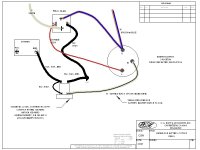
If you care to shut off your battery without using the manual standard cut-off , you never need to open the boot to completely shut it off.
Sometimes the boot is so full of baggage that it becomes an effort to reach the manual cut-off switch especially for the 100's .
As a safety factor ,if you had an electrical malfunction, you might not be able to reach the manual cut-off in time.
Has anyone ever left their battery switch 'on' at night or in a dubious area - just forgetting ?
A relay and special ignition switch is easy to hook up.
attachment.php
 

Attachments

  • HLY BAT SOLENOID & SWITCH.pdf
    28.9 KB · Views: 229
  • HLY BAT SOLENOID & SWITCH.jpg
    HLY BAT SOLENOID & SWITCH.jpg
    78.4 KB · Views: 232
Sorry, but that is incorrect. If electrons are moving,

Well If the switch is being turned on or off Bob which is its normal operational sequence, There should be virtually no current flowing.

Stead state current flow through the closed contacts which are of low resistance produces very little internal heating.

Additionally, the switch is a very low duty cycle device which prolongs its life.

The addition of the normal type electric up grades to the car will not put a destructive burden on the switch.
 
aux electric cooling fan (via a relay) which will put more strain on the electrical system OK NOw I'm confused , isn't the relay to reduce strain?

The load is the load (total of all the current draw in a circuit). The (relatively) small switches on the panel are not designed to handle a large (current) load, so for a sink (consumer of electrons) with significant current draw a relay is installed to carry the heavy load. So, panel switch is used to switch a small current to the relay, which in turn switches the large load--hence 'relay'--through some heavy-duty contacts (points). This is why OD circuits have relays, and most people that install large driving/fog lights drive them through a relay.

The increased 'strain' (load) has to be supplied by the generator, and any wires or contacts that you connect to to supply power to the fan.
 
When I went to pick up my car at the body shop recently, I turned the battery cutoff to "on" and smoke began to appear from under the dash.

Needless to say, I turned it back "off".

I'm all for keeping the switch active to keep Lucifer, err Lucas, at bay. I'm still working on the cause of the short in new (<20 yo) wiring.
 
When I went to pick up my car at the body shop recently, I turned the battery cutoff to "on" and smoke began to appear from under the dash.

Needless to say, I turned it back "off".

I'm all for keeping the switch active to keep Lucifer, err Lucas, at bay. I'm still working on the cause of the short in new (<20 yo) wiring.

I let smoke out from under the fascia (dash) one time with a newish harness. The harness came with a cigar lighter lead that was hot and unfused; I didn't insulate it and it contacted something metal.
 
Lets face it, we have added electrical components and increase power draw in a number of units. All this with many not adding fuse protection to protect from this type of short. I know I personally have gone quite far and increased the number of fuses to cover all circuits except the starter, battery cable, and the like. Yes, I may have gone too far but I only louse a fuse if my O/D circuit shorts or headlights or signal lights decide to carry water. Although I have looked at protecting the main battery/starter/alternator circuit, I have not come up with a satisfying level of function and protection and will be looking at Mr. Hart's switch approach as a possible protective path.

I, personally, believe we have gone far from the minimalist approach of our original Healey electrical system and with the addition of such components as electrical cooling fans and the like, are moving closer and closer to disaster. Although I expect each to find their own path, we are moving closer and closer to loosing ourselves in the complexity that could easily progress to inactive confusion.

Ray (64BJ8P1)
 
Thanks again for al the comments. For info - new harness installed, alternator conversion, negative ground, added additional fuses on major circuits, all tested and no issues running with bypassing the cut-off switch. The negative battery cable goes to directly ground and the white/black wire is not connected. The cut-off switch just sits there looking like it belongs.

We did take apart the cut-off switch and cleaned and reassembled with new rivets. Rings out correctly. So I suppose we will install it per original wiring and see what happens.

I have read numerous past posts that say either to eliminate or replace with a modern switch. That is the basis of my original post. So now the consensus is to use thes witch as designed assuming it is in good working order.

Thanks


jjs64bj8
 
Although I expect each to find their own path, we are moving closer and closer to loosing ourselves in the complexity that could easily progress to inactive confusion.

Ray (64BJ8P1)

I like that term, "inactive confusion." When lost in the moment of designing and building complex electrical and electronic circuits, it all makes sense. But when a problem occurs a year or ten years later, trying to figure out what one once designed can be mind boggling. If one would only make detailed schematics as one goes along . . .
 
I like that term, "inactive confusion." When lost in the moment of designing and building complex electrical and electronic circuits, it all makes sense. But when a problem occurs a year or ten years later, trying to figure out what one once designed can be mind boggling. If one would only make detailed schematics as one goes along . . .
It happens in professional circles too. It's very frustrating for troubleshooting.
 
:iagree:-- If one would only make detailed schematics as one goes along . . .and I am guilty of not doing it TOO

I even made my own in line fuses that are hidden in side a standard Bullet connector barrel. Sneakey yeah, but keeps things looking original and safe too.:highly_amused:
 
Back
Top