• Hi Guest!
    If you appreciate British Car Forum and our 25 years of supporting British car enthusiasts with technical and anicdotal information, collected from our thousands of great members, please support us with a low-cost subscription. You can become a supporting member for less than the dues of most car clubs.

    There are some perks with a member upgrade!
    **Upgrade Now**
    (PS: Subscribers don't see this gawd-aweful banner
Tips
Tips

gas tank repair 100/6 without killing myself

Hawkscoach

Jedi Hopeful
Country flag
Offline
gentlemen, Let me start with "I know this is dangerous"...........however, I would like to repair my existing fuel tank. It appears clean inside and is generally in good condition, with the exception of some rust on the flange on one side. I drained the tank over 3 years ago and left open at the fill and the sending unit. With No product in it and stored in a dry environment. Has anyone done this and what steps at this point should I use to make sure the big bang doesn't happen. I purchased the entire Moss clean, etch, etc. products to save the tank. I have good welding skills and would like to do this. Again, this tank was open for many years with nothing in it and I would not even have considered this if that were not the case. I am thinking that power washing with soap/water. and maybe even taking it somewhere to have it cleaned like a radiator shop may be a good idea??? Thanks in advance, Doug
 
gentlemen, Let me start with "I know this is dangerous"...........however, I would like to repair my existing fuel tank. It appears clean inside and is generally in good condition, with the exception of some rust on the flange on one side. I drained the tank over 3 years ago and left open at the fill and the sending unit. With No product in it and stored in a dry environment. Has anyone done this and what steps at this point should I use to make sure the big bang doesn't happen. I purchased the entire Moss clean, etch, etc. products to save the tank. I have good welding skills and would like to do this. Again, this tank was open for many years with nothing in it and I would not even have considered this if that were not the case. I am thinking that power washing with soap/water. and maybe even taking it somewhere to have it cleaned like a radiator shop may be a good idea??? Thanks in advance, Doug
I had a radiator do mine and they pressure checked it and cleaned it out plus gave it a good coat of paint. Best to have it pressure checked for leaks!
 
I re-skinned my BN4 tank because although it looked ok on the outside, it was very thin in a lot of places. If you are lucky enough to have just a few spots of rust then I'd get some acid flux solder and a very big iron and solder them up. If you have to weld metal anywhere near the seams then the welding heat will melt out the solder so you may as well take the side(s) right off to start with. If you do go that far then cleaning out the tank is a breeze as it is possible to sand/abrasive blast the majority of the inside which gives the perfect finish for tank-sealer.

Heat is the thing that reactivates vapor in old fuel tanks. Mine had been empty for about 15 years and still managed a good whoomf and a jet of molten hot solder out of the seam as I unsoldered the side panels. Fuel gunge had built up the seam on the inside and heat from the propane flame produced enough fuel vapor to burn. Nothing hugely dangerous but a good reason to wear safety gear and do it outside.

Running welder gas or even car exhaust inside the tank will prevent an explosion, as will filling it with water.

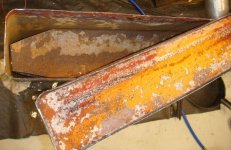
This is what my tank looked like inside, the orange stuff is mostly fuel gunge not rust. Andy.
fuel tank.JPG
 
I did some brazing on an old tank and I am still here to talk about it. I recall filling the tank about half way with water and brazing above the water line. The bad news is it still leaked slightly after my repair and I ended up coating it with fiberglass out the outside to stop the small leaks. I have had this tank on a car for 20 years and it still does not leak at all. I really suggest you forget welding, brazing, or soldering, just carefully clean and prep and apply a layer of fiberglass with polyester resin you can buy in a box store. Much safer and rather effective. Fiberglass does hold up to gasoline/ethanol OK, they use in to fabricate gas tanks in boats. Do not use JBWeld anywhere, it does get soft in gasoline.
 
Hydrocarbons will become entrapped in the grain of the steel. Ideally, you need to remove one of the three (3) components of any fire: fuel, oxygen or ignition.

A very proficcient weldor very matter of factly told me that the best way to weld on a fuel tank (fuel & ignition components present) is to connect a hose to the tailpipe of a running car and stick the other end in the fuel tank. The exhaust gas will displace all the oxygen, avoiding that awkward ka-boom period.

Try not to breath too much of the fumes...
 
thanks guys! this is a complete restoration and the tank has/and is, out of the car. I think I will spend some time cleaning the outside and look more carefully at the condition, then take it to a radiator shop to find out if there are any surprises, leaks. If all is good, I will fix the flange and move on. Doug
 
this became a mute point....................after some more cleaning and checking............the tank is toast. one side is not repairable as evidence of a shady repair became evident along with holes on the sides and bottom corner..........its only money
 
The reproduction tanks aren't quite the same as a Longbridge car in that the outlet pipe has a different fitting which needs an extra hole drilling in the bulkhead and a new pipe making.
 
I am sure that I have read somewhere about the Ozzies filling the tank with exhaust gas ( removing oxygen) and then keeping an engine running pushing exhaust in whilst they then welding up the damage.

Can understand the principle but not sure if I would try it myself.

:cheers:

Bob
 
Moss is lightning quick. New tank just came in. I guess now I will use the products that I already purchased for sealing/restoring the old tank,,,,,,,,,,,,,on the new tank. Doug
 
Moss is lightning quick. New tank just came in. I guess now I will use the products that I already purchased for sealing/restoring the old tank,,,,,,,,,,,,,on the new tank. Doug
I tries the "goop" several years ago and it left me on the side of the road when pieces broke loose and got stuck in the line between the tank and fuel pump. Keep the tank full and it will help with the inside corrosion issues.
 
Back
Top