• Hi Guest!
    If you appreciate British Car Forum and our 25 years of supporting British car enthusiasts with technical and anicdotal information, collected from our thousands of great members, please support us with a low-cost subscription. You can become a supporting member for less than the dues of most car clubs.

    There are some perks with a member upgrade!
    **Upgrade Now**
    (PS: Subscribers don't see this gawd-aweful banner
Tips
Tips

TR4/4A Moss voltage stabilizer, part number 131-555

Mink

Jedi Trainee
Country flag
Offline
For those of you using the Moss Motors solid state voltage stabilizer (for the temp and fuel gauges), have you found them to be reliable? Mine just failed after less than 2 years (and probably only about 1000 miles). I doubt that it has any warranty on it, but it seems like with minimal use it should have lasted longer. Is there a better alternative?
 
Had a new one from Moss that failed after 15 minutes run time, the replacement Moss sent for it proved to be defective as it was providing around 8Volts instead of 10Volts.
The Moss replacement for the low voltage unit is still going after some 500 miles.
All units were neg ground.
Moss takes care of customers, give them a call.

M.
 
I did my own solid state conversion using the original can and an NTE 1953 regulator chip (about $5 at the local electronics house). Still working fine after 5 years or so. (I have an early TR4 temp gauge in my TR3.)
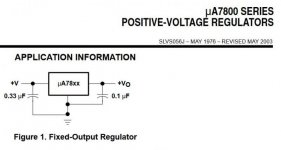
However, what I discovered is that the chip needs a capacitor on the input, which many conversion instructions do not mention. Without the cap, it was oscillating, which caused the chip to appear to be bad. In one case it overheated and shut down during testing on the bench, the second attempt with another chip seemed to work fine until I got it in the car but then appeared to only be putting out 8 volts. The NTE datasheet doesn't really mention the requirement for the cap, but two caps (one on input, one on output) are specified in the "electrical characteristics" section of the datasheet. https://www.nteinc.com/specs/1900to1999/pdf/nte1953.pdf

I don't know which chip the Moss unit uses, but almost every regulator IC on the market wants some capacitance near it. For example, the LM7810 and LM317 (which are also popular choices for VS replacement) datasheets both say explicitly "Ci is required when the regulator is located an appreciable distance from the power supply filter". (Note 30 in https://www.fairchildsemi.com/datasheets/LM/LM7810.pdf )

Here's a photo I found of the Moss VS, being used to "prove" that no capacitor is required :smile:
131-556_1.jpg


If you don't want to "roll your own", you might just try adding a capacitor from the input terminal to ground. 0.33 uF should be fine.

PS, the lifetime on solid state components should be somewhere out beyond 100,000 hours, which is basically forever in automotive terms.

 
Last edited:
Well, Moss was kind enough to replace mine at no charge, which is nice. However, I think I'm going to try adding a capacitor as Randall suggests. Unfortunately, Radio Shack doesn't exist anymore so I will have to find an electronics supply place.
 
Does Roadster Factory voltage stabilizer 128484 have the same problem? Does it need a capacitor? It appears their source is the UK. Thanks!
Bob
 
Yeah, definitely need some capacitance on the input and output; below is a clip from the 7800-series IC data sheet. The one you want is the 7810, which has 10 volt output. You can get them lots of places; look on-line or even eBay.

Automobile electrical systems, especially on 60s-era British cars, are notoriously dirty. It's not at all unusual for them to generate big spikes, which can damage an IC. I'd add some circuitry to limit the input voltage--like a 20-volt zener diode.
7800.jpg
 
I had one in my TR6 for several years (think I bought from TRF, but not certain). One day it stopped working. When I took it out, one of the spade connectors was loose. I added some solder to both connections to make them solid again and it worked fine after that. I never added any capacitors or made any other modifications. Cheers, Mike
 
I had one in my TR6 for several years (think I bought from TRF, but not certain). One day it stopped working. When I took it out, one of the spade connectors was loose. I added some solder to both connections to make them solid again and it worked fine after that. I never added any capacitors or made any other modifications. Cheers, Mike
Similar story here. I'm ending my 4th season on a new solid state stabilizer in the Herald with no issues. I'd certainly consider capacitors if I had problems but if it ain't broke...
Tom
 
I have used 7810 chips for years in LBCs and have not bothered with the input cap. That said, it certainly won't hurt to add one for protection.

I am not convinced that the output side of the chip benefits from a cap on that side. Consider for a moment that the electromechanical Smiths stabilizer switches off and on multiple times per second swinging the output voltage from 0 to about 14V to produce an 'average' 10V. The output of the 7810 chip is much more stable to begin with.
 
Which is very much the way it goes with parasitic oscillation. Happens only sometimes, not all the time.

I agree about the output cap not required, it's just to improve regulation for sudden changes in load (which aren't going to happen in this application, the load only varies slowly.

But the input cap helps keep the chip from oscillating, and is probably a good idea even if you do have a cap somewhere else in the system. (For example, I put a cap on the generator output on one of my previous TR3s, to keep the generator whine from jamming the CB radio. Most stereos have filter caps inside too.)
 
This is disappointing; I had one in my shopping cart thinking that it would be a good thing to swap an existing and functional VS which could go into spares. My fuel gauge seems to read less than expected when compared to a dip-stick in a Boyd Welding aluminum fuel tank...
 
This is disappointing; I had one in my shopping cart thinking that it would be a good thing to swap an existing and functional VS which could go into spares. My fuel gauge seems to read less than expected when compared to a dip-stick in a Boyd Welding aluminum fuel tank...

Since I originally posted this thread a couple of years ago, Moss replaced my original one with a new one which has been working fine (though the car only gets driven a couple hundred miles a year).
 
Ok, thanks for that. I didn’t realize this was an old thread. They are cheap enough, i’ll risk it and see what happens. My car doesn’t go much farther per year than yours does so...
 
Back
Top