• Hi Guest!
    If you appreciate British Car Forum and our 25 years of supporting British car enthusiasts with technical and anicdotal information, collected from our thousands of great members, please support us with a low-cost subscription. You can become a supporting member for less than the dues of most car clubs.

    There are some perks with a member upgrade!
    **Upgrade Now**
    (PS: Subscribers don't see this gawd-aweful banner
Tips
Tips

General Tech Follow up on Master Cylinder and Brake Fluid

glemon

Yoda
Bronze
Country flag
Offline
I posted a topic a short while back about my brake master cykinder speculating as to why it was leaky/empty. Well as pointed out I was totally off base about the brake servo sucking fluid out, so lets forget I ever said it.

I ordered a rebuild kit because I figured the BMC was only about 8 years old with limited hobby car mileage.

Being not overly bright this week I took the MC apart, rebuilt it, then cleaned and inspected the bores, little line of pitting or corrosion right at the bottom of the circle of the bore.

I have been a proponent of DOT 5 and will still use it, but turns out it is lighter than water, so it doesn't absorb it and water pools at the bottom of things, hence my problem, guess I need to flush it out more often.
 
Interesting thought! I have been using DOT5 for about 6 years with no issues, but I do find it strange that every cylinder I buy states "warranty void if using DOT5". I wonder if water pooling could be part of it?
 
Welcome to one of the many reasons I won't touch the stuff.
Spongy pedal for another one.

We used to get cars in the shop, rear wheel cylinders (or whatever) leaking..the water had eaten the bottom of the W/Cyl bores so badly there was no hope. Calipers, same. Masters, same. Wait until you pop a steel line because it rusted from the inside at a low spot.

On my car, all the suppliers say DO NOT use DOT 5, as none of the brake rubber bits are compatible....so I don't.

Far better off, in my opinion, to use 3 or 4 and bleed it out every couple of years (suck the reservoir out, new fluid, and bleed out a 1/2 quart or more total).

You could have it sleeved with stainless...then find stainless pistons some where....and stainless brake lines.....and you see the cost of a quart of DOT 3 or 4 is cheap.
 
Interesting thought! I have been using DOT5 for about 6 years with no issues...

18 years for me and also no problems -- but it is obvious our experience is not universal. Some love, some have issues with it.

Changing to DOT5 is one of the first things I do when I acquire a British car.
 
I'm noticing dry vs wet climates seem to make a difference. Washington state and Nebraska damp vs Texas and Arizona dry?!?
 
Eastern Nebraska is probably about halfway between dry and humid, it is certainly not like Florida or Houston, but people who come from the dry, western part of the state remark on the humidity.
 
I thought one of the advantages of DOT 5 was it did not take up water like the older break fluids did.

Is it something to do with starting with a fluid change verses a completely empty system?

Am interested as I have not got to the point where I fill my system.

David
 
One of the POSITIVES of DOT 3 and 4 IS that is is hydroscopic, and absorbs water.
Unfortunately, too many folks don't bother to change it out periodically as directed.

Since it absorbs water, and holds it in suspension, you flush it out.

Moisture (and that can read: Condensation) will develop in DOT 5 systems, how much and how often depends on locale.
The water drops out of suspension, and just sits on the bottom of whatever...and rusts it away.
 
This thread finally explains the reasoning behind the warranty disclaimers for DOT5...! I think if I were in a humid climate, where condensation is common, then I might lean towards the DOT3/4. In Fort Worth, we get no condensation, like, ever!, so DOT5 has the advantage of not harming paint in the event of a leak, so I would lean towards DOT5.
 
This thread finally explains the reasoning behind the warranty disclaimers for DOT5...! I think if I were in a humid climate, where condensation is common, then I might lean towards the DOT3/4. In Fort Worth, we get no condensation, like, ever!, so DOT5 has the advantage of not harming paint in the event of a leak, so I would lean towards DOT5.

For me I also went with dot 5 for the compatibility with paint,which worked out good after some leaks.
The Moss repro reservoirs have a bellows type seal for the cap so I don't think condensation would be an issue like with just an original vented cap.
Tom
 
This thread finally explains the reasoning behind the warranty disclaimers for DOT5...! I think if I were in a humid climate, where condensation is common, then I might lean towards the DOT3/4. In Fort Worth, we get no condensation, like, ever!, so DOT5 has the advantage of not harming paint in the event of a leak, so I would lean towards DOT5.
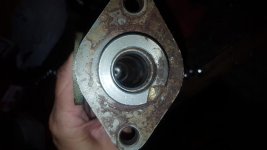
Yes, kind of a Eureka moment for me too, though I wish I could have figured this out without sacrificing my master cylinder. You can see the pitting as the bright spots in the bottom of the bore.
20170724_223954.jpg20170724_223954.jpg
Not sure why the website rotated the picture 90 degrees and repeated it, but you can see the corossion on the bottom of the bore, to the right of the picture as displayed. It is also longer along the bore than appears in the picture, but the angle compresses the length, about 3/4 of of an inch along the bottom of the bore.
 
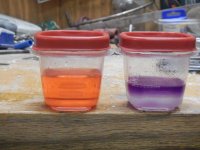
Just mixed some water with both DOT 5 (Purple colour) and DOT 3 (Red Colour).

The DOT 5 immediately separated and floated on the water.

So I think that I will be using DOT 3 or 4 as I live in a humid area.

David

brake fluid.jpg
 
Back
Top