• Hey Guest!
    British Car Forum has been supporting enthusiasts for over 25 years by providing a great place to share our love for British cars. You can support our efforts by upgrading your membership for less than the dues of most car clubs. There are some perks with a member upgrade!

    **Upgrade Now**
    (PS: Upgraded members don't see this banner, nor will you see the Google ads that appear on the site.)
Tips
Tips

Yes, another high idle string

TRclassic3

Jedi Trainee
Country flag
Offline
Hate to do it, but I couldn't find answers I need in the history. A little background first. SU H carbs. Rebuilt 2 years ago by Apple Hydraulics(by PO). Since acquiring the car it has always idled high, generally around 1300 to 1400. The idle scew for both carbs is backed out all the way, as is the choke adj. screw. Right after getting the car I had it checked out by professional and they noted he high idle and changed out the butterflys with no noticeable difference.

I also inherited a balancer and a color tune from the PO. I checked the balance. Dead on. I then proceeded to check with the color tune. I realized that I can't be sure of the results nor follow their testing scheme when I'm starting off at such a high idle. Any way, one of the carbs seems out of whack in that the color goes from blue to yellow when slowly apply more throttle, so that by around 1700 it goes to yellow and stays there, indicating a rich condition. The other carb seems to react more as indicated, and stays blue as slowly accelerate.

So, first, where do I start to try to get the idle down, and second how to approach the results from the one carb. I did do some playing with the jet height, but no appreciable difference.

Couple other notes. Plugs seem too black (DRY), exhaust color seems OK and idle note is constant, no missing. Sorry to ramble on but I figure the more info the better. Thanks
Ed
 
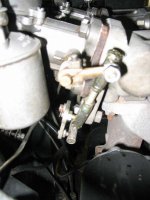
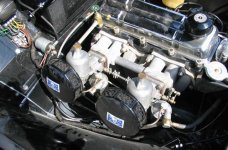
Is the linkage wedging somewhere ? Check up on front of carb #1
 

Attachments

  • 4893-Carb-ThrottleLink.JPG
    4893-Carb-ThrottleLink.JPG
    41.2 KB · Views: 89
  • 4894-CarbsandEngine.jpg
    4894-CarbsandEngine.jpg
    56.7 KB · Views: 89
The linkage is all clear and I used the carb cleaner spray method and could find no evidence of a leak. I just got back from a 70 mile run (what a beautiful day for ride) and the car ran great except the idle situation is even worse. Won't idle under about 2100 HELP
 
I would disconnect the linkage as pictured in Don's close-up photo from the brass throttle lever and see if the throttle shafts are moving freely opening and returning the plates closed in unison. You should be able to hear them click shut. The brass levers the throttle adjust screws go through may be installed incorrectly or possibly bent? There should be minimal to no free play where the throttle shaft enters or exits the carb bodys. Maybe the throttle plates that were replaced are incorrect? Maybe not enough or no tension on the throttle shaft springs. Are the mixture adjusting nuts tight or do they turn easily. I thought the throttle linkage to be sticking as well.
 
It sounds as if the needle jets are not set flush with piston. The shoulder of the jet must be set in the piston so that the needle does not stand proud of the surface of the piston when you set the holding screw. It must be flush when you rub you fingernail across the two surfaces.

Also be sure that the needles are completely centered into the jet. With the engine not running, lift the piston by lifting on the lifting pin, then let go. The piston should drop completely with a noticeable click when it hits the bottom of the carb body. Loosen or remove the damper cap when you check this and recheck after the damper cap is tightened.

If either of these in incorrect, the effect will be like you have your foot on the gas pedal. It will run fine but not idle at the spec rpm and usually run rich.

Centering the jets is a repetitive task but after a couple attempts, they WILL center unless a needle is bent. Consult your workshop manual for instructions or ask here and I can provide instruction if you need.

To check a needle for bent, roll it across a flat or spin it in your fingers. The are very delicate and cannot be fixed once bent. The must be replaced. Also check to see if the correct needleis installed. The needle number is stamped on the shouldered part. An improper needle profile may be allowing to much gas at idle vacuum.

Hope this gets it fixed.

One more thing: Have you checked to see if your timing is not advanced too far at idle?
 
A rookie followup question. Is it necessary to totally remove the carbs in order to 1) center the needle and 2)check that the jet is set flush with the piston?
 
If there is no false air then it must come from the butterflies or the linkage.
A decentered needled carb would stall the engine if the throttle is completely shut.

Maybe the butterflies aren't mounted correctly or are worn out at their sides.

Cheers
Chris
 
These are good checks as to the condition of the carbs regardless and done with the carbs on the car.

First check that the jets are centered.

Another question before proceeding: Have you filled the top of the carbs with oil?

To remove and inspect the piston and needle:
You will need to remove the 3 screws that hold the damper cover and remove filler nut on top and the damper cover. Be careful as you pull the piston straight upwards. The needle is attached to the piston at the bottom. As you pull up on the piston, the needle (about 3" long) will slide out of the jet. There should also be a slinky type spring under the piston. Just remember, if you bend the jet, it's toast. So be careful. Replace in reverse order after you check for flush mounting.
 
Thanks for the info! The dash pots are at the recommended oil level for internal ventilation hole. I had checked the piston drop...rather mixed results....somtimes gets a good clunk, and other times not. I'm of the (inexperienced) opinion that they are centered OK.

So, on to the check for the jet flush mounting.....and I suppose I need to follow procedure to ecnter after performiong this.

I don't know if it means anything, but the butterfly position looks great in both carbs as viewed through the throat.
 
I haven't, but it was checked by the "professionals" last year when they were investigating the high idle.

Also, don't think I mentioned, it has Pertronix...installed by PO
 
TRclassic3 said:
I had checked the piston drop...rather mixed results....somtimes gets a good clunk, and other times not. I'm of the (inexperienced) opinion that they are centered OK.

So, on to the check for the jet flush mounting.....and I suppose I need to follow procedure to ecnter after performiong this.

I don't know if it means anything, but the butterfly position looks great in both carbs as viewed through the throat.

Sounds like the pistons and or the needle is binding occassionally. They should drop freely and clunk everytime from what I remember. Follow Peters suggestion concerning the needles and while there clean everything well.
 
It has been said before that "50% of all fuel problems are ignition related" or was it "50% of all ignition problems are fuel related..."
 
Ed, say the word and I am over to help.
 
Sounds like one of the adjusting nuts used to synchronize the carbs might have slipped on the throttle shafts which would account for the increased idle speed.. Look between the carbs and loosen each nut on the brass interconnect between the carbs. This will allow you to check each carb individually, to balance them, and retighten the nuts. If not this probably a binding throttle linkage. Disconnect the accelerator linkage from the carbs and check for free movement. Hope this helps.
 
Several folks have suggested a problem with the linkage. I don't believe that to be a factor. It isn't that it won't return to proper idle, but rather that proper idle cannot be achieved. The idle scews are backed out on both carbs all the way, as well as the fast idle adjust, so that the throttle stop arms are hard up against the body, and the fast idle is hard up against the cam.
Am I missing something in my assumptions here?

Also, when I checked the balance I disconnected the linkage to measure each carb individually.

Thanks again to all who have responded.

And John, thanks for the offer. I'll try the suggestions made as soon as I am able and if still no luck I think I may need that house call from the Dr.
 
Back
Top