• Hi Guest!
    If you appreciate British Car Forum and our 25 years of supporting British car enthusiasts with technical and anicdotal information, collected from our thousands of great members, please support us with a low-cost subscription. You can become a supporting member for less than the dues of most car clubs.

    There are some perks with a member upgrade!
    **Upgrade Now**
    (PS: Subscribers don't see this gawd-aweful banner
Tips
Tips

TR2/3/3A Wiring harness "wire gauge" sizes?

karls59tr

Obi Wan
Bronze
Country flag
Offline
I have a new wiring harness and some of the wires look awfully light in comparison to the old original harness. Even the heavier gauge wires like the brown ground wires look like a lighter gauge than original. Are these really thin wires going to be an issue 1. too small for carrying the current? 2.ease of installing bullet connectors.3.fuse size being different?
Perhaps aftermarket harnesses made today don't need to be as thick as they were in 1959?...or are the wiring companies trying to save money by cutting down on material...copper????
Electronics is not my strong point. Any thoughts?
 
Are you looking at the conductor portion, or the overall size? It's hard to answer the question without knowing what size the new wires are. But the original wires were plenty heavy, I do believe there is room to use slightly lighter wire in most places. Using the next smaller AWG size would probably be OK. (The originals were made to an obsolete British standard.)

BTW, those brown wires are not for ground; they are the main power distribution for the car. Ground wires are black and generally not included in the harness (except for the one from the control box to the instrument panel).
 
...like the brown ground wires...

Are you a former VW owner? Vintage German cars used brown for ground.

My replacement harness came form Moss but possibly all vendors offer the same product. Anyway, I did not really compare gauges but no problems so far.
 
Karls59tr....Where did you purchase your harness from, as one supplier may not be offering the same quality product as another.
 
One thing I found when rewiring an old British motorcycle is that insulation of modern wire is thinner. This makes the new wires look smaller even when the internal copper wire is the correct size.

Ed
 
The red wires to the tailights appear to be 12 AWG I think and the heavier wires like the brown appear to be 10AWG.
 
Are you a former VW owner? Vintage German cars used brown for ground.

My replacement harness came form Moss but possibly all vendors offer the same product. Anyway, I did not really compare gauges but no problems so far.

I used to own a VW van back in the day.:smile:...who new they would become so valuable?
 
One thing I found when rewiring an old British motorcycle is that insulation of modern wire is thinner. This makes the new wires look smaller even when the internal copper wire is the correct size.

Ed
That could very well be the case. The original wires just look so much more substantial...not as flimsy. Did you have any issues crimping the bullet connectors or did Brit bikes even have those?
 
The red wires to the tailights appear to be 12 AWG I think and the heavier wires like the brown appear to be 10AWG.

That should work. In fact, I don't recall the red wire being even that heavy. It only takes a couple of amps for the tail lights, so even 18 AWG would be plenty big enough.

If you have trouble with the bullets not crimping tightly enough, try buying the next smaller size and using a drill bit to ream it out. I solder my bullets, and I've used that trick several times when none of the standard bullet sizes fit snugly.

I thought I had a chart of TR3 wire sizes (in strands), but can't find it now. Does anyone else have it?
 
That could very well be the case. The original wires just look so much more substantial...not as flimsy. Did you have any issues crimping the bullet connectors or did Brit bikes even have those?

Yes, the bike had bullets. No issues with those since the conductor was the proper size.

Ed
 
Ed is correct. Modern insulation on wires is often thinner, though provides the same or better electrical isolation and will likely hold up better over time, meaning that it wont crack like the old wires. New wire may have a part number or rating printed on it which may indicate the size of the conductor.

One thing I found when rewiring an old British motorcycle is that insulation of modern wire is thinner. This makes the new wires look smaller even when the internal copper wire is the correct size.

Ed
 
Karls59tr....Where did you purchase your harness from, as one supplier may not be offering the same quality product as another.

I hate to pit one supplier against another on a public forum - as all have their merits and demerits - and make LBC ownership easy. However, I noticed (for my TR4A) that one supplier sells wiring harnesses for $100 more than all other suppliers. Is there any "merit" to paying the higher price?
 
I think I got the wire sizes wrong. I looked up what Moss sells and they have 18AWG,16AWG and 14AWG. I think the TR3 has only two of those sizes maybe 18 and 16? I see that they sell the crimp bullet connectors in packs of 50 where British Wiring sells an"assortment pack" with a variety of sizes. I'd rather just buy the size I'll need for the TR3. I'll contact Moss to see if they know what sizes are specific to the TR3.
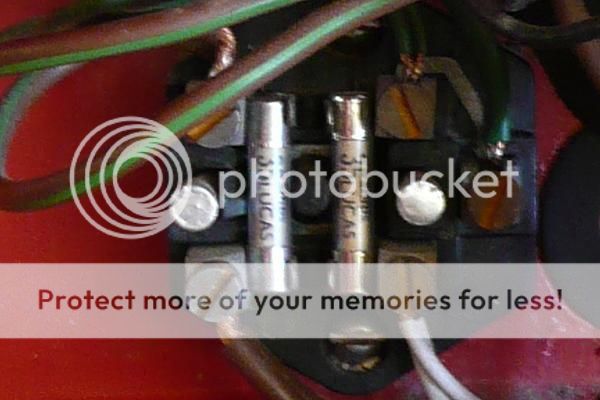
While we're on the subject...I've heard there is a difference in the fuse rating from original to modern day. What size of those glass tubular fuses do I need for the fuse box..35..30..25?
Also the 59 TR3 had an extra fuse behind the dash...what size should that be?
Thanks for your input.
 
The Lucas fuses use a different system than the US fuses commonly sold in auto parts stores. The rating on the Lucas fuse is the 'blow' amperage rather than the 'continuous' amperage. For example, the commonly used Lucas 35 amp fuse is rated for a continuous 17 amps -- so if you're using a US fuse you will want something like a 17 amp fuse.

Okay, there are probably no 17 amp fuses. As I recall, I have used a US 14 amp fuse which worked fine and may have even been a bit shorter than a US 20 amp fuse - the shorter length more closely approximates the look of the Lucas fuse.

But if you are ordering from Moss or another vendor - the correct Lucas fuses are available. With so much time on my hands I actually take the trouble to open them up and insert period correct Lucas paper labels.

FuseBlock_zps52795aef.jpg
 
I did notice the same thing with my TR3 replacement harness. Several of the large gages were reproduced smaller. It's been several years, but the horns were one wire in particular I remember being off. I started to worry, but then realized there was nothing to be done about it. It works fine.
 

I think you misunderstood my question Art (but thanks for replying). What I'm looking for is the size of the wires in the original TR3 harness. For example, is the red wire to the instrument lights 9 strand or 14 strand? I guess I could go dig out an old harness and count them, but I thought there was a table somewhere.
 
I hate to pit one supplier against another on a public forum - as all have their merits and demerits - and make LBC ownership easy. However, I noticed (for my TR4A) that one supplier sells wiring harnesses for $100 more than all other suppliers. Is there any "merit" to paying the higher price?
I don't know about harnesses in particular (still using the original), but I have observed that with other items, a big difference in price usually (tho not always) also indicates a difference in quality. For example, cheap bearings are "no name" from India or Pakistan, while the expensive ones are Timken, National or RHP made in US or UK. The last time I bought the cheap ones, they were not only a slightly different size than the originals (meaning extra hassle to adjust the shim pack), but different from each other! I pitched them and ordered Timken.
Another example, the cheap fuel pump rebuild kits use a plastic screen (that can distort and leak) and don't include the oil seal for the shaft. The expensive (like twice the price) kit from TRF has a brass screen and includes the oil seal.
 
Back
Top