

-
 Hey Guest!
British Car Forum has been supporting enthusiasts for over 25 years by providing a great place to share our love for British cars. You can support our efforts by upgrading your membership for less than the dues of most car clubs. There are some perks with a member upgrade!**Upgrade Now**
(PS: Upgraded members don't see this banner, nor will you see the Google ads that appear on the site.)

Tips
- We have a special forum called "Member Articles" where you can submit actual articles for consideration for publication. Learn More
- Don't have an Avatar? If not, your avatar will default to the 1st character in your username. Go into "Account Details" to change your Avatar.
- Some basic forum navigation info: click
 Hey - did you know if you click on the title of a thread it will take you to the first unread post since you last visited that thread?
- Hey Guest - Is your British Car Club in our Clubs database? If not, send me a PM - Basil

- Looking for a local club? Click the "Clubs" tab above and browse hundreds of clubs world-wide.
- Add Android or iPhone APP: click
- Did you know - any picture or video you add in your posts in any marque-specific forum will also get added to the Media Gallery automatically.
- A few more tips about posting and replying: click
- Hey there Guest - be sure to keep your profile page up to date with interesting info about yourself: learn more
- More tips and tricks on Posting and Replying: click
 but were afraid to ask:
  STOP!! Never post your email address in open forums. Bots can "harvest" your email! If you must share your email use a Private Message or use the
  smilie in place of the real @
- Want to mention another member in a post & get their attention? WATCH THIS

- So, you created a "Group" here at BCF and would like to invite other members to join? Watch this!
- Hey Guest - A post a day keeps Basil from visiting you in the small hours and putting a bat up your nightdress!
- Hey Guest - do you know of an upcoming British car event?
 Pretty Please - add it to our Events forum(s) and add to the calendar! >> Here's How <<
- Hey Guest - you be stylin' Change the look and feel of the forum to fit your taste. Check it out
- If you run across an inappropriate post, for example a post that breaks our rules or looks like it might be spam, you can report the post to the moderators: Learn More
- If you would like to try some different "looks" or styles for the site, scroll to the very bottom, on the left and click the Style Selector.
You are using an out of date browser. It may not display this or other websites correctly.
You should upgrade or use an alternative browser.
You should upgrade or use an alternative browser.
Who uses their ammeter?
- Thread starter Lukens
- Start date


Offline
When I swap my 3 to negative ground. I did not swap the leads at the amp meter. I just remember that when it points to me it is charging and pointing away from me it is discharging. When I replace my heater core I may change the leads since I will have more room under the panel when it is out.
Don
Don

TR3driver
Great Pumpkin - R.I.P
Offline
Myself, I much prefer an ammeter. I feel like it gives me a lot more information than a voltmeter does. For example, it gives me a quick visual check that my brake lights are working, or that I've left the headlights on. Also much quicker feedback if the control box has stuck and is letting the generator put out too much current. Voltmeters tell you what has happened in the past, while ammeters tell you what is happening right now.
Voltmeters also tend to be less accurate, since they get connected to the ignition switch. Thus any voltage drop in the ignition circuit will cause the meter to read lower than actual battery voltage.
But it is clearly a matter of personal preference, so YMMV and all that.
Voltmeters also tend to be less accurate, since they get connected to the ignition switch. Thus any voltage drop in the ignition circuit will cause the meter to read lower than actual battery voltage.
But it is clearly a matter of personal preference, so YMMV and all that.


MadMarx
Jedi Warrior

Offline
I use an ammeter in combination an alternator on negative ground.
The rewiring is very easy.
Pull out the little dashboard, swap the two big lines on the ammeter - that's it....5 min of work.
The ammeter is giving plenty of information:
- if lights does work and how many lights do work
- is the battery okay
- did I forget the indicator
- do the brakes light up?
- lose wire
- broken fan belt
- indicates if the electric fan is working (if installed)
and maybe many more things I might not mention.
Cheers
Chris
The rewiring is very easy.
Pull out the little dashboard, swap the two big lines on the ammeter - that's it....5 min of work.
The ammeter is giving plenty of information:
- if lights does work and how many lights do work
- is the battery okay
- did I forget the indicator
- do the brakes light up?
- lose wire
- broken fan belt
- indicates if the electric fan is working (if installed)
and maybe many more things I might not mention.
Cheers
Chris

CJD
Yoda
Offline
Face it, we're all old school here...and we actually LOOk at our gages. 99% of people couldn't tell you what anything but the gas gage is!
I like ammeters, although a voltmeter can be used the same way if you know what you are looking at. My only complaint with the TR ammeter is it bounces pretty wildly, so you have to study it to see what it's saying.
John
I like ammeters, although a voltmeter can be used the same way if you know what you are looking at. My only complaint with the TR ammeter is it bounces pretty wildly, so you have to study it to see what it's saying.
John
M
Member 10617
Guest
Guest
Offline
I find the ammeter and the ignition light on the TR3 to be highly distracting, but (1) they impress or sometimes concern my passengers, (2) keep things interesting, (3) and do provide some useful, real-time, information.

Moseso
Jedi Knight
Offline
Recently, the ammeter alerted me to charging issues that stemmed from some funky connections at the alternator. The red charging light didn't come on, but the ammeter clearly showed battery discharge. This sent me to the toolbox, well in advance of killing the battery. One more vote for the ammeter. It shows the here-and-now in an easily understood format.
TR3driver
Great Pumpkin - R.I.P
Offline
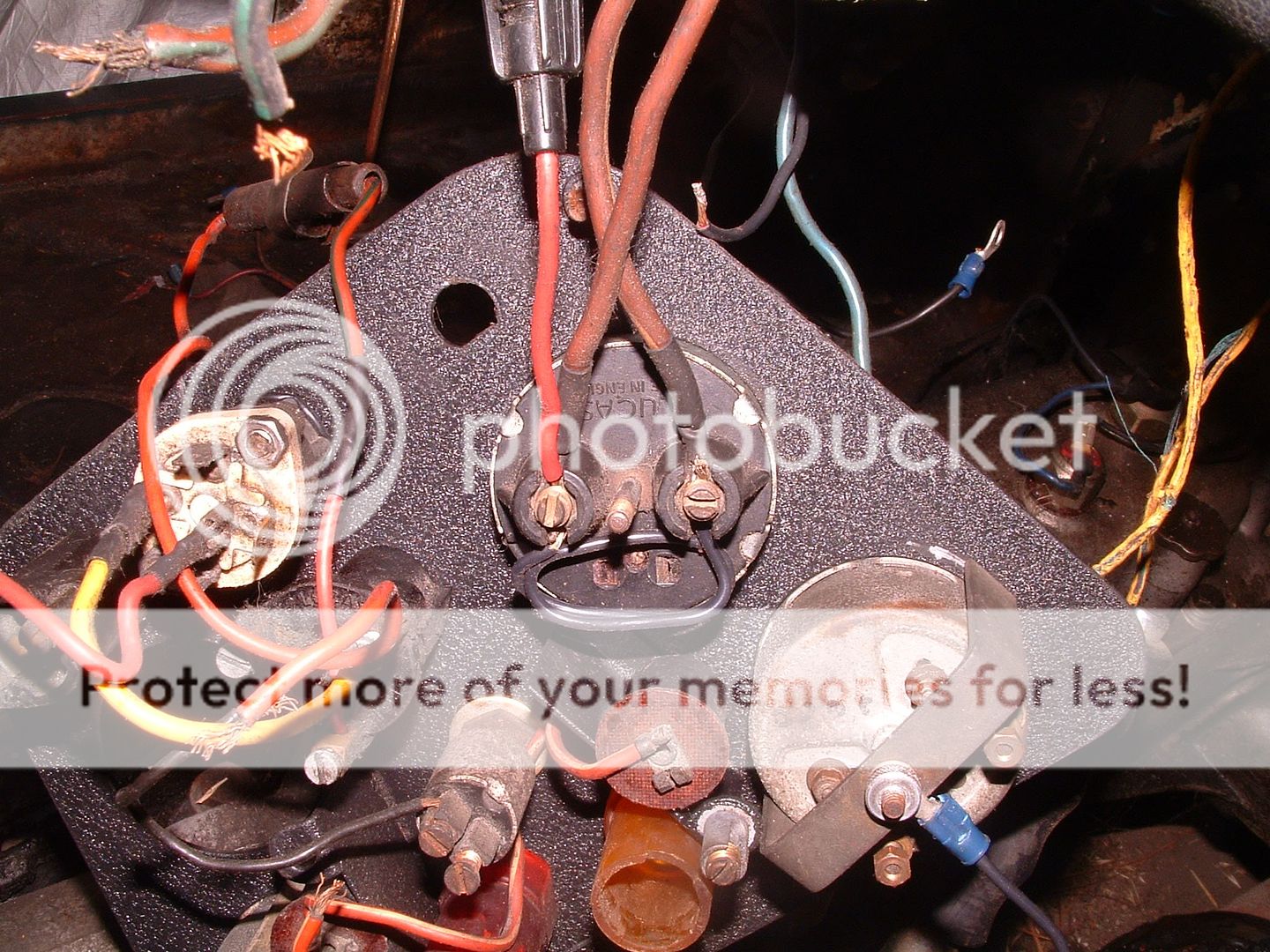
If you are going to run with an alternator, I would suggest another modification : Adding a shunt to the ammeter so the needle doesn't hit the peg when the alternator is putting out max current. Back when I was running a 60 amp alternator, the ammeter would peg at every startup and it eventually started sticking there. Adding an equal shunt (so the ammeter only took half of the charging current and hence read full scale for roughly 60 amps) eliminated the sticking.
OP

Lukens
Jedi Warrior
Offline
I find the ignition light on the TR3 to be highly distracting.
What am I missing here? My ignition light goes out after I start the car. Is there more to it?The red charging light didn't come on.
TR3driver
Great Pumpkin - R.I.P
Offline
What am I missing here? My ignition light goes out after I start the car. Is there more to it?
Well, sorta. If you have the idle rpm set to the book value of 500 rpm, then it is not unusual for the light to glow at idle. The light basically compares the generator's output voltage to the battery voltage, and the generator won't put out much of anything with the engine only turning 500 rpm.
And as Moseso pointed out, the light may not come on even if you do have a charging issue (especially if that charging issue is a bad connection between an alternator and the battery). With the original generator and control box, all the light really tells you is whether the cutout relay is open or not, so it also won't come on if the relay sticks closed even if the generator is drawing current instead of charging.
Although the needle will jump around at certain low rpms (where the generator can deliver just slightly more current than required, so the needle reflects the action of the voltage regulator relay); if it jumps around at higher rpm or all the time, then you have an incipient problem with the control box (eg dirty contacts on the VR relay) or a bad connection somewhere. A friend of mine eventually traced it to a bad connection at the ground strap on her TR250.
M
Member 10617
Guest
Guest
Offline
My car idles at 800-900 rpm. At that point, the ignition warning light comes on. As soon as it accelerates, it goes off.
My regulator is a recently installed, pre-cleaned, pre-adjusted, and tested regulator from Moss. Moss says that they don't use the specifications in the workshop manuals for cars equipped withese regulators, but "They are more conservative, and perfectly functional. Using these settings will minimize the chance of a problem with your new regulator and extend the life of your battery."
That's reassuring, but doesn't mean much to my uninformed mind.
I checked with a Triiumph experienced friend of mine and he said that my car is operating "normally." When I said that the light comes on whenever I near or reach idle, he said "It may be set a bit high, but it's OK as long as the light goes out when you accelerate."
I don't know exactly what he meant by "set a bit high," I do know, however, that if the regulator is adjusted "too high," it can overwork the generator, causing it to fail. But I decided not to worry about the light coming on at 800-900 rpm.
However, I will check the ground strap as mentioned by Randall.
My regulator is a recently installed, pre-cleaned, pre-adjusted, and tested regulator from Moss. Moss says that they don't use the specifications in the workshop manuals for cars equipped withese regulators, but "They are more conservative, and perfectly functional. Using these settings will minimize the chance of a problem with your new regulator and extend the life of your battery."
That's reassuring, but doesn't mean much to my uninformed mind.
I checked with a Triiumph experienced friend of mine and he said that my car is operating "normally." When I said that the light comes on whenever I near or reach idle, he said "It may be set a bit high, but it's OK as long as the light goes out when you accelerate."
I don't know exactly what he meant by "set a bit high," I do know, however, that if the regulator is adjusted "too high," it can overwork the generator, causing it to fail. But I decided not to worry about the light coming on at 800-900 rpm.
However, I will check the ground strap as mentioned by Randall.
Last edited by a moderator:
OP
Lukens
Jedi Warrior
Offline
Well, sorta. If you have the idle rpm set to the book value of 500 rpm
I've got my carbs set to my satisfaction... took some work to get down to 700 rpm. Can't imagine 500.
Last edited:
TR3driver
Great Pumpkin - R.I.P
Offline
Ok, so maybe I shouldn't have mentioned a specific rpm. Those old mechanical tachs really aren't all that accurate anyway. My point was simply that, at low engine rpm, the light may come on without indicating that anything is "wrong" beyond the generator not turning fast enough to generate 12 volts.
My TR3 idles anywhere from 500 to 1000 rpm (indicated), depending on conditions. At the lower end, I'll see the light glow but it usually doesn't.
Ed, I don't know what Moss did that wasn't by the book, but from the "longer battery life" comment, I would guess that they set the voltage regulator somewhat lower than called for. Since the factory setup tends to overcharge a bit when running without the headlights on, that would tend to increase battery life as well as reduce the amount of acid mist blown out of the battery to corrode cables, battery box, etc.
They may have also set the cut-out voltage somewhat higher than called for, which would make the light more apt to come on at idle. I don't see why that would lengthen battery life, but maybe they do both modifications. With the book settings, there is a small range where part of the discharge showing on the ammeter is current flowing backwards into the generator. It won't hurt anything, but I can see where someone might want to reduce the reverse current.
My TR3 idles anywhere from 500 to 1000 rpm (indicated), depending on conditions. At the lower end, I'll see the light glow but it usually doesn't.
Ed, I don't know what Moss did that wasn't by the book, but from the "longer battery life" comment, I would guess that they set the voltage regulator somewhat lower than called for. Since the factory setup tends to overcharge a bit when running without the headlights on, that would tend to increase battery life as well as reduce the amount of acid mist blown out of the battery to corrode cables, battery box, etc.
They may have also set the cut-out voltage somewhat higher than called for, which would make the light more apt to come on at idle. I don't see why that would lengthen battery life, but maybe they do both modifications. With the book settings, there is a small range where part of the discharge showing on the ammeter is current flowing backwards into the generator. It won't hurt anything, but I can see where someone might want to reduce the reverse current.
M
Member 10617
Guest
Guest
Offline
Randall,
This is what Moss did when they pre-adjusted the regulator:
"The regulator relay should be adjusted so that the points open at 13 to 14 volts. The cut-out relay should be adjusted so that the points open at 10 to 12 volts. We realize that these are not the specifications in the workshop manuals...."
Moss goes on to say: "The procedure for adjusting the two relays in the voltage regulator are covered in the workshop manual for your car. The procedure is somewhat complicated, and it takes some specialized equipment. Note that the settings for the relays in the workshop manual SHOULD NOT BE USED. Refer to the lines .. above. Because new tools are available, the instructions are a little dated. Most voltmeters today are digital, not analog. If you are not familiar with the procedure, and are not comfortable doing this yourself, there are a couple of options: Having it Done by a Professional, Buying a Pre-Tested & Adjusted Regulator." I took their advice and bought the pre-tested and adjusted regulator.
This is what Moss did when they pre-adjusted the regulator:
"The regulator relay should be adjusted so that the points open at 13 to 14 volts. The cut-out relay should be adjusted so that the points open at 10 to 12 volts. We realize that these are not the specifications in the workshop manuals...."
Moss goes on to say: "The procedure for adjusting the two relays in the voltage regulator are covered in the workshop manual for your car. The procedure is somewhat complicated, and it takes some specialized equipment. Note that the settings for the relays in the workshop manual SHOULD NOT BE USED. Refer to the lines .. above. Because new tools are available, the instructions are a little dated. Most voltmeters today are digital, not analog. If you are not familiar with the procedure, and are not comfortable doing this yourself, there are a couple of options: Having it Done by a Professional, Buying a Pre-Tested & Adjusted Regulator." I took their advice and bought the pre-tested and adjusted regulator.
Last edited by a moderator:
TR3driver
Great Pumpkin - R.I.P
Offline
Ok, so just as I said, they set the VR too cold and the cutout too hot.
I disagree with the rest of that statement, but I suppose it is a matter of opinion. I'll just say that I adjust my own original control box, by the book, and using a DMM in place of a moving coil voltmeter. I have double-checked with a moving coil voltmeter (which I don't like using around the car as it is rather fragile), and it gives the same result (within reason). The only "special tool" I use is a wrench that fits the lock nuts on the gap adjustment and the voltage adjustment. (I forget the size offhand, but it's something like 4 BA).
I disagree with the rest of that statement, but I suppose it is a matter of opinion. I'll just say that I adjust my own original control box, by the book, and using a DMM in place of a moving coil voltmeter. I have double-checked with a moving coil voltmeter (which I don't like using around the car as it is rather fragile), and it gives the same result (within reason). The only "special tool" I use is a wrench that fits the lock nuts on the gap adjustment and the voltage adjustment. (I forget the size offhand, but it's something like 4 BA).
M
Member 10617
Guest
Guest
Offline
As Moss said: "If you are not confortable with the procedure..." If I understood the procedure thoroughly and knew how to hook up the voltmeter, I would certainly prefer to do this myself, but -- alas -- it is a mystery to me and will remain so until I either (a) watch someone actually do it, or (b) have step by step instructions on how to do it. I have the Lucas instructions, but they assume the reader knows much more than I do. So, in the meawhile, I'll leave things as they are and wait until I know more. The light comes on at 800-900 rpm idle and cuts off as soon as I start up again, and I can live with that.
By the way, just for the record, I have found that the ammeter has told me some very important things. It once indicated that my generator had been fried, and lately it indicated that the spade contact on the wire from the regulator was not making proper contact. Very helpful... very useful.
By the way, just for the record, I have found that the ammeter has told me some very important things. It once indicated that my generator had been fried, and lately it indicated that the spade contact on the wire from the regulator was not making proper contact. Very helpful... very useful.

