• Hey Guest!
    British Car Forum has been supporting enthusiasts for over 25 years by providing a great place to share our love for British cars. You can support our efforts by upgrading your membership for less than the dues of most car clubs. There are some perks with a member upgrade!

    **Upgrade Now**
    (PS: Upgraded members don't see this banner, nor will you see the Google ads that appear on the site.)
Tips
Tips

Very slow in first when letting up on the clutch

Steve1970

Senior Member
Country flag
Offline
I have been endlessly messing with timing/carb floats/carb jets/fuel pumps to troubleshoot a terrible fuel consumption problem.

At this moment I am trying to make sense of one symptom, which i believe may be related:
From a standstill, when I let up on the clutch the car very slowly churns through first gear. After several seconds, I can get the car up to 2500 rpms and things seem to normalize after that.

Could it be a carb issue? or could it just be due to the standard smog equipment that I have left in tact? Shouldn't I be able to chirp the tires in first??
 
Yeah. It should rev right up. 74's really don't have smog eguipment. You have an EGR valve, but if it's clogged up, it just won't try to recycle some of the exhaust back into the combustion chambers, from which it came..
Without being there, it sounds like either a timing issue or the carbs.
The proper order of things would be to assure that you have proper valve stem to rocker arm clearance, then correct ignition timing, then carb mixture, and lastly balancing the carbs.
But, a couple of things you may check out of sequence is the condition of the Air Valve Diaphram and the orientation of the air valve.
If there is a tear or hole there will be no vacuum on the top side of the diaphram and the air valve will not rise and the metering needle with it.
Effectivly limiting the amount of gas to idle speed amounts.
Some people have replaced the air valve incorrectly with the air valve's vacuum ports not lined up with the intake manifold port. The result is the same, the air valve/needle fails to rise when the carb throttle disc opens.
 
I agree with Ken and suggest to check the diaphragms 1st. It is easy to do and only takes a couple minutes to remove the four screws and lift the lid. Nothing else will work well if they are torn so this easy check makes good sense. Besides, I have had to replace both my diaphragms twice in the last two years.

Poor quality parts are probably not the problem, BUT, I did drive two Triumphs more than 150,000 miles in the 60's and 70's with no such trouble.
 
Good advice on the diaphragms above.
Is your mixture too rich?
Are you getting black smoke out the exhaust pipe?
What do the spark plugs look like?
Getting the float height correct can be tricky but it will run very poorly if that is not corrct on both carbs.
 
"Getting the float height correct can be tricky.."

this has been what i have been fiddling with most the past week, so i guess once again i'll utilize my acquired upside down/blind slotted screwdriving skills and adjust again.

the valve clearances were re-adjusted at the start of this year. the front three plugs were fouled and since then i've been in an endless cycle of fiddling with everything that would affect mixture. i should probably be a little more scientific in my approach. i have no idea if my timiing is correct; i've set using my strobe and according to haynes (4 deg atdc @ 850 rpm) and the engine "feels" right when i drive it (aside from fuel consumption problem, 8 MPG!!! ughh!!).

also the diaphragms seem to be in tact, and the air pistons are installed correctly and i could seem them move up/down as i gave it more gas. maybe its the grose jets. they got stuck a month ago, so i threw them in a pot of boiling water to get the ball to get un-stuck. .. maybe i should try the traditional jets.

i've been down this "richness/fuel consumption problem" road before with various other british and italian roadsters.. i was just wondering exactly what the hesitation in 1st gear might signify to see if it could be related.


thanks all for the suggestions and feedback. -Steve
 
Steve1970 said:
i have no idea if my timiing is correct; i've set using my strobe and according to haynes (4 deg atdc @ 850 rpm) and the engine "feels" right when i drive it (aside from fuel consumption problem, 8 MPG!!! ughh!!).

So, if you disconnect the vacuum retard line, does it move to 10-12 BTDC?

I don't recall if the Haynes is one of the many places that have it wrong or not; but the 4 ATDC figure is only applicable if the vacuum retard is connected and working (not broken or disabled by the TVS). Most people just disconnect it and use the 'static' timing figure instead.

I would also want to double-check the accuracy of the timing mark (the rubber in the front pulley can sometimes slip and leave the mark in the wrong place); and the valve timing. A slipped timing chain can cause exactly the kind of symptoms you are seeing.

PS, good move pitching the Grose Jets! I've 'fixed' several engines that way.
 
Yes, get rid of those grose jets, use the stock ones.

I eventually got the right float height same way you are trying to do, by removing the bowls in situ and viewing the fluid level directly, I always made sure to de-pressurize the fuel line before removing them by pulling the hose off the carb.

Your timing sounds too far retarded; I set mine with a strobe light and it works best at about 8deg before TDC, of course there's no way to know if the timing marks are still in the right spot.

The manual talks about 4deg after but that's for static timing not with a strobe.
 
...finally got back to work on this over the weekend.

so it looks like i don't have a vaccuum retard on the dizzy, just a vaccuum advance. given that, i've reset the timing to just before tdc (about 3 deg), it seems to run smooth at that. if i retard it any more the engine gets a bit shaky and chatter-y. so i'm gonna settle on that for timing (for now).

replaced the ignition coil as the po had the 3 ohm unit instead of the required 1.5 unit (i've got the external ballast resistor). she sure starts up a lot easier now, and the plugs are looking more normal.

been nursing a sore back, so i didn't get to test drive it. i'm hoping these two alteration will have helped the MPG problem.

i think i still have a float problem.. i've got the carbs completely leaned out (screw turned all the way left), and i'm not getting any of the usual lean-derived 'pops' from the air filter box.

can anyone tell me approximately how full you would expect the float bowl to be when removing it from the rest of the unit? does half full sound right?
 
74 with a vaccum advance ? Never heard of that. The last TR6 that had a Vacuum Advance was in 1971 and it had both a Vacuum Advance and Vacuum Retard.
Assuming you have ZS carbs, your idea of checking the floats by simply trying to estimate the amount of fuel in the bowl isn't the way to do it.
What are you thinking of doing, removing the floats chamber while the carbs are still on the engine ?
No, that's not the way to check them and it's certainly no way to make a critical adjustment of the float height.
Better stick to the traditional way if they're ZS carbs.
 
it's the standard zenith strombergs.

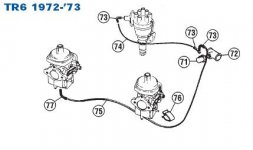
i've probably got it wrong.. was doing my best to interpret the moss diagram:
Moss Distributor Page

On #78 in the diagram they have 74-76 listed as N/A so i assumed it just wasn't part of the distribor unit for those yrs. But maybe N/A just means they don't currently stock it. In any case, when I pulled the hose off the end of it didn't affect the timing.

been struggling with setting the floats to the required 17 mm height, just thought it would be nice to know exactly what 17 mm gets you in terms of the level of fuel in the bowl(as a sort of validation).

many thanks! -Steve
 
You doing it something like this, Steve ?
floatheight.jpg
 
Steve1970 said:
i've probably got it wrong.. was doing my best to interpret the moss diagram:
Moss Distributor Page

On #78 in the diagram they have 74-76 listed as N/A so i assumed it just wasn't part of the distribor unit for those yrs. But maybe N/A just means they don't currently stock it.
Right. N/A means "not available" rather than "not applicable". If the part was not used on that car, there is no listing for it.<div class="ubbcode-block"><div class="ubbcode-header">Quote:] In any case, when I pulled the hose off the end of it didn't affect the timing.[/QUOTE]So the vacuum retard is not working, for whatever reason. My suggestion is to time it at 10-12 BTDC (the 'static' timing given in the manual) and let it go at that. Timing at 3 BTDC is going to make the engine sluggish, and burn more fuel to produce less power.

Or, since the marks may not be accurate anyway, use a vacuum gauge to set the timing.
 
Poolboy, yes it is a slide rule that is similar to that design (mine is more of an L shaped, with the bottom of the "L" sliding along the vertical part. i'm pretty sure that the metal 'frame' of the float itself is just too bent out of shape, making it more difficult to ensure that all the points along the float are 17mm from the bowl edge. however, until i'm in a position to buy new floats (and jets!) i am just going to have to go with some stop-gap steps.

Randall, was going to try to get it to the 12 you recommended but thought i would start out with what 'felt' right and adjust from there. but i may do the other way round now (start at 12 and adjust until it feels right). promise to check with vacuum gauage, when and if i find it in my dad's garage over the weekend.
 
Re: Very slow in first when letting up on the clut

Think of the float/gas level as a coarse adjustment for the carb mixture. The needle range is limited, so if you can't get the mixture leaner, drop the float level (which means increase the mm setting when upside down) in 2 mm increments so the fine adjustment from the needles can be used.

This sort of thing happens all the time on carb rebuilds - the floats are adjusted to get "in spec", but it messes up an adjustment made earlier to get the mixture right.
 
Re: Very slow in first when letting up on the clut

"74 with a vaccum advance ? Never heard of that. The last TR6 that had a Vacuum Advance was in 1971"

My 73 has a vacuum advance and as far as I know, it is the original distributor.

Sam
 
Re: Very slow in first when letting up on the clut

If the module you're talking about is on the cockpit side of the distributor, it's a Vacuum Retard.
The distributors (pre 72) that had a Vacuum Advance also had a Vacuum Retard.
The Advance was on the radiator side and the Retard on the cockpit side.
 
Re: Very slow in first when letting up on the clut

:iagree:
From 72-onwards, the US-spec TR6 only had vacuum retard.
 

Attachments

  • 21615.jpg
    21615.jpg
    15 KB · Views: 252
Re: Very slow in first when letting up on the clut

ok, got the carbs on the bench. floats on the front carb weren't off to bad, maybe height of 19 mm. but the rear was way off, they sat at maybe 13 mm at the lowest point. but in both cases the floats were really bent out of shape, and most of my time was spent twisting them this way and that until they were square.

some forehead slapping foobars:
it being late at night and with the flies and mosquitoes competing for my drop light, i had rushed the reassembly of the carbs/linkage resulting in the throttle shaft being much too 'positive'. to get it back to 'center' i tried maxing out the threads on the verticle linkage rod, but throttle was still way too much. .. time to sit down and crack open a busch and ponder. shined the light to the bottom accelerator rod bracket: turns out i had only fastened one side of the bracket!! i like to think i would have caught this had it been day light.

the entire job took me a leisurely four hours. at least one full quarter of that time was spent looking for one of the clips that binds the choke cable to the carb. when i pried it off it flew clear across to the other side of the engine bay. its final resting place: driver's side control arm.

following re-assembly, was two minutes into my test drive when i lost power. then the familiar smell of fuel leaking about the engine... then the familiar sight of fuel gushing out of my air filter... another clogged grose jet! well at least it didn't have to do with the float. limped home on 3 cylinders, threw the jet in a frying pan with about two inches of water and boiled the blasted thing clean.. my wife could only stand there and shake her head while i was tending to my 'fried grose jet' and cursing my luck not-so-silently to myself.

despite the minor setbacks, the car seems to have gotten her 1st gear thrust back. too early to tell if MPG problem has been cured.. a tr6 old timer friend of mine said that his sixes never did better than 15 MPG, so my goal is to get 15 or better.

can't thank you all enough for your wisdom and advice!
 
Back
Top