

-
 Hey Guest!
British Car Forum has been supporting enthusiasts for over 25 years by providing a great place to share our love for British cars. You can support our efforts by upgrading your membership for less than the dues of most car clubs. There are some perks with a member upgrade!**Upgrade Now**
(PS: Upgraded members don't see this banner, nor will you see the Google ads that appear on the site.)
You are using an out of date browser. It may not display this or other websites correctly.
You should upgrade or use an alternative browser.
You should upgrade or use an alternative browser.
Valve cover gasket - sealant needed?
- Thread starter tdskip
- Start date


Offline

Just be sure both surfaces are clean, straight, and not pitted. If you use any sealant, it'll be a bear to clean next time.
Mickey
Offline
Oh yeah - as with oil filters, run a thin coat of oil on it.

Don Elliott
Obi Wan
Offline
On my 1958 TR3A, I use a dark brown goop (Aviation #3 - I think it's called) that I apply to one face of the cork seal and a thin layer along the inner edges or lip of the valve cover. Then I put the seal into the lip around the valve cover and leave it overnight on a clean flat surface (like a table-top) and the day after, I set the cork a bit better and put the valve cover onto the head and tighten it down a bit. The next day, I tighten it down all the way.
For the next few days of running, I check it and if I see a bit of oil leaking, I tighten it down a bit more and wipe up the bit of oil. At this point, it's usually sealed. If I find a few days later that there is still a bit of a leak, I remove the valve cover and re-adjust the cork gasket. It is rare if you have to go through all this.
My original cork gasket was sealed this way when I removed it the first time at about 40,000 miles from new. During that time, I would guess that I had removed the valve cover and reinstalled it using the original cork gasket about 8 or 10 times by then when I would check and re-gap the valve clearances.
After this, it never leaks. I can take off the valve cover easily, many times over, because the cork is bonded only to the inside lip of the valve cover and not to the head. I can remove the valve cover when I seal the cork gasket this way for about 35,000 miles or more.
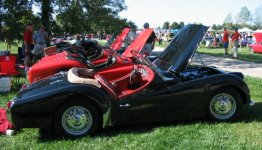
BTW, this past May 23rd, we celebrated my 50 years of ownership of "TRusty".
For the next few days of running, I check it and if I see a bit of oil leaking, I tighten it down a bit more and wipe up the bit of oil. At this point, it's usually sealed. If I find a few days later that there is still a bit of a leak, I remove the valve cover and re-adjust the cork gasket. It is rare if you have to go through all this.
My original cork gasket was sealed this way when I removed it the first time at about 40,000 miles from new. During that time, I would guess that I had removed the valve cover and reinstalled it using the original cork gasket about 8 or 10 times by then when I would check and re-gap the valve clearances.
After this, it never leaks. I can take off the valve cover easily, many times over, because the cork is bonded only to the inside lip of the valve cover and not to the head. I can remove the valve cover when I seal the cork gasket this way for about 35,000 miles or more.
BTW, this past May 23rd, we celebrated my 50 years of ownership of "TRusty".
Attachments

martx-5
Yoda
Offline
I've had many TR's over the years, and I do it the same way Don does. The only thing I do different, is after the cork gasket is "glued" onto the valve cover, I coat the bottom of the cork that mates onto the head with a thin layer of heavy grease. I've always been able to remove the valve cover many times without having to replace the gasket.
And Don, congrats on a half a century of owning the same TR3 from new. Great looking car.
And Don, congrats on a half a century of owning the same TR3 from new. Great looking car.

dklawson
Yoda
Offline
I use a method similar to Don's. I use blue RTV to bond the gasket to the cover and allow the RTV to cure while the cover is held (dry) against the head with minimal pressure. I let the RTV cure over night and apply a non-hardening sealant to the bottom of the cork the next day. I use Aviation-Form-A-Gasket as it is truly non-hardening yet makes a very nice seal that is easily separated later for maintenance.