• Hey Guest!
    British Car Forum has been supporting enthusiasts for over 25 years by providing a great place to share our love for British cars. You can support our efforts by upgrading your membership for less than the dues of most car clubs. There are some perks with a member upgrade!

    **Upgrade Now**
    (PS: Upgraded members don't see this banner, nor will you see the Google ads that appear on the site.)
Tips
Tips

vacuum gauge

M

Member 10617

Guest
Guest
Offline
Can someone tell me where to attach a vacuum gauge when testing a TR3?

 
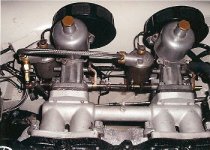
If your manifold doesn't have a fitting on the balance tube as the early TR4 (maybe TR3B?) have, then you'll have to drill and tap, either in the center balance log, or in the flange in one of the carbs. I don't know of any other way to do it. I bought a short intake with the boss and tapped hole from e-bay with the intention of adding a PCV system, but I never got around to it.

Edit:

Here's one on e-bay with the boss.
 
My manifold doesn't have such a fitting. I thought perhaps that it might attach to the vacuum tube from the manifold to the distributor, but I guess not...???
 
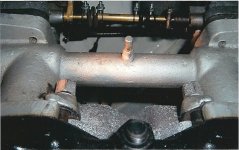
Oops... I was wrong. My manifold does have a fitting on the balance tube, but it looks like it has never been opened. I am hesitant to try to unscrew it to remove it in case I damage it.
 

Attachments

  • 29628.jpg
    29628.jpg
    29 KB · Views: 334
That fitting looks like something that someone has installed. I don't ever remembering seeing one like that on a TR3/TR4 manifold. It was probably put in there so they could hook up a vacuum gauge! :laugh:
 
How did you get my intake manifold ?!?
:smile:

The vacuum line to the advance is not "manifold" vacuum, so not really suitable for connecting a vacuum gauge (at least not if you want to see anything meaningful with the engine idling). The port into the front carb is arranged so that, with the throttle closed, the port is on the carburetor side of the throttle plate and so sees almost no vacuum at all. That way, the advance only operates when the throttle is partially open.

As others have said, there was no original port suitable for a vacuum gauge; but your manifold appears to have been drilled and tapped for a fitting. I modified the manifold on my 59 TR3A exactly the same way; then also added a second fitting at the front (to supply the manifold vacuum signal to a water injection system I was experimenting with).
 
So, Art and Randall,

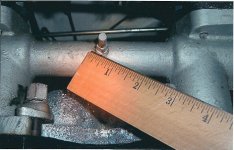
Here are two close-ups of the fitting.

Do you think I am safe in unscrewing the plug. It looks like it hasn't been removed in a very long time.

If, so, what do I have to watch for so I don't get myself into trouble.

Assuming the plug comes out neatly, then I assume I just warm up the car and then attach the vacuum gauge hose and fitting and check the vacuum. Moss Motors has a very good video on this procedure, but the demonstration doesn't show the gauge attached to an actual engine.
 

Attachments

  • 29629.jpg
    29629.jpg
    33.8 KB · Views: 292
  • 29630.jpg
    29630.jpg
    36.1 KB · Views: 287
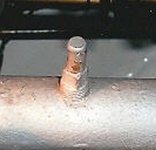
Now that I get a closer look, I'm wondering if that isn't a plugged fitting that you already have. I might try cleaning the paint off of it and see if I could figure out how to unplug it. Maybe that is a cap sticking up?

Otherwise, I suppose it depends a bit on how badly you want to hook up a vacuum gauge; but I would probably go for it. Worst case (which I think unlikely) is that the threads will come out with the plug and you'll have to remove the manifold to tap larger. Most likely though, it will come right out.
 
Randall,

It doesn't show here, but at the base of this plug are threads. The thing is threaded into the manifold, but paint obscures the threads.

I'm not in a rush to hook up a vacuum gauge, but after watching the Moss video and seeing how much one can learn from the gauge, I am tempted.
 
Would this be the recommended location for installing a vacuum gauge fitting? Any thoughts on that? Thanks.
 
Looks like a homemade nipple that has since been sealed up.
A 3/8 NPT plug, similar to the tranny oil drain plug, with a hole drilled thru the center and a 1/4 or 5/16 tube inserted and possibly soldered into that hole, which is now sealed up.
A few more links regarding the usefulness if the Vacuum Gauge:
https://www.hemmings.com/hsx/stories/2012/02/01/hmn_tips1.html
https://www.secondchancegarage.com/public/186.cfm
https://automotivemileposts.com/garage/v2n8.html
And for those who might not have seen the Moss Video Ed referred to
https://www.youtube.com/watch?v=utUSI-JYhVU
 
PatGalvin said:
Would this be the recommended location for installing a vacuum gauge fitting? Any thoughts on that? Thanks.
What you want is intake manifold vacuum. That looks like a good spot.
 
Yup, good spot. 3/8 NPT is huge, though, I used 1/8 NPT instead.

Here's a closeup of Ed's plug, where the threads at the base are more visible.
 

Attachments

  • 29635.jpg
    29635.jpg
    19.6 KB · Views: 233
If you buy the Moss supercharger it already has two ports installed for you. Just a thought....
 
tinman58 said:
If you buy the Moss supercharger it already has two ports installed for you. Just a thought....

Yep, that was the selling point for me! Of course, you need a vacuum/pressure gauge...
 
Yeah, I installed a permanent one:
 

Attachments

  • 29636.jpg
    29636.jpg
    15.4 KB · Views: 253
Darrell, What boost do you get? I get 6 to 7 lbs.
 
TR3driver said:
Yup, good spot. 3/8 NPT is huge, though, I used 1/8 NPT instead.

Here's a closeup of Ed's plug, where the threads at the base are more visible.


The pic with the ruler next to the plug seems to indicate that the plug is a 1/8 NPT. I measured one I have here at the upper end of the threads, and it measures about 0.405".

Here's a link to some animated vacuum gauge diagnostics.
 
Back
Top