
• Hey Guest!
    British Car Forum has been supporting enthusiasts for over 25 years by providing a great place to share our love for British cars. You can support our efforts by upgrading your membership for less than the dues of most car clubs. There are some perks with a member upgrade!

    **Upgrade Now**
    (PS: Upgraded members don't see this banner, nor will you see the Google ads that appear on the site.)
Tips
Tips

Vacuum and timing?

T

Tinster

Guest
Guest
Offline
A real quicky for the Experts.
The DPO stripped out ALL pollution controls and
heater related components.

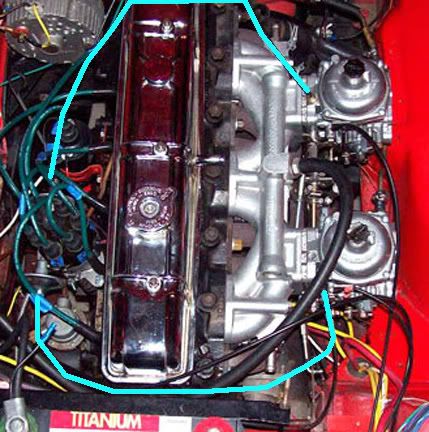
I have 1 direct line going from my rear carb to a dizzy ear.
I have another direct line from front carb to 2nd dizzy ear.

When I am setting the timing, I noticed NO difference if the
carb vacuum lines were pulled and plugged or remained in place.

The timing is at 10* BTDC with or without vacuum lines plugged.

Am I missing something here because the pollution control are gone?

thanks,

d
vacuum.jpg
 
The pollution controls are long gone and you (technically) should have vacuum to both the retard and advance. BUT.......before this becomes a major project that it doesn't need to become, do the following.

Plug both lines off at the carbs and on each end of the diaphragms. In other words, the lines will be disconnected completely.

Set the timing at 12 BTDC at your normal idle speed. The idle may go up a hair when you advance the timing, so just set it back to 850 or wherever you started from. You will now be running at the proper timing setting and will be using a total mechanical advance, with no chance of vacuum leaks. Your car should run fine because it is running that way now, you're just getting rid of the lines that have no vacuum anyhow.

I do not use my vacuum retard at all. My line has been capped off for months. And was before that on my previous engine before rebuilding.

Drive the car............drive the car..........drive the car................
 
Just curious, Paul, why do you keep telling everyone 12 BTDC when the book says 10 BTDC ?

I don't know what the fuel is like in PR, but around here's it's not all that great. And even knock you can't hear can do damage like this.
 
Randall,

I use the TR6 chart from the Moss catalog that summarizes all and it looks as though I was wrong for the early models, which are stated as 10BTDC, but 71-76 is 12BDC on this page. I ran mine at 12 for years and the pistons looked fine when I took them out. No damage to the tops or ring lands.

From personal experience I have found that the car just runs better with a little more advance. The caveat is that I use the highest octane fuel available and usually always state that in my comments.

I know that Dale uses high test only, so I didn't bother to state it here.

So....I stand corrected and Dale should probably leave his at 10BTDC.
 
Brosky said:
but 71-76 is 12BDC on this page.
Hmm, that's interesting. I have the factory emission training notes from 1973, and they say 10 BTDC.<div class="ubbcode-block"><div class="ubbcode-header">Quote:] From personal experience I have found that the car just runs better with a little more advance.[/QUOTE]Certainly true in many cases, especially with the later lower compression motors.

But IMO that's something to try only after everything else is right, and the motor is running well. It should run fine with the factory setting, if perhaps making just a bit less power and burning just a bit more fuel than with advanced timing. Plus Dale has an earlier motor, which should have somewhat higher compression.

I'm probably overly cautious with advance, especially when it comes to advising others.

Thanks for the explanation.
 
Randall/Paul-

My car has TR250 block so maybe a TR250 head also?
Paul is correct, I run on "high" octane (whatever
that might be here on the island. My car experienced
terrible run-on until I switched to high octane.

I'll do the timing light testing this afternoon
and post my findings.

PS: I might have the timing 10* BTDC already. That
setting is what I attempted over the weekend. Yesterday
the car did in fact need to use lower gears on a few hills
and it used up quite a bit of fuel.

thanks,

dale.
 
The post title is vacuum and timing.

A very good way on a mild overlap cam engine(guess what we have in our Triumphs) is using a vacuum gauge(you're already experimenting and learning) is to hook up the gauge to manifold vacuum source(the brake booster line port off of the intake manifold is good manifold vacuum). Then start the engine, with it warm, adjust your idle timing to where the vacuum gauge is reading the highest, then retard the timing two degrees.... Voila.

I still recommend that total advance is a more valuable adjustment criteria than idle timing setting.. Especially with a car that has had the emissions system modified/bypassed.

Betcha when you take your plug off the vacuum port on the carburetors, with the engine running at idle you're getting no vacuum from those ports. Vacuum retard should be supplied with manifold vacuum, and if I remember the carb hookups are under the carburetors on the early ZF's.
 
RonMacPherson said:
Vacuum retard should be supplied with manifold vacuum,
I agree with everything but that. As Triumph implemented the vacuum retard, at least on TR250, TR6 and Stag; it should be supplied with vacuum only at idle. In some cases, it was manifold vacuum controlled by a valve operated by the throttle linkage. But in most cases, it was a special carb port, that was only 'behind' the throttle plate when the throttle plate was closed. As soon as the plate moves to open, it passes over the port, and the retard port 'sees' only the slight depression caused by the mixture piston.

Since on the ZS carbs the bottom of the plate moves towards the manifold as the throttle opens, the retard port is on the bottom.

The advance port, on top, is just the opposite. It only 'sees' manifold vacuum when the throttle is open.
 
I'm so confused now :smile: Like Dale, I have no emission controls on my TR6. I also found no difference to the idle with or without the vacuum line connected from the carb to the distributor (unlike Dale's, my car only has one line). I set the timing with a light to 10BTDC, as the Bentley manual has it, although I played around with various settings.

My impression was, from responses to a post about this, that I need to remove my vacuum advance diaphragm thingy and check that it is working. But after reading this thread, should I just leave it all alone?

The problem I have is that the idle is about 1000rpm. I can tweak the slow idle adjustment downwards, but then the engine seems to be stumbling a bit, which doesn't seem normal.

Oh yes, and if I detach the vacuum line to the distributor, can I use the freed up port on the carb for my new vacuum gauge?
 
RonMacPherson said:
I still recommend that total advance is a more valuable adjustment criteria than idle timing setting.. Especially with a car that has had the emissions system modified/bypassed
-----------------
Quote Randall:
I don't know what the fuel is like in PR, but around here's it's not all that great. And even knock you can't hear can do damage like this.
------------------
As said, the engine can get into higher rpm detonation because of too much advance. It usually won't be heard, but can do serious damage. Actual distributor centrifugal advance curves can vary greatly from published numbers. The mechanical advance by design, can vary greatly at rpm around nominal idle speeds.

To be safe, advance should be set for maximum (initial plus centrifugal, vacuum disconnected) at 4,000 rpm or so, & should usually be no more than around 35 degrees.

If this 35 degree maximum setting results in loss of lower rpm power/throttle response, the distributor's mechanical advance should be recalibrated to suite.

Side note:
Some modern digital readout "do all" timing lights give notoriously unreliable readings & apparent timing scatter. A couple brands even require that a resistor core plug wire be used on the timing cylinder, the pickup position on the wire reversed, or moved to a better location.
D
 
<div class="ubbcode-block"><div class="ubbcode-header">Quote:]I'm probably overly cautious with advance, especially when it comes to advising others.[/QUOTE]

Randall,

I can't disagree that you are wise in doing that.
 
Dave,

Another good point made and some clarification is due. Mt total advance is 35-36 degrees coming at 3,700 RPMS. This is what Jeff Schlemmer and I decided to try based on my engine and cam profile.

I have to use a standard ignition wire on #1 cylinder with both my Craftsman analog and my Equiis Digital timing lights because neither will give accurate readings with the Magnecor wires.
 
jjbunn said:
My impression was, from responses to a post about this, that I need to remove my vacuum advance diaphragm thingy and check that it is working. But after reading this thread, should I just leave it all alone?
Well, if you actually have a vacuum <span style="font-weight: bold">advance</span> then I would suggest finding and solving the problem, if any. However, a US-spec 71 TR6 would definitely have had <span style="font-weight: bold">retard</span> originally, and not advance I believe (tho I see the Moss catalog shows both so perhaps it did have both). So the first problem is to figure out what you actually have.<div class="ubbcode-block"><div class="ubbcode-header">Quote:]The problem I have is that the idle is about 1000rpm. I can tweak the slow idle adjustment downwards, but then the engine seems to be stumbling a bit, which doesn't seem normal.[/QUOTE]Have you checked the accuracy of the tach? How's your mixture setting, spark scatter, valve adjustment, etc. What camshaft do you have? All these things affect idle quality (especially the camshaft). Don't I recall you earlier decided you had a 'performance' cam? If so, it may not idle smoothly below 1000 rpm. It probably also wants more valve lash than the stock cam.<div class="ubbcode-block"><div class="ubbcode-header">Quote:]Oh yes, and if I detach the vacuum line to the distributor, can I use the freed up port on the carb for my new vacuum gauge? [/QUOTE]In general, No. Both advance and retard ports give different readings depending on throttle position; what you want is straight manifold vacuum. I don't know offhand what ports are available on a 71 TR6, but there should be something. If all else fails, you can drill and tap the intake manifold for a new port (tho it's best to remove the manifold for this, to avoid getting chips into the engine).

PS, Easier than that would be to insert a 'tee' into the line to the brake booster. I don't recall the inside diameter of the booster line offhand, but if it's 3/8", I see MMC has a nice brass reducing tee with two 3/8" connections and one 1/4". P/N 44555K191 at https://www.mcmaster.com/ . Or check your local Pep Boys or NAPA (auto parts store).

PPS, disconnecting a vacuum advance normally has no effect at idle. If your engine has been modified for advance-only, then it would be normal for disconnecting the line to have no effect.
 
Hi Paul,
I have an Actron #CP7529 digital that won't give any readings with anything but old fashioned carbon core wire. It won't work with a Magnecore wire. The instruction manual even says to use a resistor core wire. Even then, the readings are not stable. The rpm & dwell functions are totally usless. I question how accurate the dial to zero function is on any of these "funny" lights.

I also have an old, old, Sears metal case analog light that is quite steady & reliable with any type of wire. Of course it has to be used with a degree marked pulley.

Just pointing out that apparent timing scatter, especially at higher rpm, as read with a light may not really be a distributor problem, but a light problem.
D
 
Dave,

Sorry about my description of my Craftsman light. It is analog, but has a total advance control on the back of it. It is not the same as the Craftsman light that I had from 20 years ago, which may or may not be why I need a different wire to use it.
 
jjbunn said:
I'm so confused now :smile:
The problem I have is that the idle is about 1000rpm. I can tweak the slow idle adjustment downwards, but then the engine seems to be stumbling a bit, which doesn't seem normal.

<span style="color: #990000">Julian, how are ya doing??

I had the same high idle problem the first time I removed the carbs
and installed them back onto the engine. I finally figured out I had
not tightened the carb securement nuts with enough force and
was thus creating a vacuum leak. I also coated the carb to manifold
junctions with engine oil before I tightened things.

Maybe you have a vacuum leak?

regards,

dale</span>
 
Tinster said:
jjbunn said:
I'm so confused now :smile:
The problem I have is that the idle is about 1000rpm. I can tweak the slow idle adjustment downwards, but then the engine seems to be stumbling a bit, which doesn't seem normal.

<span style="color: #990000">Julian, how are ya doing??

I had the same high idle problem the first time I removed the carbs
and installed them back onto the engine. I finally figured out I had
not tightened the carb securement nuts with enough force and
was thus creating a vacuum leak. I also coated the carb to manifold
junctions with engine oil before I tightened things.

Maybe you have a vacuum leak?

regards,

dale</span>

Hi Dale ... I think you may be right. I'm coming to the conclusion I need an expert to look at my car up close and personal. There's not much wrong, I'm pretty sure of that, but I'm at the stage where there are too many variables and I can't see the wood for the trees.

Perhaps I should just go fishing?
 
Okay, perhaps a little more explanation is needed.
Vacuum retard should always be manifold vacuum. i.e. vacuum supplied below the throttle plate.
This is from the California smog manual and instruction booklets from when California first implemented the smog inspection system a few years back.

Reason why is idle manifold vacuum is high, strong vacuum presence on the retard. When the engine speed is raised, throttle opened, the manifold vacuum presence drops, so the retard loses its power and the timing advances, which is what you want coming off idle, for smooth timing advance.

The 6's did go about this strangely for a couple of years, by using vacuum ported through the decel valve circuit. If the decel valve wasn't adjusted properly(or if the diaphragm was perished) you sometimes would NOT have vacuum present at the retard at idle. I used to have a very good friend who worked at Riverside Jaguar(which also was Triumph) back in the years past and he said that what the dsm's were advising when customers complained of idle speed raising and it could be sourced to no vacuum at retard, to make sure the retard was sourced to manifold vacuum. ie, vacuum connection on the engine side of the throttle plate. So it may not have been in the Triumph manuals, but it was a viable field fix in the 70's.
 
The vacuum retard did get manifold vacuum from the same source as the deceleration valves on the TR250 and 69 TR6 (a banjo fitting on the intake manifold); but the manifold vacuum was conditioned by the mechanically operated valve I mentioned before, that blocked the vacuum to the retard capsule when the throttle was opened.

But starting in 1970 and continuing through the end of the TR6; the vacuum retard came from a special port on the carb that only supplied vacuum when the throttle was closed (eliminating the troublesome mechanical valve). And the external vacuum line to the deceleration valve was eliminated as well, replaced with an internal passage.

If you bypass the mechanical valve as Ron suggests, you'll have the retard active under cruise conditions (the retard capsule starts to respond with as little as 3" of vacuum applied). The engine will still run with the extra retard, but will be even more of a dog than it would be otherwise.

Here's some drawings, courtesy of the Moss catalog.
 
Back
Top