• Hey Guest!
    British Car Forum has been supporting enthusiasts for over 25 years by providing a great place to share our love for British cars. You can support our efforts by upgrading your membership for less than the dues of most car clubs. There are some perks with a member upgrade!

    **Upgrade Now**
    (PS: Upgraded members don't see this banner, nor will you see the Google ads that appear on the site.)
  • When posting a classified ad, you MUST select a prefix from the drop-down next to the subject line. If you don't you will get an error and your ad will not be posted!
Tips
Tips

using UNI-SYN tool

I'll have to correct you a bit. It's best to do the calibration on the high end of the uni-syn scale. There can be large differences in flow at the low end that don't look that way. The nature of the flow meter.
 
"It is interesting to note that the relative placement of any of the tools will vary the readings –that is, the same sets of carb flow holes must be covered the same amount on each carb to have consistent readings."
Arguably the most important thing you've said on this subject, Texasknucklehead, and the reason I don't use a Unisyn. Placement, at least consistant placement, on multiple carbs just about requires X-ray vision.
 
The base of the uni-syn is large enough that it shouldn't be a issue.
 
Place it over the mouth of a 175 carb and see how much room there is for error in placing it in the exact same place several times in a row. The height of the indicator "ball", while not the most accurate or should I say precise indicator, will tell you. Trouble is comparing that reading to a reading on the other carb, greatly depends upon the thing being place in the exact same relative position.
I guess you could scribe the carbs' air box mounting flange and line the perimeter of the Unisyn up with those marks to aid in making the placement similar.
"Concentric" that's the word I'm looking for.
 
SkinnedKnuckles said:
I'll have to correct you a bit. It's best to do the calibration on the high end of the uni-syn scale. There can be large differences in flow at the low end that don't look that way. The nature of the flow meter.

I don’t understand your comment, but I’ll try to reiterate my point.

The indicator float of the UNISYN tool can be raised in two ways.

1)Increase the engine RPMs. This will increase the amount of air through the tool, past the adjustment, and causing a larger vacuum to be created internal to the tool which raises the indicator float.

2)Rotate the center adjustment wheel closer to the carb. This effectively decreases the area where the air is flowing into the carb, raising the vacuum level exerted on the float, causing it to rise.

The 1st method could be used when checking the synchronization of the throttle shafts so each buttery fly is opened the same amount during throttling. The 2nd method is almost required when setting the engine idle. At idle, much less air is flowing, and the adjustment wheel may have to be turned all the way until it bottoms out, before the float has enough vacuum to be pulled to a higher point on the tube (especially on my MOD A CHINA tool). When the adjustment is closer to bottom, it will more significantly restrict the amount of air entering the carb, and will effect the engine RPM. Generally, it’s a bad idea for a measuring device to effect the measurement. To minimize that effect, my suggestion was to lower the adjustment only enough for the float to rise. Both carbs should cause the same relative rise and effect the measurement the least –especially during the idle adjustment.

At higher RPMs, the center adjustment of the tool is turned so far out that the restriction is not significant.


Poolboy, There is an old saying ‘when all you have is a hammer, everything looks like a nail’. I’m sorry if you felt I was suggesting your chosen tool or method was inferior. My intent when starting this thread was to learn how to balance my carbs as I was having no luck. I’d like to hear what method or tool you would choose to use. I’m confident that my non-x-ray eyes were able to position the instrument close enough to make a considerable improvement in the adjustments.

 
What I meant was that it's an orifice meter of sorts and so gives a "square root" output. A fixed difference in flow between the 2 carbs, for instance, will show as a much smaller difference at the low end of the scale than at the high end. Like you said, you get the float to the high end by screwing in the adjuster plate.
 
Ok, glad to and no apology was necessary; I didn't take it that way at all.

It's just a refined version of the heater hose to the ear.
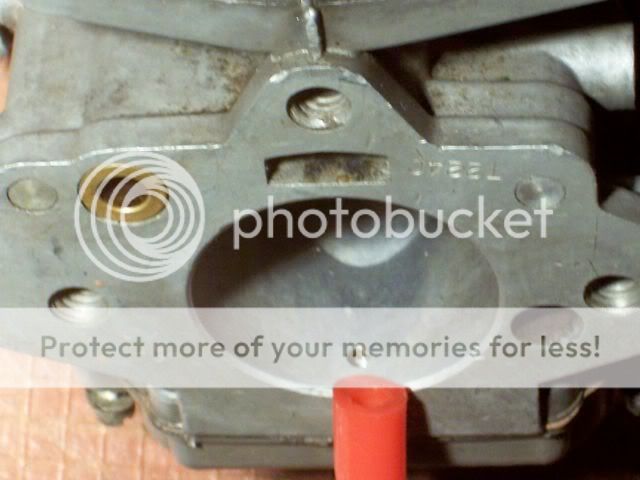
I use a stethoscopoe with the amplifier removed and listen for the hiss. On the ZS carbs in particular finding a common reference point to listen is easily found due to the location of the threaded hole as illustrated in this picture. The hole is for one of the screws that fasten the float chamber to the carb's body.
Even if you are hard of hearing, all you have to do is compare whatever you are capable of hearing, from one carb to the next.
Works for me and it seems to keep me busy at car shows.
I just find that the more consistant placement of whatever tool you use makes for more accuracy. The "snail" looking meter that you actually stick in the carb's mouths works well, too albeit kinda expensive compared to a 10 dollar stethoscope that has other applications. I have 2 Unisyns.. no.. just one that I believe came with the car; I sold the other on eBay,
CarbSyncing.jpg
 
Back
Top