Hi Kirk,
First off, let me say that if the engine was rebuilt within the past ten or fifteen years, it's pretty likely it was brought up to unleaded specs then. I wouldn't worry too much unless you hear *a lot* of valve tappet noise (there's always some ticking with these old engine designs, especially when not yet fully warmed up) and find you cannot keep the valves adjusted.
For one thing, the metal alloy used in TR4 (and TR2/3) cyl. heads is much more resistant to unleaded fuel than most folks give it credit for, better actually than most other LBCs of the same vintage.
The most likely condition that would cause problems are hard driving at high rpms, working the engine hard and heating it up above normal operating temperatures. Really pushing it.
You might be able to go for many years and tens of thousands of miles with no problem, if the car is driven just a little more oderately and carefully.
In other words, keep it under the redline. ;-)
If you were rebuilding the engine for other reasons, it would make sense to set up the head for unleaded at the same time. However, I'd be very unlikely to tear apart a good running TR4 engine for the sole purose of converting it for unleaded. Nor would I worry at all about driving and enjoying a TR4 (or 3 or 2) just because I knew it hadn't been converted for unleaded. I'd take it out and have fun, would just avoid driving it really hard. Once the valves get noisy and can no longer be adjsuted properly, then it's time to rebuild the head and, most likely, give some attention to other things in the motor, too.
Regarding your more specific questions:
1. No, there really isn't any ideal way to check without removing the cyl. head.
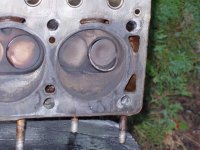
You could try to see the valve guides from above. If they are bronze colored, that would indicate at least they have been changed to unleaded type. But, the guides are a bit hard to see, hidden inside the valve springs (which are probably triple springs on the exhaust side, if the head and engine are original to your car) and are no indication if other work has been done.
You also might be able to tell if the valves are made of stainless steel, if a weak magnet won't attract to the tip that protrudes from the keeper (the valve rocker assembly would need to be removed to check this, but that's just a few nuts and bolts to lift it off).
I'm not totally sure that a valve stem that attracts a magnet would be complete proof it's not unleaded compatible, anyway. I think there are other types of unleaded valves, not stainless steel, and/or some have stainless steel valve faces and mild steel stems. But, I'm not sure of this.
It might also be possible to peek inside the cylinder with one of those fiber optic probes, but I'm not sure if you will be able to see well enough in there to tell if there are valve seat inserts installed. Maybe a local repair shop has one of these and can pull a couple spark plugs, take a look for you. Alternatively, the exhaust manifold could be pulled off and a fiber optic probe used to inspect inside the ports to see the valve seat insert from the back side. Of course, in both cases it would be useful to have someone doing the inspection who knows what to look for!
Unfortunately, even if no sign of a valve seat insert is found, that doesn't necessarily mean that the head hasn't been set up for unleaded fuel. Another process called induction hardening might have been used, in the area right around the original seats in the head, and cannot be visually detected.
2. I think I gave you some ideas above. However, let me add a bit more. If you start to notice frequent need to adjust valves, i.e. they tend to loosen up, that's a symptom of valve seat recession. This is erosion of the seat itself, due to higher temps of the combustion gases. It will mostly show up on the exhaust valves first, since they run hotter.
Another thing is more rapid wear to the valve guides, if the original cast iron type are still in use. This would show up as added valve noise, and lateral play in the valves.
A third possibility is loss of compression if the valves themselves are eroded around the sealing area, where they meet the valve seat. A leak down, compression test performed by a shop could help identify this problem.
In really extreme situations where timing is too advanced, pre-ignition and detonation can occur, which can damage pistons and cylinders, etc. However this is more likely to happen if the cylinder head has been skimmed a lot either to correct for warpage or to raise compression. If the ignition timing is reasonably well adjusted, and premium fuel is used, it's unlikely to happen. I'd avoid regular and mid-grade, lower octane unleaded fuels. (Lead also increased fuel's effective octane rating and these engines were designed to run on fuel that's closer to today's premium grade.) You can get some idea whether or not or how much a TR 4-cyl. head has been skimmed by measuring it. From the bottom face to the top edge it should measure 3.30" if unskimmed, anything less means some has been shaved off it. Unfortunately, it's difficult measure while in place and bolted down. But, you might be able to get some idea.
3. The normal mods to make the engine more compatible with unleaded fuel are:
- Stainless steel valves, especially on the exhaust side.
- Hardened valve seats on at least the exhaust side (usually seat inserts are installed, but sometimes the area is induction hardened instead).
- Phosphor bronze valve guides (which must be honed slightly on the loose side of specifications, since they expand more than the original guides and can seize a valve stem).
- If the head is removed for this work, the rocker assembly should probably be rebuilt. It's usually in need of a new shaft and bushings, at least. It is really hard to assess wear without taking it apart.
- When the head is removed for this work, the pushrods and cam followers will all need to come out. If they are going to be reused (i.e., there isn't a plan to refresh the cam which calls for at least new or freshened up cam followers at the same time) they must be carefully kept in order.
- A replacement head gasket will be needed.
- It's a good idea to check the head studs to see if new are needed, and replace as required.
- A great deal of care must be taken to not disturb the cylinder liners, unless the rest of the engine is going to be rebuilt at the same time.
- Overall, you may also need to retard the ignition timing, due to unleaded fuel the car will be more prone to pinging or knocking, both of which can do damage if left uncorrected. This has probably been done already, in previous tune-ups.
Parts cost of these items you can get from any of the usual catalogs or online sites. Labor is a bigger issue, but that varies a lot from one part of the country to the next, and even from shop to shop.
While it's apart for this work, it often makes sense to renew and refresh a lot more in the engine: valve springs, timing gears and chain, pistons & liners, rings, bearings, camshaft, cam followers, pushrods, oil pump, etc., etc. Of course, cost goes up quite a bit as more is done and more parts or machine work are needed.
Of course, total costs for any of this engine work can be kept down quite a bit if you have the skills and experience to do the work yourself. The TR 4 cyl. engine isn't terribly difficult to work on.
4. Do an Internet search about unleaded additives. There are lots of articles out there that might answer your questions better than we can here.
Congratulations on getting a nice car to enjoy!
/ubbthreads/images/graemlins/cheers.gif


 Hey Guest!