• Hey Guest!
    British Car Forum has been supporting enthusiasts for over 25 years by providing a great place to share our love for British cars. You can support our efforts by upgrading your membership for less than the dues of most car clubs. There are some perks with a member upgrade!

    **Upgrade Now**
    (PS: Upgraded members don't see this banner, nor will you see the Google ads that appear on the site.)
Tips
Tips

TR2/3/3A Transmission oil leak

TomMull

Darth Vader
Silver
Country flag
Offline
If I left the car in the garage for a week or more the drip pan under the transmission would collect a puddle of oil. The longer it sat, up until about a month, the more oil would collect. After that the leak about stopped. When I took the tunnel out I found out why:
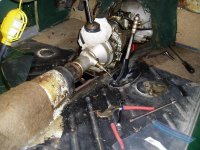
baggie.jpg
About the only place it could leak there at the shift tower was at the o-rings sealing the shift shafts. Any easy fix I thought. When I disassembled the shift housing all went well until I got the the little square headed setscrew that locks the fork on the 3rd and 4th shift rod. The other two came right out although requiring a bit of force on the 12 point socket. The last one wouldn't budge and the socket rounded the square edges. I think the square is the same size as the square brake tool but I couldn't find mine so got out the grips. I don't have to tell you that the thing broke. I did sleep on it and managed to drill it out the next morning.
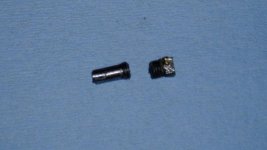
set screw.jpg

As you can see from the picture, it was not bound by the threads but rather by the (apparently) slightly tapered end that goes into the rail. This is a TR4 transmission and does not have the wired setsrews on the forks.
So two questions: Is it common for those o-rings to leak and is it normal for the lock bolts to bind?
Tom
 
Yes to both, in my experience. I have not had to drill a setscrew yet, but several came out to mangled to re-use. Tapered setscrews should not be cinched as tight as most cinch them. About 18-20ftlbs is plenty.
 
The earlier ones without the hole for safety wire are especially fragile because there is a big hole in the threaded portion for a nylon insert.

AFAIK, the only shift rails seals available don't fit right. The cavities are slightly too deep and the o-rings don't fill them.
Herman van den Akker showed me how to machine a brass washer to fill the gap, but I found some commercial "backing rings" that worked well for me. The same source (MMC) sells "quad seal" O-rings that should seal better as well.

But the combination was a bit stiff, so you might want to check the detent force before tightening the clamp plate. Seemed to bed in pretty quickly though, at least I didn't notice any stiffness after a few weeks.
 
PS, your best chance of getting them out is an 8 point socket, combined with a T-handle so you can apply force on both sides and not put any side force in the screw. (Like turning a tap handle.)

Even with that, though, I've broken several of them. I didn't check the angle, but I suspect they qualify as locking tapers which means they tend to tighten up with use.
 
Thanks to both. I did notice that the o-ring holes appeared to be a bit deep and the o-rings show no sign of damage, age, or wear.
Randall, I thought it was the earlier transmissions that had the wires. At least one of my TR3s have wired setscrews on the forks. This TR4 transmission does not and I did not notice a nylon insert but will look again closely.
Tom
 
Yes, earlier gearboxes used the safety wire. Perhaps I'm mistaken, but I thought that later on (late TR6 maybe), they went from the nylon button to a coating on the threads (and still no hole).
 
Thanks Randall, perhaps mine had the thread coating and may have been apart before so anything is possible. Tom
 
Thanks very much Graham for that information and the part number. Very helpful. I've got a pack on the way. By the way, it would appear that the original o-ring part number was replaced by a standard o-ring number, at least in Revington's catalog. Perhaps it's only the replacement o-rings that do not fit? Mine must have been redone in the past.
Tom
 
I got mine from Ace hardware...too impatient to wait after the Moss were too small!?!
John, did you get the correct size o-rings or the quad-rings?
(I found the quad-rings on eBay, didn't think the hardwares carried them)

Tom
 
I have never seen the quad rings. Every one I have taken apart used individual o-rings, and that is what I used to replace them. No leaks on 2 rebuilds using them.
 
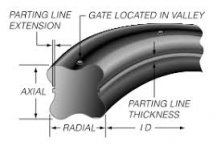
heres the ones I use from mcmaster car and they dont leak, X-Profile oil resistant Buna-n o-ring part 90025k226

Phil
90025K226p1-j05-digital@60p_635949190758115870.png
 
I decided to drill the screws&shift forks for a safety wire after having visions of screws falling into rotating gears.
Berry
 
I have never seen the quad rings. Every one I have taken apart used individual o-rings, and that is what I used to replace them. No leaks on 2 rebuilds using them.

I was hoping the quads would have a thicker profile than the standard o-rings, without an increase in outside or decrease in inside diameters. Standard O-rings that fill the recess in the housing would be fine but I could not find any (I did not try the local hardware). Perhaps this issue arose with the later transmissions. I've had no trouble with my earlier TR3 transmissions This one is an early all synchro type from a TR4. I'll post some pictures when I get the quadrings.
images.jpg
Tom
 
SOME CONCLUSIONS:
Leak was likely confined to 3-4 rail and very unlikely O-Rings were not at fault. (original O-rings from a non leaky TR3 transmission were also loose in recess but still sealed well). I do have back up rings and will use them with the new quad rings but I did find other issues.
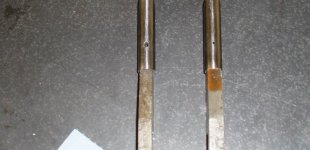
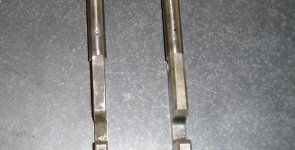
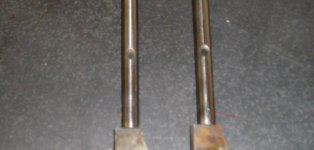
Fault was in the pin that holds the lever end on to the rail. I don't know how that pin was secured but there was what appeared to be welding slag or perhaps just a slip with some other staking process. At any rate there were bits of metal stuck to both sides of rail around the pin. I tried to scrape them off at first and then picked up a file. In hindsight, I should have chucked the thing up on the lathe. This pin was also in a different location when compared to my TR3 pin and that location was directly under the o-ring when in 4th gear position. Don't know if the pictures will help (no flash seems much better) but here they are, for what they're worth
rail 1.jpg
shift 4.jpg
On the left, the rail from the good TR3 transmission, on the right my leaky TR4 trans. The hole in the right rail goes right through, the left is filled on the other side as in the second picture.
rail 2.jpg

Here's where the slag, or whatever, was located. It was on both sides of the shaft.

The dilemma I have now is whether to use the TR3 shaft, which was a bit rusty around the o-ring area or the TR4 shaft, which I filed and polished rather crudely. Replacement shafts are NLA.

Tom
 
O-rings are generally pretty tolerant. If you chuck up either one and polish it with 600grit paper while you spin it, then I think either one will work fine. Getting rid of the slag will be the main cure!
 
Thanks, John. I decided to use the one with the light rust. I put it in the lathe chuck and sanded with 220 to 1000 in 4 or 5 increments. Still not perfect but close. I think it is the only shaft, 3rd and 4th, that's the same on the TR3 and TR4 transmissions. Good luck for once.
Tom
 
Back
Top