Hi,
Well, all British cars are supposed to leak a little, I think! "British Undercoating and Parking Lot Sealer" is the proper term, I believe.
First of all, TR4 and earlier all have an open crankcase breather on the engine (LH side, right behind the fuel pump). This does tend to "undercoat" the car nicely, especially the gearbox. Don't mistake this engine oil for gearbox leaks. There is really no way to prevent some oil mist from working it's way out the open crankcase breather. An engine with higher mileage and somewhat worn rings (which would show up as slighlty lower compression) often allows more blowby into the crankcase and is even more prone to push oil mist out that breather pipe.
One way to check, if the oil level in your gearbox doesn't gradually drop over time, then there's not any leaking from it. Slow seepage from it might be hard to identify this way, though.
With the dipstick on a TR3 gearbox, I'm not sure of this... But I do know the later TR gearboxes (full synchro, TR4 and later) have a tiny vent hole (maybe 1/16") in the top to help prevent pressure leaks. If that hole is plugged up by dirt, old oil or whatever - and it often is - heat causes expansion and can cause fluids to leak whenever the car is driven.
However, I am not certain the earlier gearboxes with the dipstick have or need that vent hole. The dipstick itself might provide adequate venting to equalize pressure.
You should be able to top up the oil near to the top line. That's what I'd want to do to give the gearbox as much lubrication as is practical. I'd not want to lower the oil level, trying to compensate for some leaks.
One exception, if the gearbox dipstick has a felt seal on it (like the engine dipstick does) and that's replaced with a new one that's overthick, it will hold the dipstick higher than normal. In this case the fill marks might be artificially high and could cause a little overfilling.
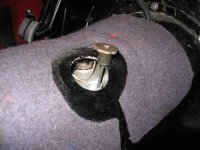
Depending upon how severe the leak is and if you feel it's not the engine vent tube, I'd suggest you go ahead and remove the gearbox tunnel from inside the car to get a good look at things and try to figure out where exactly the oil is coming from. You will probably at least need new rubber seals around the edges of that tunnel cover (prevents fumes and heat from entering the cockpit of the car).
The top cover of the gearbox itself is easily removed with some 8 or 10 bolts, and the seal around it replaced if that's the culprit. You'll see the seepage around the rim of the top cover, if this seal is the problem. Get a new seal to replace the old one and use a thin wipe of Hylomar or aviation sealer on both sides to help it seal.
On the very top - even though yours is not an overdrive gearbox - sometimes there are be holes drilled and tapped for the OD actuator switches, plugged up when the OD and its switches aren't installed. These are another place that can leak. A little Locktite Thread Sealer can solve that. (If it were an OD gearbox, I'd also look at the "seals" under the OD actuator switches. In truth, these are more shims than seals, used to adjust the height of the actuator switch, so there may be more than one under each switch. The thickness of thoe shims needs to be kept the same, to keep the switch properly adjusted.)
If the leak is coming from under the rear overhang of the top cover, that most likely means the o-rings on the selector rods have given up and need to be replaced. This is a more involved repair since the holding tension on the selectors needs to be re-adjusted carefully to keep the gearbox from popping out of gear. The info to do this job is in the service manual. However, if you don't want to tackle it yourself someone like John Esposito at
www.guantumechanics.com (East Coast) or Herman VDA at
www.hvdaconversions.com (West Coast) might be able to help. It would just be a matter of removing the top cover and sending it to them for rebuild.
In fact, they might even have exchange units all ready to go, and be able to provide those for minimal delay. In case you are unaware, with an exchange like this you buy the rebuilt one and in addition pay a "core" charge, then send them your old but rebuildable one and get the "core" charge refunded to you. I'd ask them about this possibility, if downtime is a concern.
One word of caution, be sure to prevent anything from falling into the gearbox - scraps and shards of old top cover seal, dirt, grit, etc. etc. - while the top cover is off. A core/exchange such as mentioned above offers the benefit that the top cover is off and the g'box innards are exposed for the least possible amount of time. Thus there's less opportunity for something to get in there.
One last thing, are you by any chance using a synthetic oil in the gearbox? If so, it's much more prone to working it's way past seals and leaking. Some specialized synthetics like Redline offers might be fine, but most synthetic motor oil or synthetic gear oil is actually be "too slippery" for the TR gearbox and can also make it prone to popping out of gear.
Standard motor oil (with detergents in it) might also cause problems. It tends to foam. That's why non-detergent gear oil (GL-4 only, nover GL-5 which has sulfates in it and can damage brass parts in the g'box) is specified. Many synthetic motor oils have lots and lots of detergents in them (extended mileage oils), and can be even more of a problem.
Non-OD gearboxes use 90W gear oil or 20W50 *racing* motor oil (non-detergent).
OD gearboxes seem to do better with 30W to 40W racing motor oil (also non-detergent), although original specs (TR2/3/TR4/4A) call for 90W here too. Use the lighter 30W if an OD is in good/newer condition with little wear, slightly heavier if there are some years and miles on it. If unsure, the best way to decide would be with a pressure gauge temporarily installed, checking if the lighter oil gives adequate hydraulic pressure and if necessary increasing viscosity with heavier oil or a blend of oils.


 Hey Guest!