• Hey Guest!
    British Car Forum has been supporting enthusiasts for over 25 years by providing a great place to share our love for British cars. You can support our efforts by upgrading your membership for less than the dues of most car clubs. There are some perks with a member upgrade!

    **Upgrade Now**
    (PS: Upgraded members don't see this banner, nor will you see the Google ads that appear on the site.)
Tips
Tips

Trailer Tie Down Points

davidk

Jedi Trainee
Offline
Plan to trailer the TR-6 about 600 miles each way to the VTR Regionals next week, and I'm trying to figure out where to attach the tie down straps. I'm considering attaching to the skid plate under the radiator in the front, and may add eye bolts to the frame in the back. How do you guys do it? Thanks for your help.
 
The eyes on the skid pan were adequate in the front for the factory when new. If you don't trust them, hook into the suspension both front and rear.
Tire slings are also good for long distances.
 
Lots of tie-down places, basically, anything structural.

Just remember to adequately keep the car from rolling forward in case you brake suddenly - I use wheel chocks in addition to tire slings over the front tires.

On the rear I use the rear axle and criss cross the straps diagonally to keep it from moving side to side. I wouldn't use eye-bolts into the frame as this would put all the weight in one spot and might pull out. Better to wrap around the frame. Same on the front - wrap around the radiator support or lower suspension.

If the trailer has a wooden floor, you can also screw blocks into the deck to keep it from rolling.

Set the brake. Check after 10 miles and again after 100.

Very important to get the weight centered over the tire axle(s). To much wieght on the rear is dangerous and can cause a tail wag (you don't want that).
 
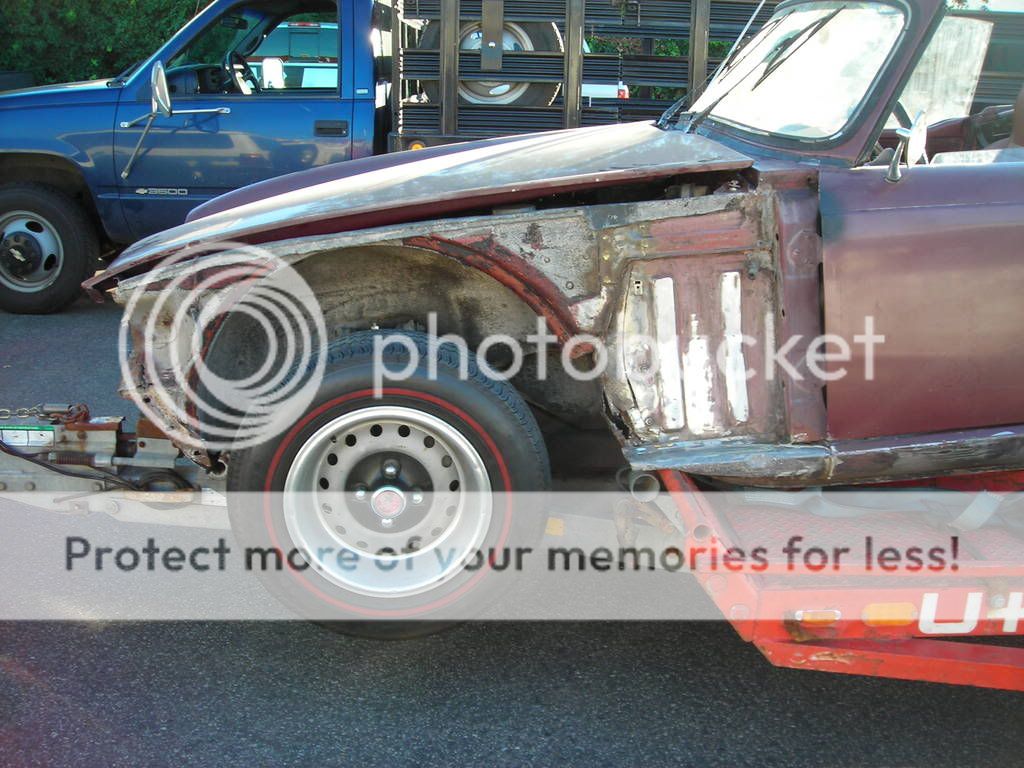
Good advice from Peter. Where is what happens if you don't do it properly...

DSCN2820.jpg
 
One more thought...
When everything is tied down be sure the E-brake is set AND
be sure the tranny is OUT of gear. Hard on the tranny to
travel with the car bouncing back and forth.
Have a safe trip.
Gil
 
My personal opinion is that tying the chassis down is a bad idea anyway. My last few tows have been done with only all 4 wheels tied to the trailer, and it seems to go better that way. The car can bounce on it's suspension without the straps going slack and then suddenly being pulled super-tight (which it seems to me is what snaps them).

I also leave the gearbox out of gear, and the e-brake NOT set.

As shown above, keep in mind that by far the strongest force on the car wants to push it forward. Those ramps ain't gonna stop it! But it will also want to move sideways (especially if you find some big bumps on curves), so be sure at least two straps are holding it from moving in any direction. Preferably strong enough to support the entire weight of the car!

Stop frequently at first, and check that all the straps are tight. Then do it again every time you stop for any other reason.
 
Thanks for the input guys. Randall, why with the E-brake not set?
 
It has been my experience that tying the car down using the frame (in whatever combination) puts a static load on the wheel brgs in only one spot on only one or two rollers. Add the bumps and bouncing of the trailer and that increases the load. Knowing the quality, or lack thereof, of some of the after market brgs, you may end up with a flat spotted or crushed roller. No joy.

Use tire slings on all four wheels and add a chain or strap front and rear with enough of an angle in the strap to allow the car to move up and down but not forward/backward.

As stated above, check at 10 miles, 50 miles, 100 miles, and every time you stop.

Also check trailer tire pressures as low pressure will allow the trailer to wag like a dog's tail. I had one wagging so badly that the trailer tires were coming off the ground. You also need at least a 100#s load on the hitch. Adjust the car location to acheive this.

Jim

 
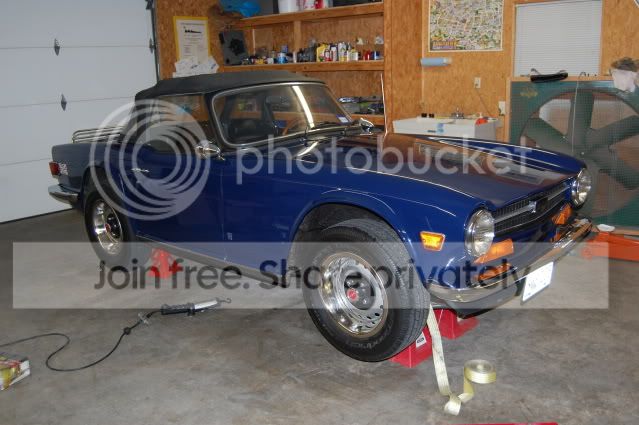
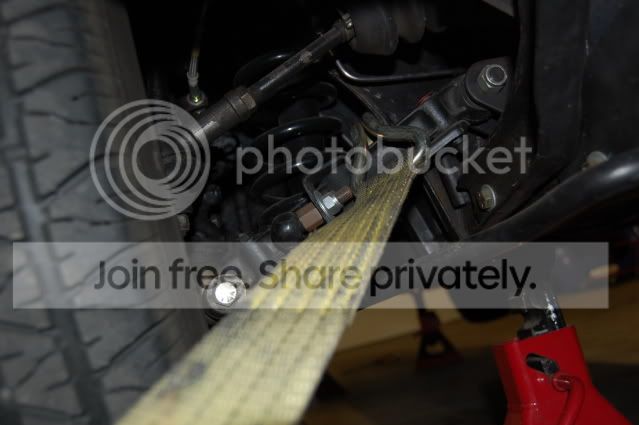
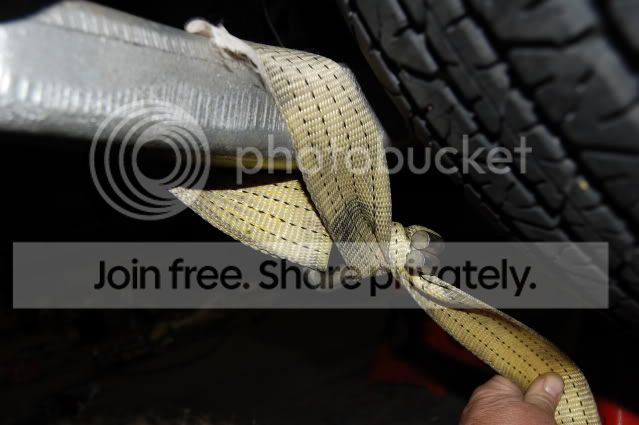
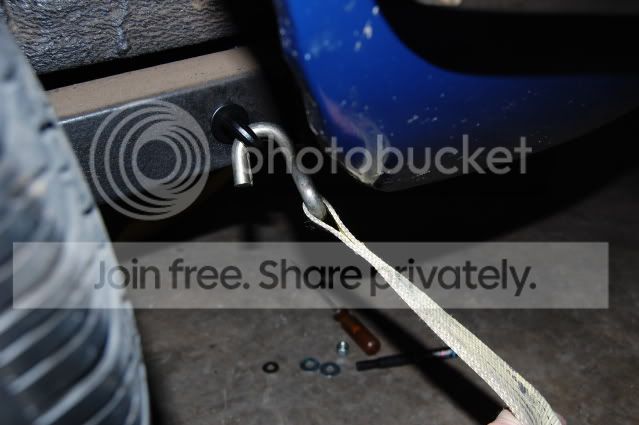
Don't have tire slings, so here's a few pictures of the best ways I could figure out to attach the straps to the wheel area so that the car can still bounce on the springs. The car is up on jack stands making final checks before the big trip to Regionals next weekend. I can cross the rear straps. Also a picture of the newly installed and painted eye bolt that I probably won't be using.

DSC_0345.jpg


DSC_0347.jpg


DSC_0351.jpg


DSC_0352.jpg
 
I like having a soft mounting on the car rather than metal hooks. I use axle straps outboard over the rear axle.
url]
The straps have metal D-rings which I grab with 2" ratchet straps that connect to in-bed d-rings.

On the front, I now use tire slings but I have also used axle straps over the lower a-arms without problems.

I always set the handbrake. The car doesn't bounce around if you have a trailer with good suspension - mine is aluminum with a single 3500 torsion axle, radial tires and hydraulic brakes. Some say two axles are a must, mine has been fine.

Never had more than 1" of movement but it's when you don't expect it and have to suddenly brake or swerve that you need to load for, just in case.
 
I never use the frame, wheel ties and cross chains on the axle so the car can move on its suspension.
If you'll do this regularly get some wheel strap baskets, just like lock tite.
 
bgbassplyr said:
You also need at least a 100#s load on the hitch.
VERY important! But I (and most authorities) prefer to make it AT LEAST 10% of the loaded trailer's gross weight. IOW, if the trailer weighs 500#, and the car 2000#, you should have at least 250# on the hitch.
 
Back
Top