• Hey Guest!
    British Car Forum has been supporting enthusiasts for over 25 years by providing a great place to share our love for British cars. You can support our efforts by upgrading your membership for less than the dues of most car clubs. There are some perks with a member upgrade!

    **Upgrade Now**
    (PS: Upgraded members don't see this banner, nor will you see the Google ads that appear on the site.)
Tips
Tips

TR6 TR6 Suspension changes

pdplot

Yoda
Country flag
Offline
Our cars have their good points but ride and handling are not among them. My '02 V6 Accord will run away from my TR6 on a bumpy back road - and my son's FIAT Spider rode smoothly and handled perfectly despite a solid rear axle(until the front suspension a-frame bolts pulled out of the chassis). Their secret was long, soft but well-damped springs. Many French cars use the same philosophy. Question - has anyone tried to improve the ride of a TR6 by installing longer, softer springs with shocks that act primarily on the rebound like the old FIATs, or some other method to improve the bone-jarring ride without losing the road grip? According to a Road & Track road test at the time, the TR7 rode and handled better than the TR6 even with a solid rear axle. And what about the solid axle TR3s and 4s?

PD
 
I can't say I've ever thought of the stock TR6 suspension as bone-jarring.
Is the front and rear alignment correct for the way you want to drive your TR6 ? How about the condition of the components including bushings, shocks and springs on your TR6 ?
 
One front spring and both rear springs are original. PO installed only one front spring. Front shocks are original, rears are tube conversions done by me about 10 years ago. Bushings are new this Fall when rear suspension was rebuilt and aligned perfectly with shims by an expert friend. Car has very limited travel to the springs - almost like a Morgan, maybe 3/4" of give. Car has 103K miles. Original redline tires & tubes.
 
Tube shocks may be non compliant with the natural arc like movement of the trailing arms.
Shocks, springs and tires may need replacement by now.
And it wouldn't hurt to put the car on an alignment machine.
The stock suspension and bone jarring does not compute and the tube shocks may have a lot to do with it.
 
Bone jarring sounds like the suspension is bottoming or one or more shocks are frozen. It would be worth checking the ride height. Why did the PO replace only one spring, giving you one new and one old spring? That sounds like a recipe for unbalanced handling. Was the replacement spring the correct rate and length for the car? I assume you are running reasonable sized wheels and tires at normal pressures. My 4A with tube shocks on the rear, Richard Good's 450lb rear springs and standard ride height rides better than my 95 Holden. On a recent TR club outing, the club president was surprised at how well I kept up with his 911 on a winding road. So was I!
 
I've ridden in two other TR6s and they all bang and crash over the bumps on these back country New England roads. If I was driving in Florida or California, I'd be fine. The roads are straight, flat and smooth.
 
These cars were made for, well, not New England, but English roads. From what I have seen of CT would love to drive around there in my TR. Maybe you should just stick with the Honda.
 
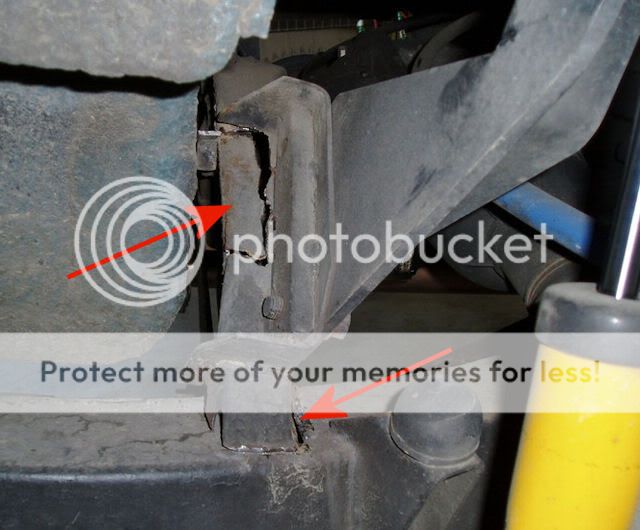
A few years ago I converted my TR6 Armstrong shocks to tube shocks. It made a difference in the ride quality. I also went a little nuts by installing some 215/15 performance Yokos. The result was the TR6 handled like a slot car. Last year I had the engine rebuilt when it began to burn excessive oil. On my way to my friend's pole barn for the engine pull I began to hear some banging in the rear. Turns out the tube shock brackets had caused the frame to fracture on both sides. I had the frame welded and returned to my Armstrongs. I may reinstall the tubes again but this time with a support bar to accommodate the different arc characteristics inherent in the tube shock dynamics versus the levers. Lesson learned.
 
I've ridden in two other TR6s and they all bang and crash over the bumps on these back country New England roads. If I was driving in Florida or California, I'd be fine. The roads are straight, flat and smooth.
Might be more fun in a Jeep.
Don't be surprised if one day something like this happens with those tube shocks on those kind of roads.
TR6BrokenMount.jpg
 
Redlines are definitely over the hill (like their owner). I plan to replace them with more modern tires from that place in Greensboro, NC whose name escapes me (I just turned 79..). I have a client who is an independent mover who goes down south a lot - he's also a car nut - and I'll turn the wheels over to him to take down there. I don't trust the tire shops around here. I'll also pull & check out the front shocks. Like I said, there seems to be barely 1/2" or so of free play in the suspension when I push down hard on the front and rear of the car. I'd be interested to hear what kind of free play you guys have on your TR6s, front and rear when you do the same and what kind of shocks you have.
 
Car has very limited travel to the springs - almost like a Morgan, maybe 3/4" of give.
That seems like a red flag, should be a lot more than that. The TR6 rear suspension is normally a bit too soft IMO, softer even than the TR7/8 and a whole lot softer than TR2-4.

Original redline tires & tubes.
And you actually drive it ??! Worse yet, you're unhappy with the handling!

Get some decent tires on there and try again. While it won't solve the suspension travel issues, at least there will be some compliance left in the tires, and you won't have to worry about them flying apart and turning into giant flap wheels.

(Unfortunately I didn't get a photo of the Stag where one of the old tires let go and took off not only the paint but part of the sheet metal before I could get pulled over to the side of the road. But this photo should give you some idea)

shreddedtire.jpg
 
I'd be interested to hear what kind of free play you guys have on your TR6s, front and rear when you do the same and what kind of shocks you have.

My car is all stock; I have replaced the front shocks with standard replacements maybe 10 years (not more than 20k) ago, and the rear with rebuilt standard spec lever shocks. The problem with the rear is that it's too soft when you're accelerating away and go over a bump; easy to run out of travel. Pushing down on the back of the car also feels 'soft'. The front I would say feels more like just a stiff spring and suspension; I don't bottom often but it can easily feel 'crashy' if I don't pick my way around bumps- more to do with the fact that it's not a very stiff structure (scuttle shake I guess?). Tires and pressures make a huge difference- the stock tires are 185 section, I believe 20psi front and 24 back. Same thing in my Miata as far as that- recommended 26 all the way around and if you fill them to 32 the ride quality suffers greatly.
 
Have any of you read the comments on the TR6 frame in the current Classic Motorsports article on handling? Personally I found it maddening. They said the frame flexes like a ribbon and folds up on bumps or something similar.

This post has a little of the same flavor. The TR6 was the evolution of the TR2. Similar ladder frame that is a little flexible. And it does ride rough compared to almost any car made after say 1980. But that's all part of the experience. The raucous noise, quick handling, good torque and reasonable price all contributed to the popularity. The looks were great for the time and remain so today (IMO)

I bought my first TR6 in 1973, It was a 1971 model and replaced my 1969 MGB. The difference between the two cars was amazing. With the increased performance and the looks I was in 7th heaven. At 21 I never noticed the rough ride, wind noise. less than perfect seats or any of the things people complain about now.

I drove (not owned) Datsun 240, 260 and 280Z's that my friends owned back in the day. They rode better but felt like a Camero. I preferred the TR

One of my toys today is a 1975 TR6 with 23K original miles. I notice the differences between our Miata, Honda, Toyota and other modern cars. But I don't care. The TR6 is still a blast to drive. My 2009 4Runner Sport will take the exit ramp on my drive home faster that the TR6. So what. My 95 Civic Hatch back with it's 1500cc engine will probably beat it in a drag race. So what.

The bottom line for me is the TR6 is a throwback to the good old days of the British sports car. I cherish the experience even if my back hurts after a 200 mile drive.

Pdplot, I say leave yours as it is. Unless of course some parts are worn out.

BTW how many of you guys like to goose it going through a tunnel or under an overpass. Yea that's what I'm talking about!
 
Last edited:
No, pdpilot has something wrong. The TR6 with it's IRS is pretty springy compared to solid axle cars with their leaf springs.
Of course at 79 years of age he's going to take beating in just about any short wheelbase sportscar, but the fact that his suspension is not moving the normal range tells me something and I'd have to put my money that a lot of it is the tube shocks and the limitation they impose on the TA's designed motion.
His seats may need new cushions, too. I don't think that's been mentioned
 
I agree with others who have said the car in question has something wrong, should have more travel and shouldn't have a jarring ride. As far as the TR6s having a harsh ride in general, I think some of that perception has to do with the nature of the flexibility in the frame and how tightly everything is buttoned down, if your windows rattle around over a bump, or some other part rattles the ride may seem or be perceived to be more harsh. (hey this thing is correcting my awful spelling). All things are relative, raised on Sprites and a solid axle 4A the TR250s ride seems pretty compliant to me. I will also add that with stock springs and tube shocks (the cheapo KYBs) the rear suspension seems to be right, decent ride, but doesn't bottom or squat. Will also add that the front and rear anti-roll bar set I have really transform the handling of the 250, and keep the rear wheels fairly even with none of the big angle changes that can cause the rear to bind up under some situations, which brings me to another thought, have you greased your axle splines lately? the axles need to slide freely for the suspension to go up and down smoothly, maybe something is bound up there?
 
My 74 is a bit jarring. I have stock springs and shocks up front, probably a bit worn and Good Parts springs and Armstrongs in back. Top up the Armstrongs and cycle through to remove air. The springs are great and the car is very compliant. It is damped well and won't jounce and rebound repeatedly. Some aftermarket springs give a better ride than stock. If you push down on the front, mine only goes down a few inches and comes up and settles. No dramatics. If the car hasn't been used in a while, check all the rubber in the front as the shocks may be binding. I love the long wheelbase smoothness on the highway. The frost heaves and potholes around town are another story. It's a sports car after all. Also, replace the seat diaphragms. It makes a world of difference as the seat back won't catch you across the shoulders inducing a hunched over posture. Gets you up off the floor.

Perry
 
Great posts, all. You guys are great. The rear suspension has been completely reworked by an expert friend who has owned 14 TR6 - splines greased, new suspension arm and shims added to right side to straghten out right rear wheel which was toed out way too far, right rear hub rebuilt by TRF a couple of years ago and wheel studs cut off to correct length (never done by PO) to fit wire wheels. Front end was rebuilt about 25 years ago by a PO (I have invoices from TRF) and car has been driven very little since then, maybe 8k miles. Why he replaced only one front spring I haven't a clue - maybe broken - but spring travel is identical on both sides. As to the drivers seat, it's original to the car but has lost its mojo compared to the passenger seat, so much so that I had to raise it up about 2" with wooden spacers under the seat track (I'm "vertically challenged" these days). It also has a couple of rips in the seatback which I patched with black tape but I guess I'll have to rebuild the seat over the winter- either that or get a more padded ass. As to body rattles endemic to a separate-frame car, I eliminated many of them with some weatherstripping on the passenger door and trunk lid, but body shake and top rattles are part of the experience as has been said and I can live with that. (When I was 21 and raced a TR-3 back in the day, seat comfort and ride were the last things on my mind.) Finally, the car didn't ride any better with the original lever shocks as I recall.
 
So what is your expert friend's, who has owned 14 TR6's, advice to you regarding this matter ? Please share because so far the only thing it seems you've conceded to from the Forum responses is that you could use new tires and drivers seat
 
Last edited:
Back
Top