• Hey Guest!
    British Car Forum has been supporting enthusiasts for over 25 years by providing a great place to share our love for British cars. You can support our efforts by upgrading your membership for less than the dues of most car clubs. There are some perks with a member upgrade!

    **Upgrade Now**
    (PS: Upgraded members don't see this banner, nor will you see the Google ads that appear on the site.)
Tips
Tips

TR6 TR6 misses at low rpms

Carbs are probably too lean on lower end. Try raising floats a little, or maybe heavier oil in the dampers.

Sam
 
poolboy said:
I guess I forgot Randall, did you explain how the AC component in the ballast resistor wire feed to the coil is different than a straight 12 volt feed ?
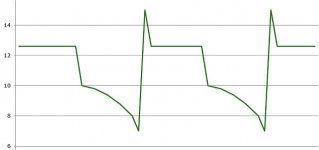
How much voltage drops across the ballast resistor depends on how much current is flowing through it. With the engine running, the coil is repeatedly connected and disconnected. Obviously no current flows through it with the (virtual) points open (once the spark is over with), so the voltage drop across the ballast changes constantly. Plus of course, the coil is an inductor rather than a simple resistance, so the current flowing through it varies with time when it is connected. At higher rpm, the result might look something like the chart below.

Your car may have run fine with this setup, but it is not what Pertronix recommends. And if you are going to pay all that money to get something that is "more reliable" than points, then IMO it pays to install it as the manufacturer says. YMMV and all that.
 

Attachments

  • 22500.jpg
    22500.jpg
    10.5 KB · Views: 142
OK, but I thought your point was that the voltage had an AC component as you ilustrated above going thru the ballast wire. I don't get that a non- ballasted wire would not under go the same sort of rise and fall.
Wasn't that your point that with this: "We've had this discussion before ... notice where it says "DC" ... but the voltage drop across the ballast resistance is NOT constant and so what you are feeding the module has a large AC component" ?
Seems like the Attachment (above) shows a battery voltage feed and a drop below the 8 volt minimum for Pertronix operation during the cycle as well.
What am I missing ? Must be something.

I guess my mileage does vary, because 20k miles and not a miss or sputter.
 
poolboy said:
I don't get that a non- ballasted wire would not under go the same sort of rise and fall.
Well, it does, but because the resistance of the wire is very low, the change in voltage due to current flowing in the wire is also very low. So without a ballast, the coil/Pertronix 'sees' nearly battery voltage, with just a slight bit of noise on it.

Lessee, 16 AWG is about .001 ohm (1 milliohm) per foot, so if we assume there is 10 feet of wire involved and peak coil current is about 4 amps: 4 amps through .01 ohms is about .04 volts.
 
Aww what the heck. Too much calculating and such. All I really know is that on my 74 hooking the red Pertonix wire to the coil works fine and there's a few others running like that, too.
Anyway, thanks for taking it this far, Randall.
 
Back
Top