• Hey Guest!
    British Car Forum has been supporting enthusiasts for over 25 years by providing a great place to share our love for British cars. You can support our efforts by upgrading your membership for less than the dues of most car clubs. There are some perks with a member upgrade!

    **Upgrade Now**
    (PS: Upgraded members don't see this banner, nor will you see the Google ads that appear on the site.)
Tips
Tips

TR6 TR6 misses at low rpms

SCguy

Jedi Warrior
Country flag
Offline
I'd like some help trying to trouble shoot my low rpm misses.
The car runs beautifully with the choke out as its warms up, but once warm, with the choke off it misses as I pull away from a stop then runs fine at higher rpms. My car has always done this so its really nothing new. At various times I've replaced the wires, plugs, coil, rotor and cap and I run Pertronix ignition and have recently had the time adjusted by a British car mechanic.

So where to start to trouble shoot. Suggestions are welcome.
 
Vacuum leak would be my first thought. Could be lots of other things too.

Based on my recent experiences, I would also try switching back to points. In my case, the engine ran so much better that way that I'm going to leave the Pertronix in the parts bin.
 
I am experiencing similar symptoms with my '73 TR6... had Jeff at Advance have another look at my dizzy and all is fine.
My next thought was going to be fuel, but I just might take Randall's advice and remove my Pertronix and go back to points to see if that makes a difference.
Please keep us posted to see what works!
 
Hey!

Vacuum leak could be a couple places. One idea - which I love the idea of but haven't tried - is to use a combustible spray on the connections on find a leak. Sounds dangerous hence the attraction :smile:
 
Suppose you are parked and in neutral, can you bring the engine up to a certain speed and experience the miss ? Or does the engine have to be under a load, in gear and moving ?
 
If I slowly give the car gas even if its not under load the car still misses. Interestingly enough, I changed the rotor cap (lucas) and wires today which seemed to exacerbate the problem. Once I put back the old cap and wires it ran as before still missing but not nearly as bad. Any thought?

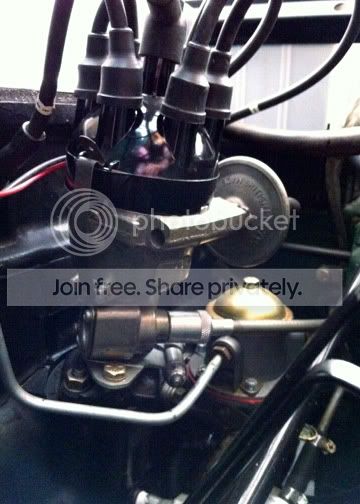
Here's a picture of my distributor. My car is a 73, but the engine is an earlier, higher compression engine out of an earlier year.

I'm thinking of sending the distributor to Advanced Distributors, letting them rebuild it and convert it back to points (even though to be honest I have know idea if that's the problem).
distributor.jpg
 
Ah, you did not mention the Pertronix! A 73 TR6 would have a ballast resistance incorporated in the wiring harness ... Are you sure the Pertronix module is getting a full 12v (no ballast) while the coil either has a ballast or is a "ballast not required" coil?

Also, based on my recent experiences with a Pertronix ignition, the first thing I would do is convert back to points (as a test). My problems were not as severe as yours, but it definitely did not run right with the Pertronix module installed. I put the old points back in; discovered that the coil I had swapped in before was bad; put back the coil I had originally used with the Pertronix and it suddenly ran great!

If you get it running good on points, you can try the Pertronix again. Personally, I'm just going to leave the darn thing in the parts bin. Points are cheap, and having to replace them twice a year (for the amount of driving I do) just isn't that big a deal, IMO.

Someday, I still hope to try a Crane XR700 triggering a MSD-6, but for now the points are doing just fine.

But the conversion back to points should be something you can do yourself. Just unbolt the Pertronix module, then it's mounting plate, and you should be able to install the points plus the original lead to the side of the dizzy. Set the gap, make sure your coil/ballast situation is consistent, and away you go.
 
Randall,

I think you may be on to something. I'm pretty sure that the wire harness is a new harness for a 73. The coil I'm running is a Pertronix coil and I'm thinking that I would have bought the one for a ballasted (1973) harness.

I'm really not sure where to start?
Check to see that the Pertrontix is getting 12v?
How can I check to see if my harness is ballasted? If my car has a ballast as I suspect it does in the harness then is that OK?
 
Ok, I take it you've got the wire from the harness connected directly to both the coil & the Pertronix, right? In that case, an easy check is to connect a jumper temporarily from the negative side of the coil (black wire from the Pertronix) to ground. Turn the key on, use a voltmeter to check the voltage across the coil. If it's down around 6-9 volts, you've got a ballast.

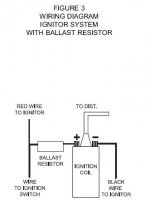
The Pertronix module needs to get a full 12v somehow. As I recall, there is a fuse block nearby on the inner fender that has a white wire to it and an extra terminal. You could just extend the red wire from the Pertronix over to that extra terminal (leaving the harness wire on the "+" terminal of the coil). That would give you the equivalent of the Pertronix-recommended circuit:
 

Attachments

  • 22494.jpg
    22494.jpg
    15.4 KB · Views: 279
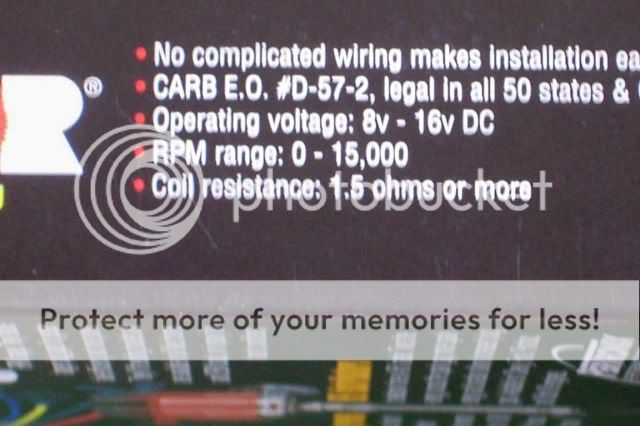
I thought it'd be good to post this from the Pertronix box. Seems like the ballasted voltage to the TR6 coil is around 9 or 10. I think that diagrham is generic and is really for 6 volt or at least less than 8 volt coil feeds.
PERTRONIXvolts.jpg
 
poolboy said:
I thought it'd be good to post this from the Pertronix box. Seems like the ballasted voltage to the TR6 coil is around 9 or 10. I think that diagrham is generic and is really for 6 volt or at least less than 8 volt coil feeds.
PERTRONIXvolts.jpg
We've had this discussion before ... notice where it says "DC" ... but the voltage drop across the ballast resistance is NOT constant and so what you are feeding the module has a large AC component.

See above for the Pertronix-approved method of wiring when a ballast resistance is present.
 
the petronix is nothing but a magnetic triger, it only opens and closes to fire the coil to each cylinder, so If the car runs its not the petronix system, its either bad coil, vacuum leak, bad intake gasket, or could be carb related, it could be just one cylinder misfiring, good luck

Hondo
 
I guess I forgot Randall, did you explain how the AC component in the ballast resistor wire feed to the coil is different than a straight 12 volt feed ?

Taping into the Pertronix feed prior to the external ballast is insuring that the Pertronix gets more than 8 volts, I understand that. What I don't understand is the implication that there's an AC component of the 9-10 volts on the downstream side of the ballast and none on the upstream side.

Seems like the voltage to the coil, whether reduced by a high resistance wire or not, comes from the same source.

I've had a Pertronix on a 74 TR6 with the ignition stock otherwise for about 4 years and just about 20k miles before I sold it..never so much as a hiccup.

I'm better with carbs than electricity, but I'm willing to learn.
 
Back
Top