• Hey Guest!
    British Car Forum has been supporting enthusiasts for over 25 years by providing a great place to share our love for British cars. You can support our efforts by upgrading your membership for less than the dues of most car clubs. There are some perks with a member upgrade!

    **Upgrade Now**
    (PS: Upgraded members don't see this banner, nor will you see the Google ads that appear on the site.)
Tips
Tips

TR6 TR6 enine running hot - need some adivce

Tim Tucker said:
My red went to 3/4 the black went to 1/2. Same exact VS, gauge, etc. Both being sold as a GTR108.
Exactly!
I don't know about red vs black, but I know there are a lot of senders on the market that make the gauges read wrong.
 
I went from black to red (on a TR4) and had no problem so color alone may not be an indicator but the sending unit is always a suspect in the hunt for hot running.

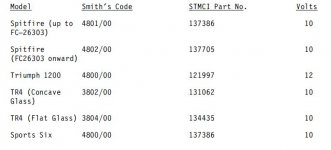
The sender can certainly be checked with an ohm meter but alas all I have are the values for a TR4 sender. Those I will post if someone thinks they are correct for a TR6.
 
I think Kevin just got his meter last year so he needs the practice
 
Geo Hahn said:
but alas all I have are the values for a TR4 sender.
Is that for early or late TR4?

I don't have the answers, but it seems exceeding strange to me that the factory originally had a bunch of different part numbers and they now all supercede to the same number (it seems). Smells like multiple layers of someone saying "We don't have the right part, but this one is close enough."

The individual gauge calibration is suspect as well, IMO. One of the Stag voltmeters (which is basically the same movement with a bit higher resistance) was so loose inside that I could literally change the calibration just by tapping the gauge on the bench!
 
Here is the part number:
BlackTopSender2.jpg
 
That's an interesting photo, Tim. The original TR4 senders sealed against a tapered seat below the threads, rather than using a gasket above the threads. Possibly that explains some of the part number changes.

Bit off topic, but I thought some folks might enjoy this:
 

Attachments

  • 25666.jpg
    25666.jpg
    26.3 KB · Views: 258
Randall,

That's interesting as the TR4A SPC shows a reversal of the temperature sending units from early to late compared to the TR4.

TR4
Up to CT11307 131062
After CT11308 134435

TR4A
Up to CTC62636 134435
After CTC62637 131062

I wonder what the difference is.

Scott
 
<span style="font-size: 26pt">Hey Kevin</span> you started this thread. What's up???
 
I have been reading all the posts, but there isn't a lot to do until I get my new temp sending unit, which is on order. I figure I will start with the simple, and then check the other items mentioned. I think once the new temperature unit is in, it will answer a number of questions.

Since the amp meter was brought up, how do you really know that it or any other gauge is working correctly? My amp meter will some time shoot up. When I tap it with my finger, it drops back to where it should be. Any idea why it would do this? The only reason I bring this up here is because of the earlier discussion about the voltage stabilizer being a factor.

Kevin
 
I rebuilt my engine 7 years ago. Before that the temp was at 2/3 or higher. The pic shows what it has been since the rebuild for more than 20,000 miles. It has held that temp on short drives and long drives. In Wisconsin and Oklahoma. City traffic and highways. Driving fast or slow.

There have been two times that the temp has been higher.
One was when we got stuck in traffic for nearly an hour on a very hot day. I popped the hood latch and it went right back down.
The other was when I was experimenting with the timing. Set the timing back and the temp went right back where it belongs.

When I rebuilt my engine the block and head were thoroughly cleaned inside. I also rebuilt my own water pump, see the three part article in the WIKI. I had the dizzy and carbs rebuilt to match the engine mods. And set the carbs according to the builder's recommendations and the timing to the book.

Last summer I replaced the cap, rotor, and plugs. Then checked the timing. Other than that and the experiment it has been drive it and forget it.
 
ichthos said:
Since the amp meter was brought up, how do you really know that it or any other gauge is working correctly?
The only way to really be certain is to measure the same thing with something else and see if they agree. That's why I suggested sticking a thermometer in the radiator neck.

But I consider the ammeter to be about the most reliable of the gauges.
My amp meter will some time shoot up. When I tap it with my finger, it drops back to where it should be. Any idea why it would do this? The only reason I bring this up here is because of the earlier discussion about the voltage stabilizer being a factor.
By "shoot up", do you mean to the "+" side? That would mean either your alternator is suddenly putting more current into the battery (perhaps a bad regulator or bad connection in the charging circuit), or you have some aftermarket load connected between the ammeter and battery.

Plus it sounds like your ammeter is sticking.

The Voltage Stabilizer does not supply the ammeter, and so would have no effect on it, unless it somehow changed the current going into or out of the battery (like the short I suggested before).

 
Kevin, you couldn't get one at NAPA?
Jeez, you want me to send you mine?
 
I went to different shops, and none had one in stock. Not only that, they were at least double and higher when compared to the big three. Thanks for the offer, Don, but I will wait. With all the rain this week, I'm probably not going to drive till things let up anyway.
Kevin
 
Suppose to be nice for the next week ,Kev.
Always heard that it was pretty much a standard temp sensor.
Gm ones I thought worked.
 
Just an update. I bought one of the infrared thermometers-thanks for the suggestion. I also installed a new temp sending unit with the black insulation. The new temperature sending unit works the same, with the needle registering over 2/3. I checked, and I have a 180 thermostat installed. I pointed the thermometer at the top hose and it read 183, so it doesn't really look like I have a overheating condition after all. So now my question is why is the gauge registering so high? Based on what everyone said, it is either the sending unit (which I now know is not the problem), the temp gauge itself, or the voltage stabilizer. The other gauges appear to be working properly, so does that mean the voltage stabilizer is good? If my engine does overheat, I presently have no way of telling. How do I narrow it down from here?
Kevin
 
The only other gauge (I believe, I'm speaking from a TR4A perspective) that would be sensitive to the voltage stabilizer would be the fuel gauge. Does that seem to be working as expected?

The 4A temp gauge has an adjusting screw, so if yours has that, and you are sure the temp is "normal", you could re-calibrate the gauge.
 
The fuel gauge is working correctly. I will pull the temp gauge and see if I can recalibrate it. Thanks,
Kevin
 
Back
Top